


Key takeaways
ISO 3691-4:2023 sets out the safety requirements for driverless industrial trucks and their systems, as well as the means of verifying them. Its full English title is "Industrial trucks: Safety requirements and verification, Part 4: Driverless industrial trucks and their systems". The ISO page1 shows edition 2, published in June 2023 by committee ISO/TC 110/SC 2. It replaces the 2020 edition and applies to automated guided vehicles (AGVs) and autonomous mobile robots (AMRs) alike.
In Europe, its version EN ISO 3691-4:2023 has been a harmonised standard under the Machinery Directive 2006/42/EC since Implementing Decision (EU) 2024/13292 of 13 May 2024, published in the Official Journal on 15 May 2024. A truck designed to this standard is therefore presumed to comply with the requirements it covers. Regulation (EU) 2023/12303 will replace the directive on 20 January 2027. This page is part of our logistics robot guide.
What does ISO 3691-4 cover?
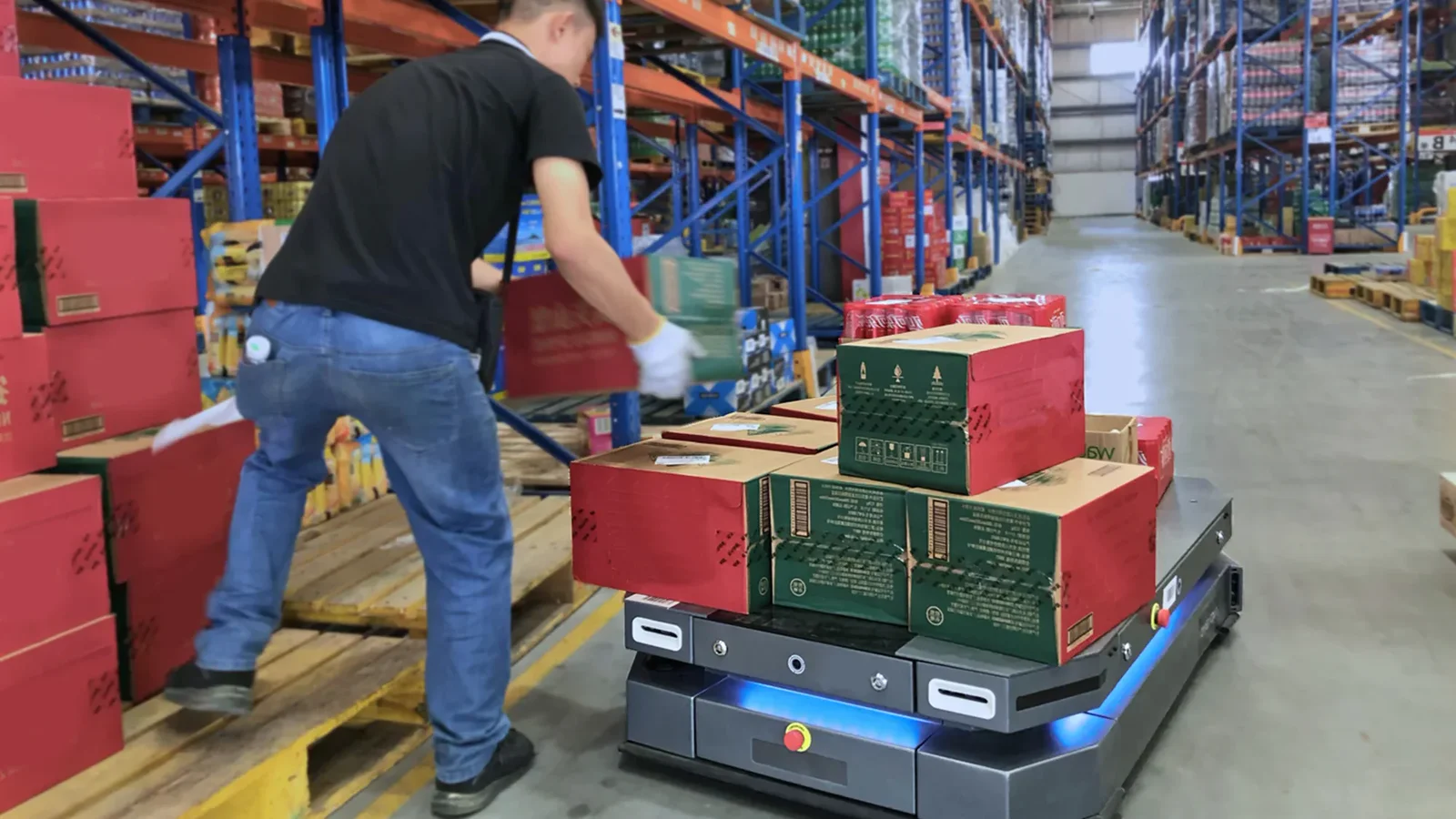
ISO 3691-4 covers powered industrial trucks designed to operate automatically, and the system around them: control system (on board or not), guidance devices and power system. ISO1 gives as examples the automated guided vehicle, the autonomous mobile robot, the automated guided cart, the "tunnel tugger" and the "under cart".
ISO 3691-4 also covers trucks with a manual mode, a maintenance mode or the ability to carry riders. Work area arrangements are dealt with in its Annex A, and the list of hazards in its Annex B.
What is excluded from ISO 3691-4?
ISO 3691-4 first excludes two families of vehicles: trucks guided solely by mechanical means (rails, guides) and remotely controlled trucks, which are not considered driverless trucks. Requirements relating to power sources are not covered.
According to the ISO page1, ISO 3691-4 does not deal with noise, vibration, radiation or laser radiation either. It does not cover the additional risks associated with severe conditions (extreme climates, cold-store applications, strong magnetic fields), explosive, nuclear or military environments, public roads and specific hygiene requirements. For public areas, ISO refers to ISO 13482:2014. A cold-store or ATEX site project therefore requires an additional assessment.
What does the 2023 edition change compared with 2020?
The 2023 edition of ISO 3691-4 is a technical revision, prepared so that it could be harmonised under the Machinery Directive, which the 2020 edition was not. According to the Evolis technical note4 (the French trade association that led the expert group, May 2024), it:
- clarifies the list of significant hazards not covered;
- adds definitions of "active detection field" and "operational stop";
- adds requirements in clauses 4.1.16 to 4.1.27, on protective measures, information for use, preparation of work areas and rated capacity;
- takes into account the virtual bumper, hybrid-mode trucks (manual and automatic), other clearances in the operating zone and zoning specific to each installation.
What are the key dates of ISO 3691-4?
| Date | Event | Source |
|---|---|---|
| December 1997 | Publication of NF EN 1525, "Safety of industrial trucks: Driverless trucks and their systems" | AFNOR5 |
| May 2020 | NF EN ISO 3691-4:2020, which replaces NF EN 1525 | AFNOR |
| June 2023 | ISO 3691-4:2023, edition 2, which cancels and replaces the 2020 edition | ISO1 |
| 2023 | NF EN ISO 3691-4:2023 in the French collection (2 August according to Evolis, October according to AFNOR) | Evolis, AFNOR |
| 15 May 2024 | Reference of EN ISO 3691-4:2023 published in the OJEU as a harmonised standard (Directive 2006/42/EC) | Decision 2024/13292 |
| 20 January 2027 | Application of Regulation (EU) 2023/1230 and repeal of Directive 2006/42/EC | Regulation 2023/12303 and corrigendum6 |
| In progress | Draft ISO/DIS 3691-4, which ISO says will replace the 2023 edition "in the coming months" | ISO |
How do ISO 3691-4, the Machinery Directive and Regulation 2023/1230 relate?
ISO 3691-4 is voluntary, but its European version gives a presumption of conformity. Directive 2006/42/EC7 of 17 May 2006 on machinery provides, in its Article 7, that a machine built to a harmonised standard published in the Official Journal is presumed to comply with the essential requirements covered by that standard. This has been the case for EN ISO 3691-4:2023 since 15 May 2024.
Regulation (EU) 2023/12303 of 14 June 2023 on machinery applies from 20 January 2027: the original text stated 14 January, a date corrected by a corrigendum6 published on 4 July 2023. The list of harmonised standards under the directive, set by Decision 2023/1586, is repealed on the same date by Implementing Decision (EU) 2026/20158. The European Commission9 is preparing the list under the regulation and states that it will include the vast majority of the standards currently cited. Whether EN ISO 3691-4:2023 is included in that list remains when it is published.
Which ISO 3691-4 requirements can be seen on site?
On a site equipped with AGVs or AMRs, ISO 3691-4 translates into concrete arrangements. INRS (the French occupational health and safety institute) describes several of them in its feature in the journal Hygiène et sécurité du travail no. 27310 (December 2023):
- the robot's speed must be reduced when it passes within 500 mm of an object;
- zones classified as hazardous are marked on the floor;
- a 500 mm wide clearance allows a person to escape from a hazardous zone;
- when a safety laser scanner is muted, speed must be below 0.3 m/s.
INRS also points out that a forbidden zone in an AMR's map is only a "software stop": in front of a dock or a staircase, a physical barrier is preferable.
Who is responsible: manufacturer, integrator or user?
Responsibilities are shared. The manufacturer defines the conditions and limits of use in the instruction manual and provides the EC declaration of conformity. According to INRS10, the user must, under the "Use of Work Equipment" Directive 2009/104/EC, ensure that each AMR purchased is compliant and supplied with its manual and EC declaration, and assess the risks associated with its use.
ISO 3691-4 is also aimed at integrators, because the working environment determines the measures to be taken. Any modification after commissioning (new zone, new function) requires the risk assessment to be updated. In a June 2026 note11, INRS stresses that safety laser scanners do not cover every configuration and that safety still relies heavily on measures taken within the company.
Risk assessment must follow the selected flow: robotic material handling, order picking or indoor robotic delivery. The AGV versus AMR comparison clarifies architectures, but choosing a robotics integrator is still needed to define who assesses and validates the installation.
The abbreviations and concepts used here are defined in our robotics glossary.
How RoboNex supports you
RoboNex is the official distributor in France of ForwardX, a manufacturer of AMRs and autonomous forklifts whose product sheets state CE marking (the Flex range12, for example). Our approach follows three steps:
- Proof of concept on your site, with a survey of flows, crossing zones and points within 500 mm of installations.
- Integration: EC declaration and manual for the selected model, zoning, floor marking, setting of detection fields, interfaces with your doors and conveyors, briefing of teams.
- Deployment and support, with the risk assessment updated at every change to the site or the missions.
To compare technologies, see AGV vs AMR and our page on the autonomous mobile robot (AMR).
Frequently asked questions
RoboNex team · answers in French, English and Chinese
Is ISO 3691-4 mandatory?

No. Like any standard, ISO 3691-4 is voluntary. What is mandatory are the essential health and safety requirements of Directive 2006/42/EC, then of Regulation (EU) 2023/1230 from 20 January 2027. Applying EN ISO 3691-4:2023, cited in the Official Journal since 15 May 2024, is the most direct way to benefit from a presumption of conformity.
Does ISO 3691-4 apply to AMRs?
Yes. The ISO page explicitly lists the "autonomous mobile robot" among driverless industrial trucks. INRS specifies that, from a standards point of view, AMRs are considered AGVs and fall under the same standard, whatever their trade name: LGV, AIV, IGV or mobile platform. The risk assessment therefore follows the same approach.
Is there an ISO 3691-4 certification?
The conformity of a driverless truck is declared by its manufacturer in the EC declaration. A manufacturer may have its machines assessed by a third party, but ISO 3691-4 is not a company certification scheme like ISO 9001. Whether examination by a notified body is not mandatory for this type of machine is to be confirmed with a competent body.
Where can I find the ISO 3691-4 PDF?
ISO 3691-4:2023 is a paid standard. As of 21 November 2026, ISO sells it for 204 CHF in English or French, in PDF and ePub or paper format. The French version NF EN ISO 3691-4 can be purchased from AFNOR. Free copies online are not authorised and may be out of date.
Does ISO 3691-4 cover robots in public areas?
No. ISO 3691-4 excludes the additional risks of trucks intended for public areas and refers in particular to ISO 13482:2014. A robot operating in a hall open to the public, a hospital or a shop therefore requires a specific assessment, beyond the standard. For these uses, see our guide to service robotics.
Updated on 21 November 2026.
Sources and references (12)
- iso.org/fr/standard/83545.html
- eur-lex.europa.eu/legal-content/FR/TXT/?uri=CELEX:32024D1329
- eur-lex.europa.eu/legal-content/FR/TXT/?uri=CELEX:32023R1230
- evolis.org/medias/files/10510_FICHIER_0.pdf
- boutique.afnor.org/fr-fr/norme/nf-en-iso-36914/chariots-de-manutention-exigences-de-securi
- eur-lex.europa.eu/legal-content/FR/TXT/?uri=CELEX:32023R1230R%2801%29
- eur-lex.europa.eu/legal-content/FR/TXT/?uri=CELEX:32006L0042
- eur-lex.europa.eu/legal-content/FR/TXT/?uri=CELEX:32026D2015
- single-market-economy.ec.europa.eu/single-market/goods/european-standards/harmonised-stand
- inrs.fr/media.html?refINRS=DO%2042
- inrs.fr/media.html?refINRS=NO%2049
- forwardx.com/flex-series/