


Key points
A French company can finance a robot in five ways: cash purchase, an equipment loan, a finance lease (crédit-bail, leasing with a purchase option), an operating or long-term rental, and, as a complement, public support. As of 21 November 2026, Bpifrance (the French public investment bank) offers for instance a crédit-bail mobilier (equipment finance lease)1 from €70,000 excl. VAT, generally over 3 to 7 years, and a Prêt Équipement (equipment loan)2 from €50,000 excl. VAT over 2 to 7 years. The right choice depends on the amount, the expected period of use, cash position and whether or not you want to own the robot.
On the support side, there is no general national grant for buying a robot in November 2026. The former "digital and robotics" suramortissement (enhanced tax depreciation) applied in 2019 and 2020: around 2,400 companies used it, at a budgetary cost of around €30m, according to a DGE note of 8 April 20263. A new "industry 4.0" suramortissement, which includes robots, appears in the 2027 finance bill but has not yet been definitively adopted. No support is automatic: eligibility is checked case by case with the body concerned.
What are the ways to finance a professional robot?
Robot financing rests on five levers, which are often combined. Purchase (cash or on credit) gives immediate ownership of the robot. A finance lease gives use of the robot in exchange for lease payments, with a purchase option at the end of the contract. An operating rental (location financière) gives use without a purchase option. Long-term rental, or robots as a service (RaaS), usually adds maintenance and support into a single payment. Finally, public support reduces cost or risk, without replacing a main financing method.
| Method | Ownership of the robot | What the company pays | Indicative term | Typical profile |
|---|---|---|---|---|
| Cash purchase | Immediate | Full price on delivery | Not applicable | Strong cash position, long-term use |
| Equipment loan | Immediate | Monthly instalments and interest | 2 to 7 years at Bpifrance | Project above €50,000 excl. VAT |
| Finance lease | At the end of the contract, if the option is exercised | Lease payments, then purchase option | 3 to 7 years at Bpifrance | Preserve cash, keep the option |
| Operating rental | Never | Rental payments | 2 to 7 years at Bpifrance | Equipment renewed regularly |
| Long-term rental or RaaS | Never | Payment often including services | Depends on the contract | Testing, scaling up in stages |
The terms quoted are those of the Bpifrance catalogue consulted on 21 November 2026. Banks and private lessors apply their own conditions.
Should you buy a robot outright or with a loan?
Buying a robot makes sense when the company plans to use it for a long time and wants to record it as an asset and depreciate it. Paying cash avoids financing costs but ties up cash. A loan spreads the expense: the Bpifrance Prêt Équipement2 finances new or used equipment from €50,000 excl. VAT, generally over 2 to 7 years, at a fixed or variable rate according to the current scale, often co-financed with the company's own bank.
For the expenses surrounding the robot (staff training, compliance upgrades, working capital requirements), the Prêt Industrie PME 24 targets micro, small and medium-sized companies in industry and industrial services: from €50,000 to €2,000,000, over 8 to 10 years, with no security on assets, and necessarily paired with partner financing on a 1 for 1 basis. Companies that are members of the UIMM (the French metallurgy industry federation) also have access to a Prêt UIMM5, from €50,000 to €300,000, which mentions industry of the future technologies.
How does a robot finance lease work?
A robot finance lease is a rental contract combined with a promise to sell: the company uses the robot in exchange for lease payments and can buy it at the end of the contract for the agreed residual value. The Bpifrance crédit-bail mobilier1 is open to companies of all sizes, from €70,000 excl. VAT of investment, generally over 3 to 7 years, with a term often aligned with the economic useful life of the asset. Payments can be straight-line, decreasing or start with a larger first payment.
Bpifrance points out that lease payments are deductible expenses. A finance lease preserves borrowing capacity and cash at the outset, at the cost of a total cost that is generally higher than a cash purchase. The exact accounting and tax treatment is a matter for the company's chartered accountant.
What is the difference between operating rental and long-term rental?
Operating rental (location financière) finances the use of a robot without a purchase option: at the end of the contract, the company returns the equipment or renews it. The Bpifrance location financière6 starts at €70,000 excl. VAT, generally over 2 to 7 years, with deductible payments. It is a pure financing arrangement: maintenance is not included by default.
Long-term rental, or robots as a service (RaaS), bundles use of the robot and services into one payment: maintenance, updates, support. ForwardX, for example, presents on its website a subscription-based RaaS offer7 for its autonomous mobile robots, which turns the investment into an operating expense and allows robots to be added as activity grows. Availability of this arrangement in France, for each brand, is confirmed at quotation stage.
Leasing or rental: how to choose for a robot?
The choice between leasing and rental depends mainly on one question: does the company want to own the robot eventually? A finance lease suits stable, long-term use with the intention to buy. Operating or long-term rental suits fast-moving technology, such as humanoid robots, or a project you first want to prove.
Our guide to robot leasing and rental compares contracts, terms, end-of-contract clauses and the points to negotiate in detail, for example maintenance, insurance or replacement in the event of a breakdown.
What public support is available for robotisation in November 2026?
Public support for robotisation in November 2026 consists mainly of loans on favourable terms, subsidised consulting assignments and regional schemes. The table below only includes schemes checked at source on 21 November 2026.
| Scheme | Operator | Nature | Status as of 21/11/2026 |
|---|---|---|---|
| Prêt Équipement2 | Bpifrance | Loan, from €50,000 excl. VAT | In the catalogue |
| Crédit-bail mobilier1 and location financière6 | Bpifrance | Lease financing, from €70,000 excl. VAT | In the catalogue |
| Prêt Industrie PME 24 | Bpifrance with the EIF | Unsecured loan, €50,000 to €2m | In the catalogue |
| Prêt UIMM5 | Bpifrance | Loan, €50,000 to €300,000, UIMM members | In the catalogue |
| Prêt Boost8 | Bpifrance | Unsecured loan, €5,000 to €100,000, financial structure | In the catalogue |
| Mission Stratégie Industrie du Futur9 | Bpifrance | Consulting, €13,000 excl. VAT after 23 % coverage | In the catalogue |
| Prêt Boost Industrie | Bpifrance | Loan from €5,000 to €100,000 according to les-aides.fr10 | Absent from the Bpifrance catalogue consulted |
| Industry 4.0 suramortissement | French State (PLF 2027) | Tax deduction of 40 % to 120 % | Bill under discussion |
| Digital and robotics suramortissement | French State | Tax deduction of 40 % | Ended (2019 and 2020) |
| Regional support | Regions | Variable | To be checked region by region |
Two clarifications. Bpifrance's former "Prêt robotique" no longer appears in the catalogue consulted. The France 2030 call for projects Défi Flagships11 targets designers of robotic subsystems, not companies buying a robot.
What does the industry 4.0 suramortissement provide for robots?
The industry 4.0 suramortissement is a measure in the 2027 finance bill (projet de loi de finances, PLF), not yet a rule in force. According to LégiFiscal (2 October 2026)12, article 9 of the bill would create an article 39 decies H of the French general tax code (CGI). SMEs and mid-caps (ETI) taxed under the real regime could deduct, on top of normal depreciation, 80 % (small companies), 40 % (medium-sized companies) or 40 % (mid-caps) of the value of eligible new assets, with higher rates in regional aid zones. "Robots and cobots" are on the list of assets, for acquisitions between 1 January 2027 and 31 December 2029.
The Assemblée nationale adopted this article on 27 October 2026, according to LégiFiscal13. However, the Assemblée rejected the entire first part of the finance bill on 4 November 2026: the Sénat14 has been examining the Government's original text since 20 November, and the amendments made by the deputies have fallen away. The final text depends on how the bill progresses between the two chambers. No purchase decision should rely on this scheme before it is published.
Can public support finance the purchase of a robot?
Public support rarely finances 100 % of a robot: it lowers the cost of credit, reduces tax or funds the preliminary study. To find local schemes, the national directory aides-entreprises.fr15 lets you filter by region and by need, and the CCI network (French chambers of commerce) publishes les-aides.fr10. The regions hold most of the competence for direct economic support, hence significant differences from one territory to another.
Our guide to robotics grants and subsidies details each scheme, its eligibility conditions, the documents required and the timetable. It is updated from official sources only.
How do you calculate the ROI of a robot?
The return on investment of a robot is calculated by dividing the total project cost by the net annual gain it produces. Total cost includes the robot, integration, commissioning, training, maintenance and financing (interest or lease payments). Net annual gain adds up redeployed working hours, increased capacity, fewer errors or accidents and service continuity, minus the robot's operating costs.
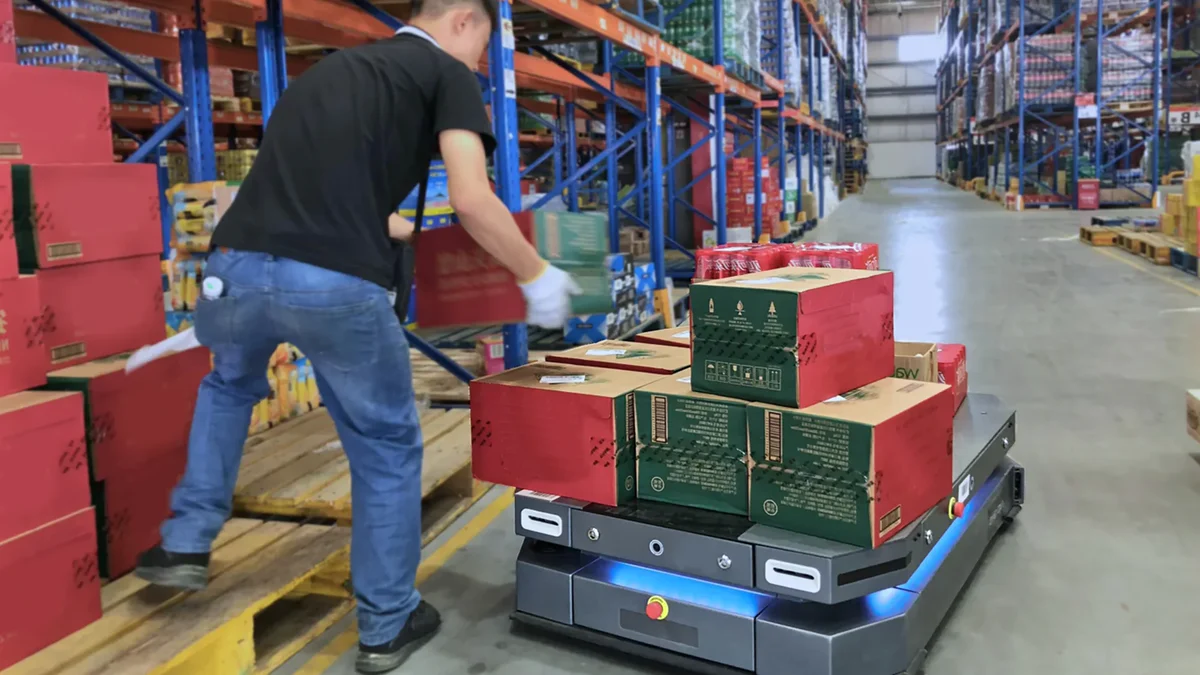
Manufacturers publish orders of magnitude, which remain their own claims: ForwardX states on its website16 a return on investment of 5 to 9 months for its autonomous mobile robots. Only a measurement on your own site gives a reliable figure. Our guide to calculating the ROI of a robot offers a step-by-step method, with the variables to measure during a proof of concept.
Which financing method should you choose for your project?
The financing method for a robot is chosen according to the project stage and how clear the use case is. The table below covers the most common situations.
| Situation | Method that often fits | Point to watch |
|---|---|---|
| First robot, use still uncertain | Long-term rental or RaaS | Minimum term and exit conditions |
| Mobile robot fleet growing with activity | RaaS or operating rental | Adding robots during the contract |
| Robot central to production, use of more than 5 years | Purchase with a loan, or finance lease | Residual value and maintenance |
| Tight cash position, project above €70,000 excl. VAT | Finance lease | Total contract cost |
| Industrial SME with a preliminary study to carry out | Consulting assignment, then loan | Processing time |
These pairings are guidelines, not personalised recommendations. The company's chartered accountant and bank validate the final structure.
What documents should you prepare for a robot financing application?
A robot financing application rests on three elements: the detailed quotation, the investment plan and a quantified estimate of the gains. The lender generally expects the latest annual accounts, a project description (workstation concerned, volumes, target organisation) and the deployment schedule. An on-site proof of concept strengthens the application, because it replaces assumptions with real measurements: throughput, autonomy rate, human intervention time.
For a loan or finance lease above €50,000 excl. VAT, allow a processing time of several weeks. Tax schemes, for their part, are handled in the tax return for the financial year of acquisition.
Financing should start from a costed need: AMR pricing, industrial project budgets or humanoid pricing. The return on investment calculation tests the project’s ability to deliver benefits; robotics grants and subsidies are never secured income before funder approval.
About RoboNex describes the team’s role and project support in France.
How RoboNex supports you
RoboNex SAS is the official French distributor of AGIBOT (humanoid robots and embodied AI), ForwardX (autonomous mobile robots for intralogistics) and KEENON (service robots). The approach follows three stages: a proof of concept on your site, which measures the real gains; integration into your flows and systems; then deployment and support.
On financing, RoboNex provides a detailed quotation after study, the data measured during the proof of concept to build the ROI calculation, and the technical information requested by your bank, your lessor or Bpifrance. RoboNex does not decide eligibility for support: that is the financing body's decision. The use cases covered are detailed on our humanoid robots, logistics and service robotics pages.
Frequently asked questions
RoboNex team · answers in French, English and Chinese
Can you rent a robot rather than buy it?

Yes. Operating rental and long-term rental let you use a robot without buying it. At Bpifrance, operating rental starts at €70,000 excl. VAT, generally over 2 to 7 years. Some manufacturers, such as ForwardX, also offer a subscription model (RaaS) that includes services. Rental payments are expenses, which preserves cash, but the robot never belongs to the company at the end of the contract.
What is the difference between a finance lease and an operating rental?
A finance lease includes a purchase option: at the end of the contract, the company can acquire the robot for the agreed residual value. An operating rental does not: the robot is returned or the contract renewed. At Bpifrance, both arrangements start at €70,000 excl. VAT; the finance lease generally runs over 3 to 7 years and the operating rental over 2 to 7 years.
Is there a grant to buy a robot in 2026?
As of 21 November 2026, there is no general national grant for buying a robot. The levers available are mainly Bpifrance loans, subsidised consulting assignments and regional support. An industry 4.0 suramortissement including robots is under discussion in the 2027 finance bill, for purchases from 1 January 2027, subject to its final adoption.
Does the robotics suramortissement still exist?
The former digital and robotics suramortissement, at 40 %, applied to industrial SMEs in 2019 and 2020; it is no longer open. According to the DGE, around 2,400 companies benefited from it. The 2027 finance bill provides for a new industry 4.0 suramortissement, from 40 % to 120 % depending on size and zone, still under discussion: the Assemblée rejected the first part of the budget on 4 November 2026 and the Sénat has been examining the original text since 20 November. Nothing is final as of 21 November 2026.
How long does it take for a robot to pay for itself?
The payback period of a robot depends on the total project cost and the gains measured on site. ForwardX states 5 to 9 months for its autonomous mobile robots, a manufacturer's claim that is not a guarantee. For a reliable figure, you need to measure redeployed hours, capacity gained and real operating costs during a proof of concept.
Updated on 21 November 2026.
Sources and references (16)
- bpifrance.fr/catalogue-offres/credit-bail-mobilier
- bpifrance.fr/catalogue-offres/pret-equipement
- entreprises.gouv.fr/la-dge/publications/le-suramortissement-un-levier-efficace-pour-la-mod
- bpifrance.fr/catalogue-offres/pret-industrie-pme-2
- bpifrance.fr/catalogue-offres/pret-uimm
- bpifrance.fr/catalogue-offres/location-financiere
- forwardx.com/raas/
- bpifrance.fr/catalogue-offres/pret-boost
- bpifrance.fr/catalogue-offres/mission-de-conseil-strategie-industrie-du-futur
- les-aides.fr/aide/dWJf3w/bpifrance/pret-boost-industrie.html
- entreprises.gouv.fr/espace-entreprises/appels-a-projets-et-appels-a-manifestation-d-intere
- legifiscal.fr/actualites-fiscales/4665-plf-2027-suramortissement-industrie-40-credit-impot
- legifiscal.fr/actualites-fiscales/4705-suramortissement-industrie-40-assemblee-ajoute-ia-c
- senat.fr/travaux-parlementaires/textes-legislatifs/la-loi-en-clair/projet-de-loi-de-financ
- aides-entreprises.fr/
- forwardx.com/