


Key points
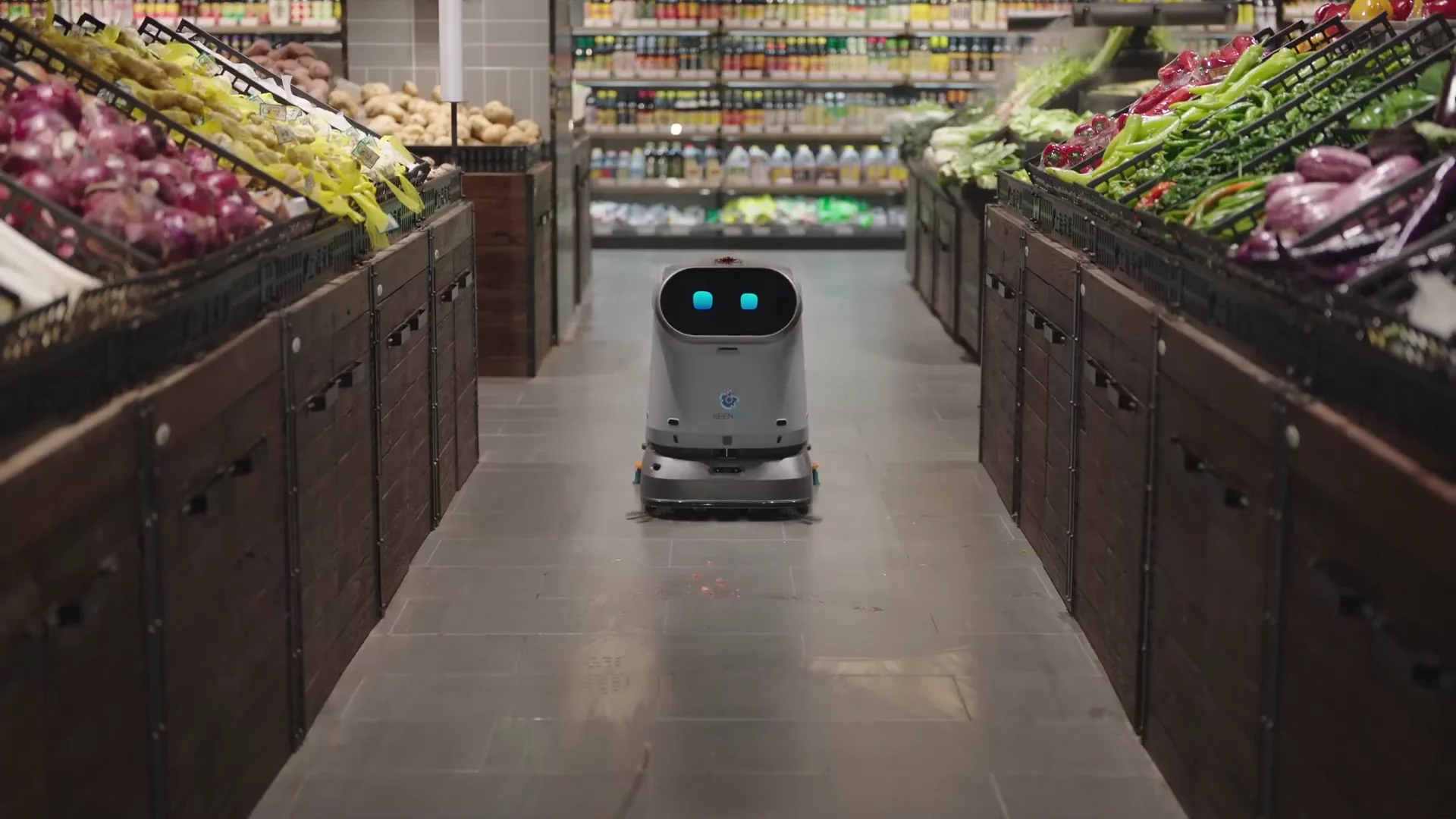
A commercial cleaning robot is an autonomous scrubber dryer: it sweeps, scrubs and recovers dirty water on its own, along a mapped route, then returns to recharge. RoboNex distributes two models in France. The AGIBOT C5 targets large areas: up to 1 980 m²/h, a 550 mm scrubbing width and 3 h of runtime when scrubbing, with a station that recharges the robot, refills it, drains it and rinses its tank (AGIBOT1). The KEENON KLEENBOT C40 targets small and medium areas: up to 1 100 m²/h, 4 functions in a single pass, 5 h of scrubbing and a battery that can be swapped in 5 seconds (KEENON2).
The choice depends first on floor area and aisle width: the C5 for warehouses, factories, hypermarkets, stations and shopping centres, the C40 for offices, hotels, cafés, convenience stores and corridors in healthcare facilities, with a minimum passage of 650 mm. On site, you need a clean water supply, a dirty water drain (as for a washing machine) and a location for the charging station. RoboNex delivers in about 4 days from its European stock and commissions the robot in about ten days on average after the order.
What is an autonomous cleaning robot?
An autonomous cleaning robot is a floor scrubbing machine that operates without a driver. It locates itself using lasers and cameras, follows a site map recorded during commissioning and avoids obstacles and people. Unlike a ride-on scrubber dryer, it does not tie up any operator during scrubbing: the team programs the zones and schedules, then takes care of the tasks the machine does not do, such as corners, stairs or vertical surfaces. The models distributed by RoboNex also take the lift and go through connected doors when the building is equipped (AGIBOT1, KEENON2).
Which tasks does a cleaning robot perform?
A commercial cleaning robot combines several operations in a single pass. The AGIBOT C5 is a 4-in-1 machine: it sweeps, vacuums, scrubs and dries in a single pass, with a scrubbing pressure of 25 kg and a debris pick-up rate above 95 % according to the manufacturer (AGIBOT1). The KEENON KLEENBOT C40 sweeps, vacuums, scrubs and pushes dust; its triple brush system separates dry and wet, and the floor dries in 30 seconds after scrubbing according to KEENON (KEENON2). The C40 handles low-pile carpet, marble, wood, tiles, vinyl, epoxy resin, granite and engineered stone.
AGIBOT C5 or KEENON C40: which one should you choose?
The C5 and the C40 address two site scales. AGIBOT presents the C5 as a robot for medium and large scenes, KEENON presents the C40 as a robot for small and medium spaces.
| Feature | AGIBOT C5 | KEENON KLEENBOT C40 |
|---|---|---|
| Manufacturer positioning | Medium and large areas | Small and medium areas |
| Functions | 4-in-1: sweeping, vacuuming, scrubbing, drying | 4-in-1: sweeping, vacuuming, scrubbing, dust pushing |
| Maximum productivity | 1 980 m²/h | 1 100 m²/h |
| Working width | 550 mm scrubbing | 560 mm sweeping, 400 mm scrubbing and vacuuming |
| Runtime | 3 h scrubbing | 5 h scrubbing, 12 h sweeping |
| Power | Automatic recharging on the station in 1 h 30 | Recharging in 2 h or battery swapped in 5 s |
| Water | 90 L tank | 16 L clean water, 11 L dirty water |
| Station | Recharging, refilling, draining, tank rinsing in 4 min | Automatic recharging, refilling and draining |
| Dimensions | Not published | 578 × 500 × 690 mm, 70 kg, 650 mm passage |
| Sites cited by the manufacturer | Supermarkets, airports, factories, offices, hotels, hospitals, shopping centres | Hotels, offices, supermarkets |
Sources: official product pages AGIBOT C51 and KEENON C402, accessed on 22 November 2026. Productivity figures are maximums stated by the manufacturers; actual productivity depends on obstacles, travel and how dirty the floor is.
Which cleaning robot for a factory or a warehouse?
For a factory or a warehouse, the cleaning robot must cover long aisles with as few returns to the station as possible. The AGIBOT C5 is designed for this case: 1 980 m²/h at most, a 90 L tank and a station that chains recharging, refilling, draining and tank rinsing without intervention (AGIBOT1). In continuous operation, 3 h scrubbing cycles alternate with recharging on the station; the RoboNex home page presents a simulation of this regime over 24 h. Forklift and AMR traffic zones are declared during mapping, so that the cleaning robot and the vehicles share the aisles without conflict. For automating the flows themselves, see our logistics page.
Which cleaning robot for retail and offices?
In retail, the cleaning robot often works during opening hours, between shelves and customers. For a hypermarket or a shopping mall, the productivity of the C5 limits the number of machines. For a convenience store, an office, a hotel or a café, the KEENON C40 fits through 650 mm, swaps its battery in 5 seconds to chain tasks and also handles low-pile carpet (KEENON2). KEENON publishes the example of a café where the C40 sweeps and scrubs in a single pass without interrupting service; this testimonial is published by the manufacturer and is not a RoboNex customer reference (KEENON3).
Which cleaning robot for a healthcare facility?
In a healthcare facility or a nursing home (EHPAD), the cleaning robot scrubs corridors, halls and common areas at set times and leaves to the teams the hygienic cleaning of rooms and risk areas, which follows the facility's protocols. AGIBOT lists hospitals among the sites where the C5 is used (AGIBOT1). The C40 suits narrow corridors thanks to its 650 mm passage. The choice of cleaning products and frequencies is still defined with the hygiene manager. For internal delivery and reception, see service robotics.
What needs to be prepared on site before installation?
An autonomous cleaning robot requires little building work. Three points need to be planned before installation:
- a clean water supply for automatic refilling;
- a dirty water drain, as for a washing machine;
- a location for the charging station, near an electrical socket.
The C5 station runs on 200 to 240 V (AGIBOT1). For lifts and doors, the connection is prepared with the building manager. On installation day, a RoboNex engineer maps the site in one day and sets the zones, schedules and routes.
How long does it take to deploy a cleaning robot?
RoboNex organises a demonstration on your site within 10 days of the request, then a pilot of about 15 days in your real conditions. You can also go straight to ordering if you have made your choice. The robot is delivered in about 4 days from our European stock and commissioned about ten days after the order on average, 15 days at most if the site is ready. Several sites can be deployed in parallel. The full process, from needs analysis to maintenance, is detailed on the home page.
How much does a commercial cleaning robot cost?
The price of a cleaning robot depends on the model, the number of machines, the station, the accessories and the maintenance. RoboNex draws up each proposal on quotation, after a site study, and sells its robots outright. Rental or leasing goes through a financing provider, and public grants can reduce the investment: see our financing guide and the return on investment calculation.
How does after-sales service work for a cleaning robot?
Machines and spare parts are in stock in Europe. A reported incident is resolved within 48 to 72 hours, remotely, by your trained teams or by a RoboNex engineer on site. The five RoboNex engineers are based in Lille, Strasbourg, Rennes, Lyon and Toulouse. Your teams are trained from commissioning and replace common parts themselves.
How RoboNex supports you
RoboNex SAS is the official distributor of AGIBOT and KEENON in France and in the European Union. For an autonomous cleaning project, RoboNex studies your floor areas and schedules, recommends the C5, the C40 or a mixed fleet, organises the demonstration and the pilot, then installs, trains and provides support. To describe your site, use the quotation form: an engineer replies within 24 hours.
Frequently asked questions
RoboNex team · answers in French, English and Chinese
How much floor area does a cleaning robot clean per hour?

According to the manufacturers, the AGIBOT C5 scrubs up to 1 980 m²/h and the KEENON KLEENBOT C40 up to 1 100 m²/h. These are maximums: actual productivity depends on the shape of the zones, obstacles, travel to the station and how dirty the floor is.
Does a cleaning robot replace a cleaning operative?
No. The cleaning robot takes over repetitive scrubbing of large floor areas. Operatives keep corners, stairs, washrooms, vertical surfaces and quality control, and they program the robots.
Can a cleaning robot work with the public present?
Yes. The C5 and C40 models detect people and obstacles using lasers and cameras and adapt their path. Many facilities nevertheless schedule scrubbing of the busiest areas outside peak hours.
Is building work needed to install a cleaning robot?
Generally not. You need a clean water supply, a dirty water drain comparable to that of a washing machine and a location for the charging station near an electrical socket.
Can a cleaning robot change floors?
Yes, if the building allows it. The C5 and the C40 manage the link with lifts and connected access controls; the interface is prepared with the building manager during the study.
Can you test a cleaning robot before buying?
Yes. A RoboNex engineer comes to give a demonstration on your site within 10 days, then runs a pilot of about 15 days in your real conditions.