


Key takeaways
The difference between an AGV and an AMR lies in how the robot finds its way. An AGV (Automated Guided Vehicle) follows a route defined in advance and physically marked or referenced in the building: wire, magnetic tape, magnets, reflectors or floor codes. An AMR (Autonomous Mobile Robot) builds a map of the area with its LiDARs and cameras, locates itself on it and adapts its path in real time around obstacles. According to INRS1 (the French occupational health and safety institute, journal Hygiène et sécurité du travail no. 273, December 2023), deploying an AMR "requires no or few changes to the existing infrastructure".
In terms of safety, there are not two regimes: INRS points out that, in standards terms, AMRs are considered AGVs and fall under the same standard, ISO 3691-4:20232. The market is driven by these transport robots: the IFR3 counted 117 500 professional service robots sold in 2025 for transport and logistics, or 47 % of the total (press release of 30 September 2026). This page complements our logistics robot guide.
What is the difference between an AGV and an AMR?
An AGV executes a route; an AMR chooses its route. The AGV travels along paths laid out during installation; if it meets an obstacle, it slows down, then stops and waits for the way to clear. The AMR knows the site map and the goal of its mission; faced with an obstacle, it can recalculate a route.
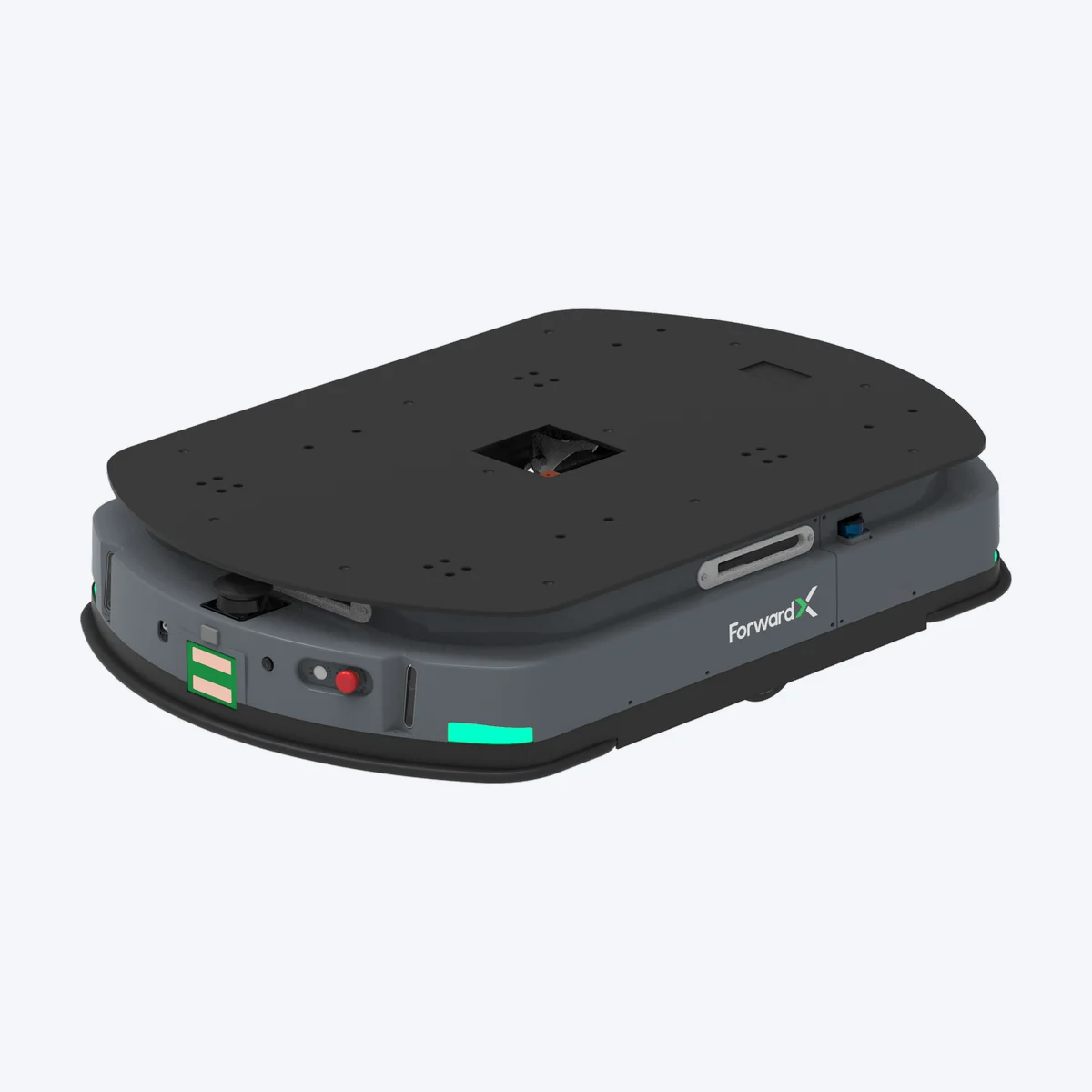
This difference changes how the system is operated. With AGVs, changing a flow means changing the guidance infrastructure. With AMRs, you mainly change the map and the missions in the fleet management software. INRS also notes that AMRs have reached SMEs "previously little concerned by automated handling", thanks to this lighter deployment.
AGV or AMR: the comparison table
| Criterion | AGV (automated guided vehicle) | AMR (autonomous mobile robot) |
|---|---|---|
| Guidance | Physically marked or referenced path: wire guidance, magnetic tape, magnets, laser reflectors, floor codes | Localisation on a map built by LiDAR and cameras (SLAM), with no physical path required |
| Navigation | Fixed routes; stops in front of an obstacle until it is removed | Route planning; obstacle avoidance within authorised areas |
| Flexibility | Low: each new route requires work on the guidance system | High: new routes and new missions through software configuration |
| Infrastructure | Floor works or installation of markers; floors and routes must be fixed | Little or no change to the building according to INRS; initial mapping |
| Cost of changes | High with every layout change (works, area shutdown) | Mainly engineering time: map, zones, missions, risk assessment to update |
| Safety | ISO 3691-4; predictable path, well known to teams | ISO 3691-4 as well; variable path, to be managed through zoning, marking and training |
| Use cases | Stable, repetitive flows, heavy loads, closed circuits | Changing flows, picking, line replenishment, sites shared with pedestrians and trucks |
How does an AGV guide itself?
An AGV guides itself by following a physical marker or by correcting its position against fixed markers. The most common techniques are wire guidance (a wire embedded in the floor), magnetic tape or floor magnets, laser reflectors mounted on walls or racks, and floor codes read by a camera. This guidance method is proven and highly repeatable.
The trade-off is rigidity: a new workstation or a relocated aisle means redoing the markers. An AGV therefore suits flows that change little over years.
How does an AMR navigate?
An AMR navigates thanks to its perception of the environment. INRS1 explains that the development of LiDAR and camera vision has given AMRs 2D or 3D perception, used to map the work area and locate themselves in it, then to adapt their path to the obstacles present.
Some manufacturers go further. ForwardX4 states that its AMRs and autonomous forklifts use machine vision to recognise people, manual trucks, pallet jacks, other AMRs, pallets and cartons, and respond according to what they identify. Lithium batteries, more compact than lead-acid, have also made small robots possible for transporting totes or cartons.
Is the line between AGV and AMR clear-cut?
No, and this point is often overlooked. Many AMRs can also run on fixed routes when the site requires it. The product sheets of the ForwardX Flex range5, for example, offer three navigation modes: real-time optimal route, predefined route network and hybrid mode, with positioning by laser SLAM, by vision or by QR codes on the floor or wall. The Max range6 adds an operator-following mode.
INRS also notes the profusion of trade names: LGV, automated guided cart, mobile robot, AIV, IGV, mobile platform. Whatever the name, these machines fall under the same standard. The right reflex is therefore to compare navigation modes and safety functions, not labels.
Do AGVs and AMRs have the same safety rules?
Yes: the ISO 3691-4:2023 standard covers both, and the ISO page explicitly mentions the automated guided vehicle and the autonomous mobile robot. The risks are the same: collision with a person, crushing between the robot and a fixed object, the robot or its load falling.
The difference lies in how they are controlled. Because an AMR's path varies, INRS1 stresses several limits: safety laser scanners detect in a plane parallel to the floor and cannot see the raised forks of a stacker; a person entering the path from the side is more exposed; forbidden zones on the map are only a "software stop". In a June 2026 note7, INRS adds that the safety of these machines still relies heavily on the organisational measures taken by the company.
When should you choose an AGV, and when an AMR?
Choose an AGV if your flows are stable, your routes short and repetitive, your areas separated from pedestrians and your loads heavy, with a layout that will not change. The investment in guidance is then paid back over a long period.
Choose an AMR if your flows change with seasonality or product references, if the robots share aisles with operators and trucks, or if you want to start small and then add robots. For pallet racking, autonomous forklifts such as the ForwardX Apex range8 combine forks with navigation by laser SLAM or vision. In all cases, INRS recommends drawing up a specification before purchase: floors, slopes, doors, people present, loads, interfaces. For budgets, see our AMR price page.
Test the AGV/AMR choice against robotic material handling and order picking routes, rather than guidance technology alone. Compare AMR pricing and safety and ISO 3691-4 on an equivalent scope.
The abbreviations and concepts used here are defined in our robotics glossary.
How RoboNex supports you
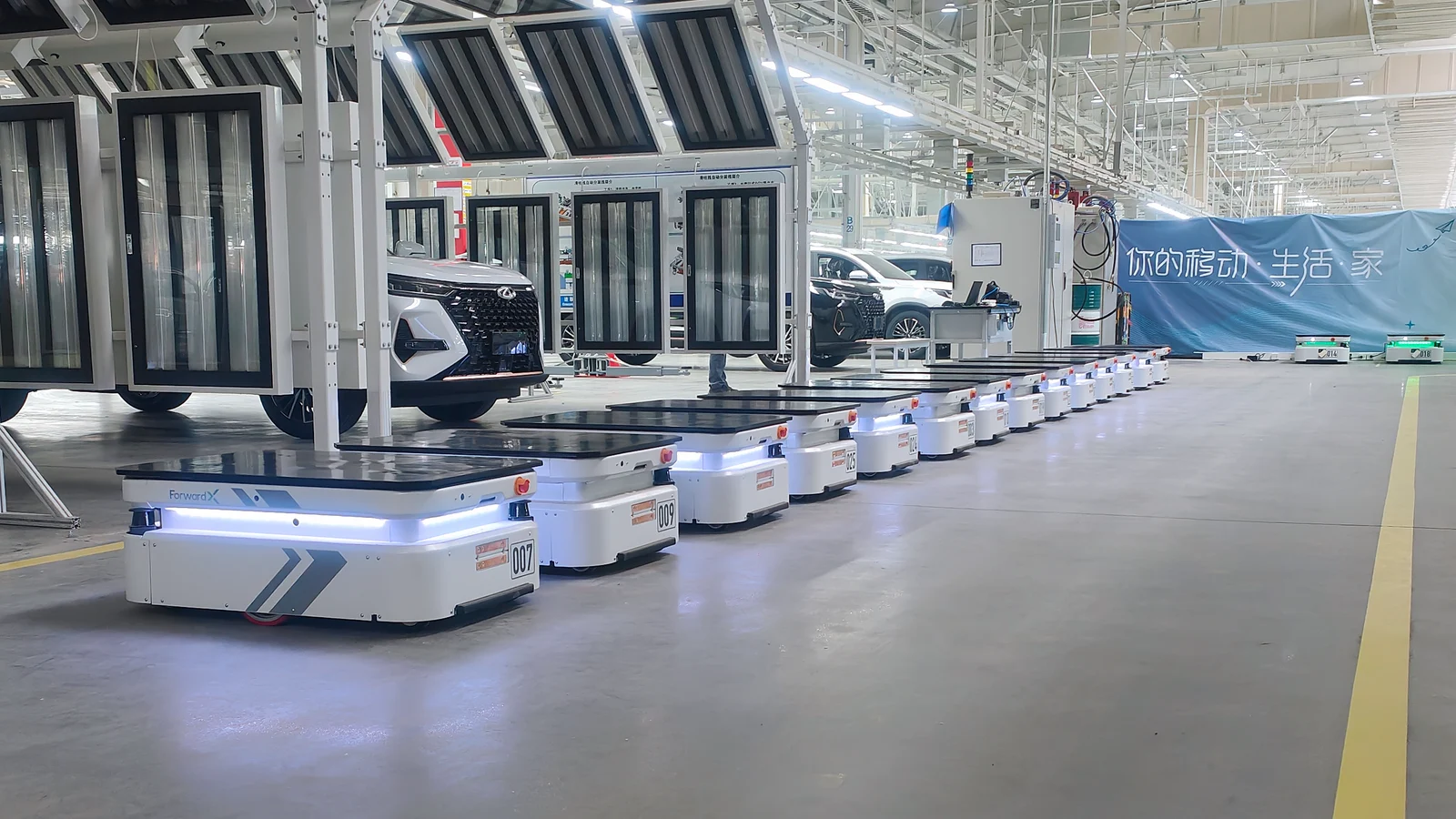
RoboNex is the official distributor in France of ForwardX, whose Flex, Max, Apex and Lynx ranges cover the transport of totes, shelves and pallets as well as automotive plant flows. Our approach:
- Proof of concept on your site: flow survey, testing of navigation modes (free routing or route network) in your actual aisles.
- Integration: mapping, zoning, floor marking, connection to the WMS or MES, team training, risk assessment with you.
- Deployment and support, then gradual addition of robots if the results justify it.
If your analysis concludes that an AGV or a conveyor is better suited, we will tell you.
Frequently asked questions
RoboNex team · answers in French, English and Chinese
What is an AGV and what is an AMR?

An AGV, or automated guided vehicle, is a driverless truck that follows a path referenced in the building: wire, magnetic tape, reflectors or floor codes. An AMR, or autonomous mobile robot, locates itself on a map built with its sensors and plans its route. Both are driverless industrial trucks within the meaning of ISO 3691-4:2023.
Does an AMR cost more than an AGV?
The purchase price depends on the model, the payload and the options, and is not enough for a comparison. An AGV requires guidance works at installation and at every relayout. An AMR mainly requires configuration. Total cost should therefore be compared over the project's lifetime, flow by flow. Our dedicated page details the cost drivers of an AMR.
Is an AMR safer than an AGV?
Not inherently. Both fall under ISO 3691-4 and must bear the CE marking. The AMR perceives its environment better, but its path is less predictable for pedestrians. INRS points out that safety laser scanners do not cover all risks and that zoning, floor marking and training remain essential, whatever the type of robot.
Can a cobot be mounted on an AMR?
Yes, collaborative arms mounted on a mobile base exist, for machine tending or picking parts. The assembly becomes a new machine whose combined risks must be assessed: those of the arm and those of the movement. To compare cobots, AMRs and humanoids in a factory, see our page dedicated to industrial robotics.
What is the difference between AGV, AMR and AS/RS?
AGVs and AMRs carry loads by moving through the building. An AS/RS (automated storage and retrieval system) is a fixed storage installation, with stacker cranes or shuttles, that brings products to the operator. The three are often combined: the AS/RS stores, while AMRs or AGVs link the stock to picking stations or production lines.
Updated on 21 November 2026.