


Key takeaways
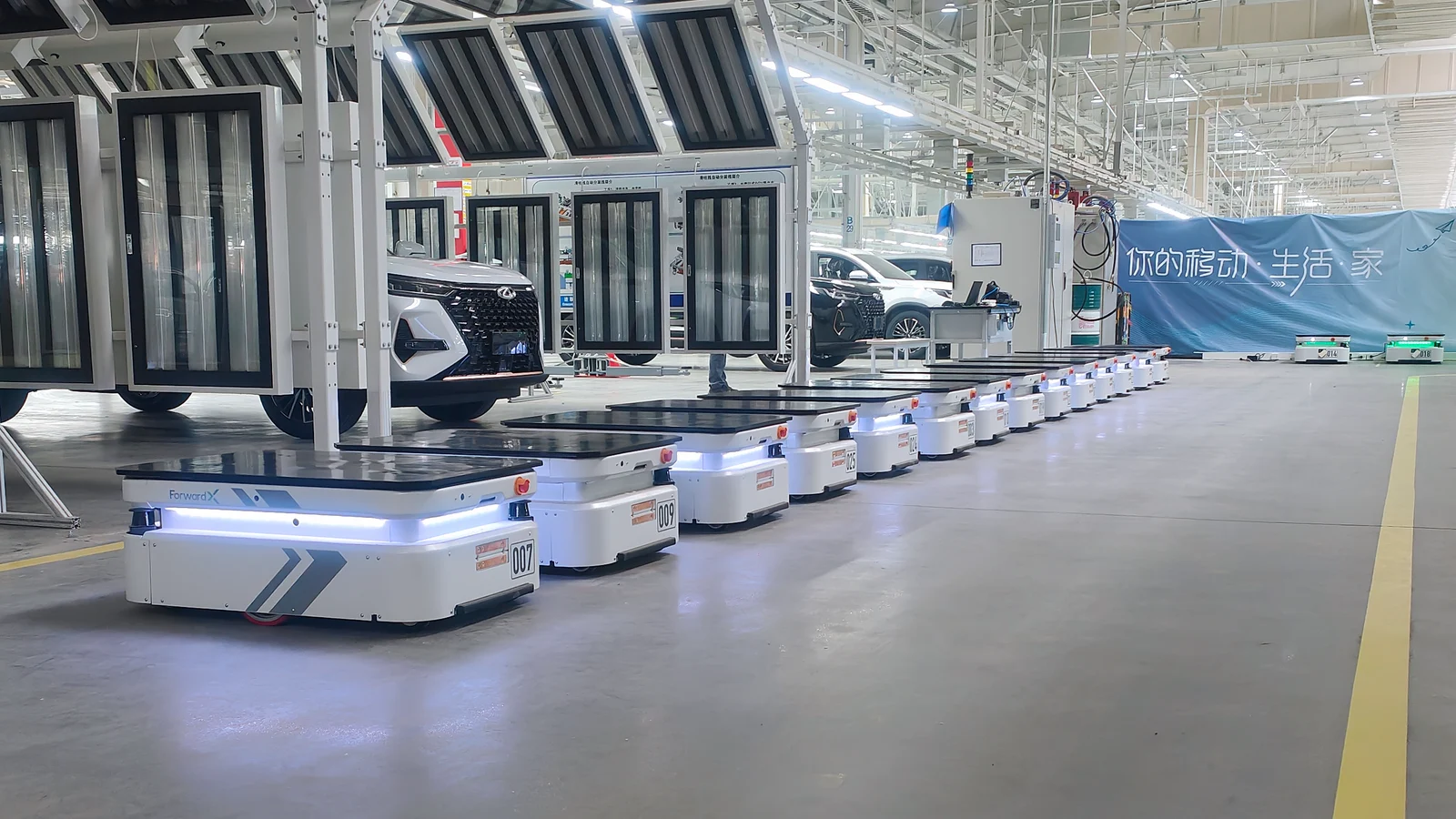
A material handling robot is a machine that moves, lifts or sets down loads without a driver: totes, carts, racks, pallets, production parts. In intralogistics, this mainly means heavy-duty autonomous mobile robots (AMRs) and autonomous forklifts. INRS1 (the French occupational health and safety institute, journal Hygiène et sécurité du travail no. 273, December 2023) describes AMRs that handle "pallets, totes, shelves, cartons, assembly parts, tooling" and that can reduce the risk of musculoskeletal disorders by relieving operators.
Public capacities give an order of magnitude. At ForwardX, for which RoboNex is the official distributor in France, the Max 2500-L2 AMR carries up to 2 500 kg and the Apex 1400-L3 autonomous forklift lifts 1 400 kg to 1 600 mm, according to the product sheets consulted on 21 November 2026. Transport and logistics account for 47 % of professional service robots sold in 2025, according to the IFR4.
What is a material handling robot?
A material handling robot is automated equipment that replaces a handling task: pushing a cart, carrying a tote, lifting and moving a pallet, stacking a load. A mobile handling robot travels between areas; a fixed handling robot (a palletising arm, for example) works at a station.
This page covers mobile robots, which link goods receipt, storage, production and dispatch. In regulatory terms, they are machinery; in terms of standards, driverless industrial trucks covered by ISO 3691-4:2023. It is part of our logistics robot guide.
What types of material handling robots are there?
Mobile handling robots fall into families according to load and task. The table is based on the public ranges of ForwardX and, for the humanoid, of AGIBOT.
| Type | Task | Published payload | Example |
|---|---|---|---|
| Compact lifting AMR | Carrying totes, cartons, light shelves | 300 kg, 60 mm lift | Flex5 |
| Heavy-duty AMR | Sliding under a rack or pallet and lifting it | 1 500 kg (Max 1500-L), 2 500 kg (Max 2500-L, 145 mm lift) | Max2 |
| Autonomous stacker | Picking up, lifting and stacking a pallet | 1 400 kg, forks at 1 600 mm (Apex 1400-L) | Apex3 |
| Autonomous counterbalance truck | Handling pallets without support under the load | 1 500 kg, 1 600 mm (Apex 1500-L) | Apex |
| Autonomous pallet truck | Transporting a pallet at floor level | 2 000 kg, forks at 195 mm (Apex 2000) | Apex |
| High-lift truck | Dense warehouse storage | 4 400 lb and 17.9 ft (about 2 000 kg and 5.5 m) | Apex R2000-L |
| Industrial AMR | Feeding production lines | Not published | Lynx6 |
| Humanoid robot | Moving stacked containers, feeding a station | Depending on model | Uses described by AGIBOT7 |
How does a robot transport a pallet?
A robot transports a pallet in two ways: by lifting it from underneath (heavy-duty AMR) or by picking it up with forks (autonomous forklift or pallet truck). The second method makes it possible to pick up a pallet from the floor or from a rack, as a forklift driver would.
ForwardX Apex3 trucks illustrate the equipment required: pallet presence and misalignment sensors (two of each), five LiDARs, safety bumpers and two emergency stops. They accept Euro pallets and, according to ForwardX, custom pallets. They navigate on a route network, on a preferred route or by calculating the optimal path. Pallet quality and consistent pallet placement determine how reliable the pick-up is.
What are the uses of a material handling robot in a factory?
In a factory, a material handling robot is mainly used to feed workstations and remove finished products. It brings parts to the line side, returns empty containers and links the stores to production. These repetitive flows involve a lot of non-value-adding travel.
ForwardX dedicates its Lynx6 range to the automotive industry, with case studies published in a welding shop and an engine assembly plant (the manufacturer's customers). AGIBOT, for its part, describes humanoids that move stacked containers and load or unload components at production and test stations. These humanoid uses still need to be validated in a pilot.
How can robots, forklift drivers and pedestrians work together safely?
Coexistence is prepared through organisation as much as technology. INRS1 points out that safety laser scanners detect in a plane parallel to the floor: an AMR can hit the raised forks of a stacker, which in turn hits the operator. It also cites the case of an empty pallet on the floor being struck and then thrown towards a person.
The recommended measures are well known: keep traffic areas clear, mark hazardous zones on the floor, provide a 500 mm clearance for escape, reduce speed near obstacles, install physical barriers in front of docks. ForwardX states that its robots use vision to recognise people, manual trucks and pallet jacks, and signal with indicator lights when a person enters the safety zone (ForwardX technology8). The applicable standard is detailed on our ISO 3691-4 standard page.
Does a material handling robot reduce physical strain?
Yes, if it is properly integrated. INRS1 writes that AMRs "can reduce the risk of MSDs by relieving operators of physically demanding tasks, such as handling or moving loads".
INRS also warns that the tasks left to operators can become more demanding, and that frequent robot stoppages require repeated interventions, a source of fatigue and stress. In a June 2026 note9, it points out that technical safeguards "barely manage to cover all hazardous situations". A material handling robot should therefore also be judged on the work organisation it brings about.
How do you choose a material handling robot?
Choose a material handling robot based on your loads and your site, not on a catalogue. The points to record:
- the load: type of pallet or container, dimensions, maximum weight, stability;
- the task: floor-level transport, lifting, stacking, placement height;
- the site: aisle width, floor condition, slopes, doors, docks;
- coexistence: pedestrians, forklift drivers, other robots;
- interfaces: conveyors, racking, information system;
- throughput: pallets per hour, operating hours, charging time.
For budgeting, see our AMR price page.
In a warehouse, order picking organises how the operator, tote and order meet. In a factory, automating an SME helps isolate a first flow; AMR pricing and choosing a robotics integrator then clarify budgets and interfaces.
The operating principles of an AMR explain what navigation handles and what depends on flow organisation.
How RoboNex supports you
RoboNex SAS is the official distributor in France of ForwardX, whose Max, Apex and Lynx ranges cover the handling of racks and pallets and line feeding, and of AGIBOT for humanoid uses. RoboNex also distributes KEENON. Our approach:
- Proof of concept on your site: survey of pallet flows, pick-up and drop-off trials with your actual load carriers.
- Integration: choice of model, zoning, marking, interfaces, risk assessment with you, training of forklift drivers and pedestrians.
- Deployment and support, with maintenance and adjustment of missions.
The availability of each model in France is confirmed at the quotation stage. See ForwardX France or contact us.
Frequently asked questions
RoboNex team · answers in French, English and Chinese
What is a material handling robot?

It is a machine that moves, lifts or sets down loads instead of an operator. In logistics, this mainly means heavy-duty autonomous mobile robots and autonomous forklifts. In factories, fixed palletising arms are added to the list. Mobile robots fall under ISO 3691-4:2023 on driverless trucks.
What load can a material handling robot carry?
It ranges from a few hundred kilos to several tonnes. At ForwardX, Flex robots carry 300 kg, Max robots up to 2 500 kg and Apex trucks lift from 1 400 to 2 000 kg depending on the model. Actual capacity also depends on the lift height and the load's centre of gravity.
Can a robot replace a forklift?
For repetitive, predictable flows, yes: an autonomous forklift picks up, transports and stacks standard pallets. Irregular operations (damaged pallets, oversized loads, truck loading) often remain manual. A site generally combines autonomous and driven trucks, which means coexistence has to be organised.
What is the difference between a material handling robot and an AGV?
The AGV is a category of material handling robot: it follows a route referenced on the floor or on the walls. An autonomous handling robot (AMR) navigates on a map and avoids obstacles. Both fall under the same safety standard. The choice depends on how stable your flows are and on the presence of pedestrians.
How much does a pallet transport robot cost?
RoboNex does not publish prices. The specialist US press puts an autonomous forklift at between 80 000 and 150 000 dollars per robot, excluding software and integration (Warehouse Revolution10, June 2026). The actual cost depends on the model, the number of robots and the site adaptations; it is priced on quotation after a study.
Updated on 21 November 2026.
Sources and references (10)
- inrs.fr/media.html?refINRS=DO%2042
- forwardx.com/max-series/
- forwardx.com/apex-series/
- ifr.org/ifr-press-releases/news/global-sales-of-professional-service-robots-surge-24-perce
- forwardx.com/flex-series/
- forwardx.com/lynx-series/
- store.agibot.com/pages/about-us
- forwardx.com/innovative-technology/
- inrs.fr/media.html?refINRS=NO%2049
- warehouserevolution.net/automation/autonomous-mobile-robots/