


Key points
According to ISO 8373, as adopted by the International Federation of Robotics, a service robot is a robot for personal or professional use that performs useful tasks for humans or equipment, outside industrial production (IFR1). In professional settings, it delivers items from one floor to another, welcomes and directs visitors, and transports linen or medicines. In 2025, global sales of professional service robots rose by 24% to nearly 250,000 units (IFR, 30 September 20262).
Hospitality is the second-largest application of professional service robots worldwide, behind transport and logistics, according to the same report. The manufacturer KEENON, for which RoboNex is the official distributor in France, claims more than 100,000 robots delivered and a presence in more than 70 countries and regions (keenon.com3, consulted on 21 November 2026). This page covers service robot uses outside food service (healthcare, hospitality, reception), the selection criteria and the deployment method, with a link to each detailed guide.
What is a service robot?
A service robot is a robot that provides a service to people or equipment, as opposed to an industrial robot, which takes part in manufacturing. The IFR, which relies on ISO 8373, distinguishes service robots for personal use (domestic vacuum cleaner, lawnmower) from those for professional use, operated by companies and institutions (IFR1). The 2021 revision of the standard adds medical robots as a third category, which the IFR includes in its service robot statistics. In a professional setting, the service robot is usually mobile and autonomous: it finds its way around the building, avoids obstacles and sometimes takes the lift or opens connected doors.
What is the market for professional service robots?
The professional service robot market is growing strongly. The figures below come from the IFR World Robotics 2026 Service Robots report, published on 30 September 2026 and covering the year 2025.
| Indicator (year 2025) | Value |
|---|---|
| Professional service robots sold worldwide | nearly 250,000 (up 24%) |
| First application: transport and logistics | 117,500 units, 47% of the market |
| Second application | hospitality (mobile guidance, information kiosks, telepresence) |
| Third application | professional cleaning |
| Medical robots | up 19% |
| Full-size humanoids | around 7,000 units |
Source: IFR, 30 September 20262. The IFR states that these data come from a panel of suppliers and are not extrapolated to the whole sector. The report also notes the growth of the rental-with-service model, or "robot as a service".
What are the main types of professional service robots?
Professional service robots are classified by the task they perform. The table below presents the most common families outside food service and cleaning.
| Family | Typical tasks | Places of use | Example from the KEENON range |
|---|---|---|---|
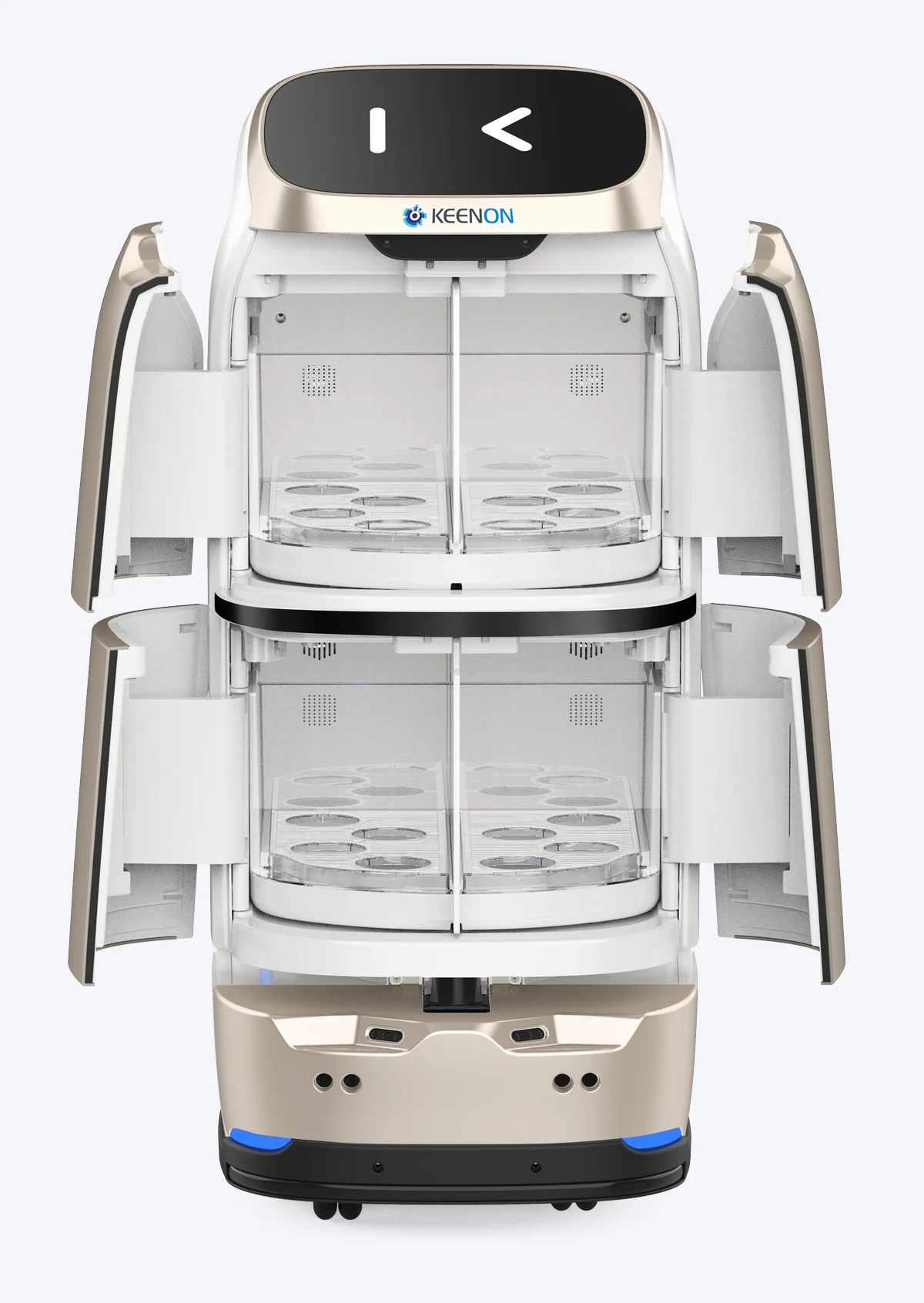
| Indoor delivery robot | room service, parcels, trays, forgotten items | hotels, residences, offices | BUTLERBOT W3 (four compartments, lift access) |
| Reception and guidance robot | welcome, wayfinding, information | hotel lobbies, company receptions, public-facing buildings | KEENON hotel reception solutions |
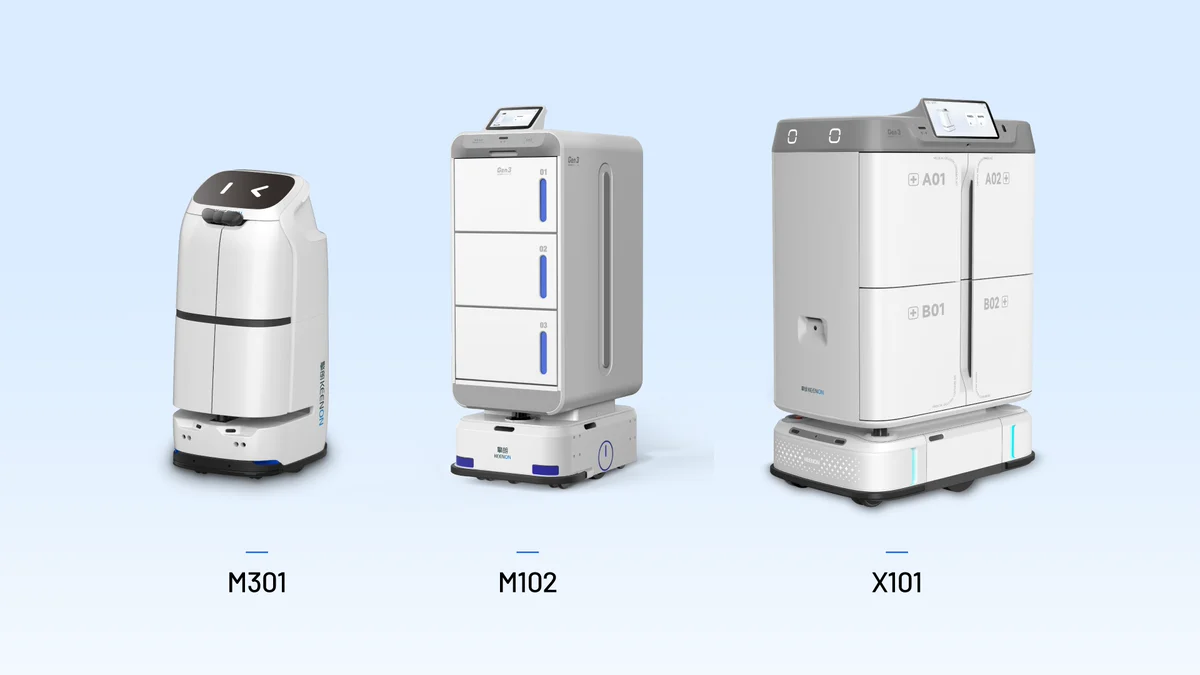
| Hospital logistics robot | medicines, samples, supplies, linen | hospitals, clinics, nursing homes (EHPAD) | X101, M102 |
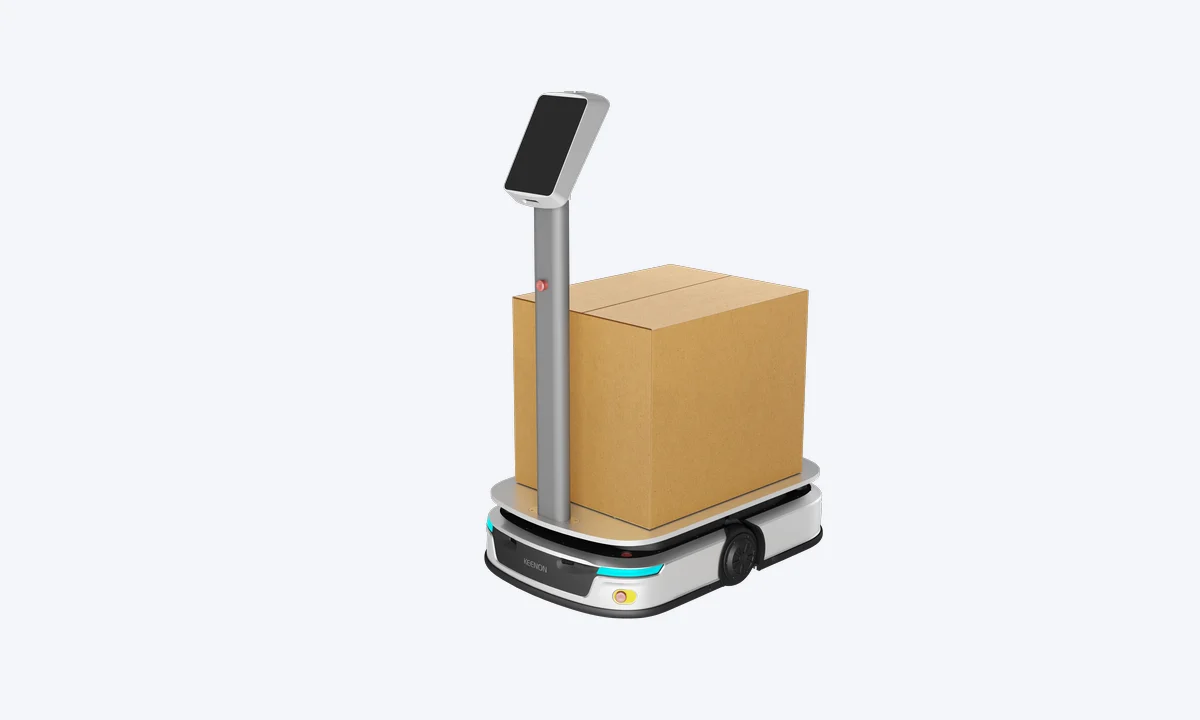
| Load transport robot | linen, waste, carts over 100 kg | hospitals, office sites, industrial sites | S100, S300 |
| Humanoid service robot | interaction, demonstration, welcome | public-facing venues | XMAN range |
Sources: KEENON range4, BUTLERBOT W35, KEENON S1006.
Which service robots for nursing homes and healthcare facilities?
In nursing homes and hospitals, the service robot takes care of logistics: transporting supplies, linen, meals, medicines or samples. KEENON presents its robots for care homes as "force multipliers" rather than replacements for care staff: they move between floors and take the lift to deliver to rooms (KEENON, nursing homes7). In hospitals, the manufacturer cites the central pharmacy, sample transport, operating theatres and sterilisation (KEENON, healthcare8). Our guide to robots for nursing homes and hospitals details the uses, hygiene constraints and testing method.
Which service robots for hospitality?
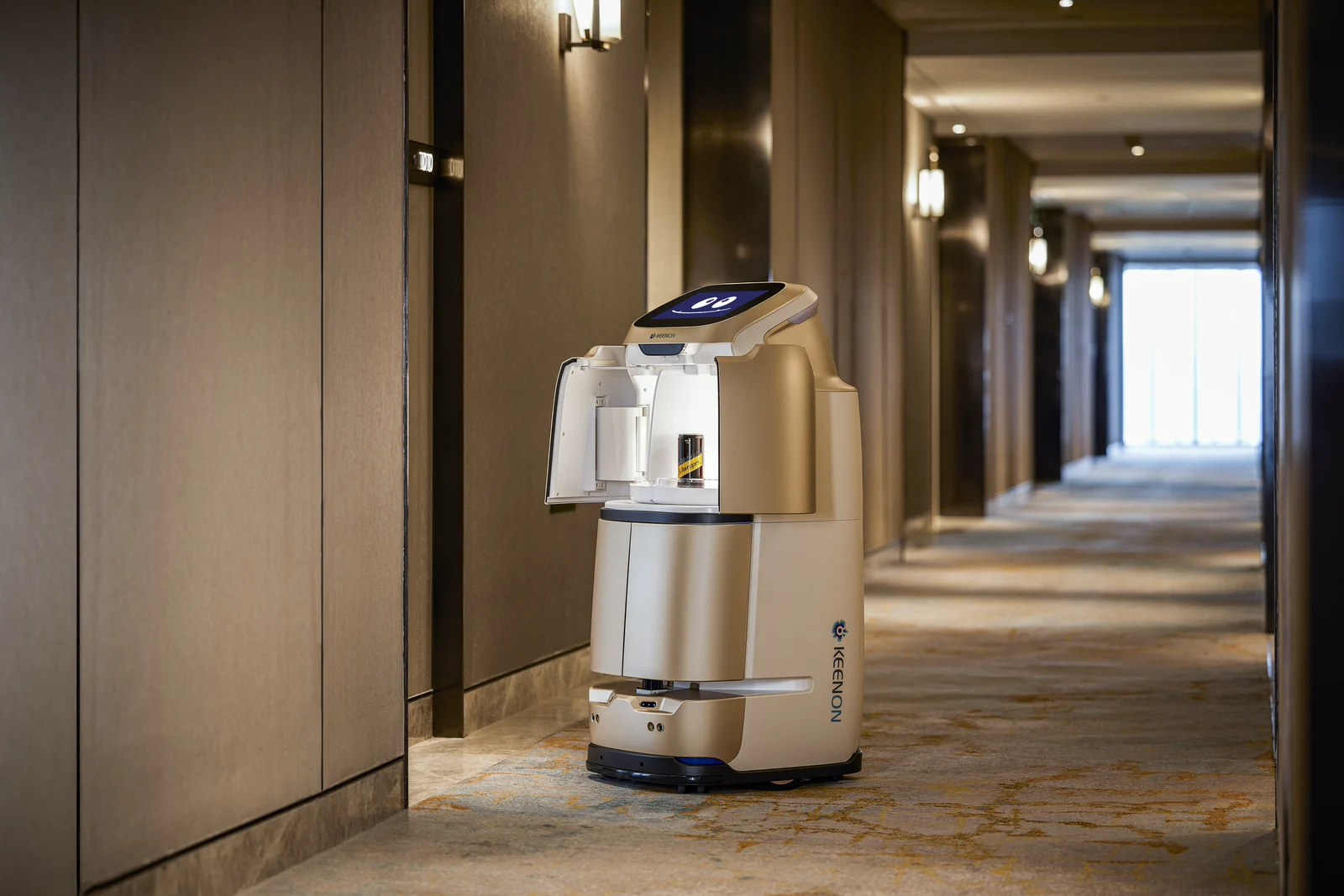
In a hotel, the service robot delivers room service, guest amenities and luggage, and welcomes guests in the lobby. KEENON states on its website that return on investment is generally achieved in under 12 months with two robots, a manufacturer figure to be confirmed for each property (KEENON, hospitality9). The BUTLERBOT W3, designed for floor-to-floor delivery, has four compartments with automatic doors and can take the lift thanks to a connected module (W3 data sheet5). Our guide to robots for hotels presents the use cases, technical prerequisites and questions to ask.
What is a reception robot used for?
A reception robot greets visitors, answers frequently asked questions and directs them to the right department or room. It does not replace a receptionist for complex requests, but it handles repetitive questions and draws attention in a company lobby, a hotel or a public-facing building. The IFR indicates that mobile guidance, information kiosks and telepresence account for most robots in the hospitality category (IFR2). Our guide to reception robots compares the approaches and selection criteria.
What about food service or cleaning?
For food service, robots that serve dishes in the dining room are covered by a dedicated RoboNex site: robot-serveur.com. For professional floor cleaning, see our autonomous cleaning page: AGIBOT C5 and KEENON KLEENBOT C40.
Who is KEENON, the service robot manufacturer?
KEENON Robotics is a Chinese manufacturer of service robots, founded in 2010, which presents itself as the world's leading embodied AI service robot company by scale of commercial deployment. According to its website, KEENON has passed 100,000 robots delivered, and its products are deployed in more than 70 countries and regions and more than 600 cities (keenon.com3). The manufacturer highlights an IDC ranking that places it first worldwide in commercial service robot shipments. Its range covers delivery, hospitality, healthcare, load transport, cleaning and humanoids. The institutions cited by KEENON are its customers, not those of RoboNex. See our KEENON in France page.
How much does a service robot cost?
The price of a service robot depends on the model, the accessories (lift module, connected doors, compartments), the number of robots, integration with the building and the maintenance contract. RoboNex does not publish catalogue prices: every proposal is quoted after a site visit. Three acquisition models generally exist: purchase, long-term rental and "robot as a service", whose growth the IFR notes (IFR2). The real cost should be weighed against the time freed up for teams. Our robot financing pillar details purchase, leasing and rental.
How do you prepare a service robot deployment?
A service robot deployment is prepared by checking the building before choosing the model. The points to check are as follows.
| Criterion | Question to ask | Why it matters |
|---|---|---|
| Circulation | Are the corridors wide enough? | the BUTLERBOT W3 requires a minimum passage width of 70 cm according to its data sheet |
| Floors | Does the robot need to take the lift? | a lift connection module is then required |
| Doors | Are there fire doors or badge-access doors? | an access control module must be planned |
| Network | Does the Wi-Fi cover the whole route? | supervision and calls depend on it |
| Payload | What weight needs to be carried? | around 20 kg for the W3, more than 100 kg for the S100 |
| Battery life | How many hours per day? | the W3 states up to 12 h, the S100 8 h according to the manufacturer |
| Hygiene | Are closed compartments needed? | essential in healthcare and for room service |
Sources: W3 data sheet5 and S100 data sheet6.
What are the limits of a service robot?
A service robot is effective on repetitive, well-defined, high-volume tasks, but it has limits. It handles neither complex unexpected situations nor in-depth human relationships: in a nursing home, the value comes from time given back to care staff, not from replacing human contact. It also depends on the infrastructure, with compatible lifts, doors and network. Finally, the gains announced by manufacturers are averages: they must be measured in your own facility. That is why an on-site test, with indicators defined in advance, remains the best way to decide.
Choose the service before the model: reception robots, indoor robotic delivery, robots in hospitality or robots in healthcare and nursing homes. The KEENON ranges then connect each use to a range, subject to checks on circulation and supervision.
About RoboNex describes the team’s role and project support in France.
How RoboNex supports you
RoboNex SAS is the official distributor in France of KEENON for service robots, as well as of AGIBOT and ForwardX. For a healthcare facility, a hotel or an office site, RoboNex follows three steps. First, a proof of concept on your premises: technical visit, choice of the right KEENON model, real-world test and measured indicators. Next, integration: mapping, connection to lifts and doors, route configuration and team training. Finally, deployment and support. Every proposal is priced after a site assessment. The availability in France of each model mentioned on this page is confirmed case by case.
Frequently asked questions
RoboNex team · answers in French, English and Chinese
What is the definition of a service robot?

According to ISO 8373, as adopted by the IFR, a service robot is a robot for personal or professional use that performs useful tasks for humans or equipment. It differs from an industrial robot, which is used in production. In business, the professional service robot is generally mobile and autonomous: it delivers, transports, welcomes or guides in places such as hotels, hospitals, nursing homes or offices.
How much does a service robot cost outside restaurants?
The price of a service robot depends on the model, accessories such as the lift module, the number of units, integration with the building and maintenance. There is no meaningful single price without a site assessment. RoboNex prepares every proposal as a quotation after a visit, and reviews with you purchase, long-term rental or a service-inclusive formula. For restaurant serving robots, see robot-serveur.com.
Can a service robot take the lift?
Yes, some service robots take the lift on their own. KEENON states, for example, that its BUTLERBOT W3 can use the lift to deliver to upper floors, thanks to a connected module. This function requires the building's lift to be compatible and its maintenance company to accept the interface. This is checked during the technical visit, before any commitment, because it determines whether the robot can be used in a hotel or nursing home.
Are there humanoid service robots?
Yes. Several manufacturers are developing humanoids for service, notably for reception and interaction with the public. KEENON presents an XMAN humanoid range, and AGIBOT, another brand distributed by RoboNex, states that it has deployed more than 300 robots in a Chinese leisure park to welcome visitors (AGIBOT website, September 2026). The IFR estimates that around 7,000 full-size humanoids were sold worldwide in 2025, a market still in its early days. See our humanoid robots pillar.
What is the difference between a domestic and a professional service robot?
A domestic service robot, such as a robot vacuum cleaner or lawnmower, is bought by an individual for personal use. A professional service robot is used by a company or institution: it moves through public-facing buildings, carries heavier loads, connects to the site's lifts and systems, and is covered by a maintenance contract. RoboNex distributes professional robots only.
Does a service robot replace staff?
No. A service robot takes care of trips and repetitive tasks, such as delivering, transporting or directing, to free up time for teams. KEENON itself presents its robots for care homes as operational assistants rather than replacements for care staff. Staff remain essential for human relationships, unexpected situations and complex requests. The right sizing is measured during an on-site test.
Updated on 21 November 2026.
Sources and references (9)
- ifr.org/service-robots
- ifr.org/ifr-press-releases/news/global-sales-of-professional-service-robots-surge-24-perce
- keenon.com/en/about/
- keenon.com/en/
- keenon.com/en/product/W3
- keenon.com/en/product/S100
- keenon.com/en/solution/smart-nursing-home
- keenon.com/en/solution/healthcare
- keenon.com/en/solution/smart-hotel