


Key takeaways
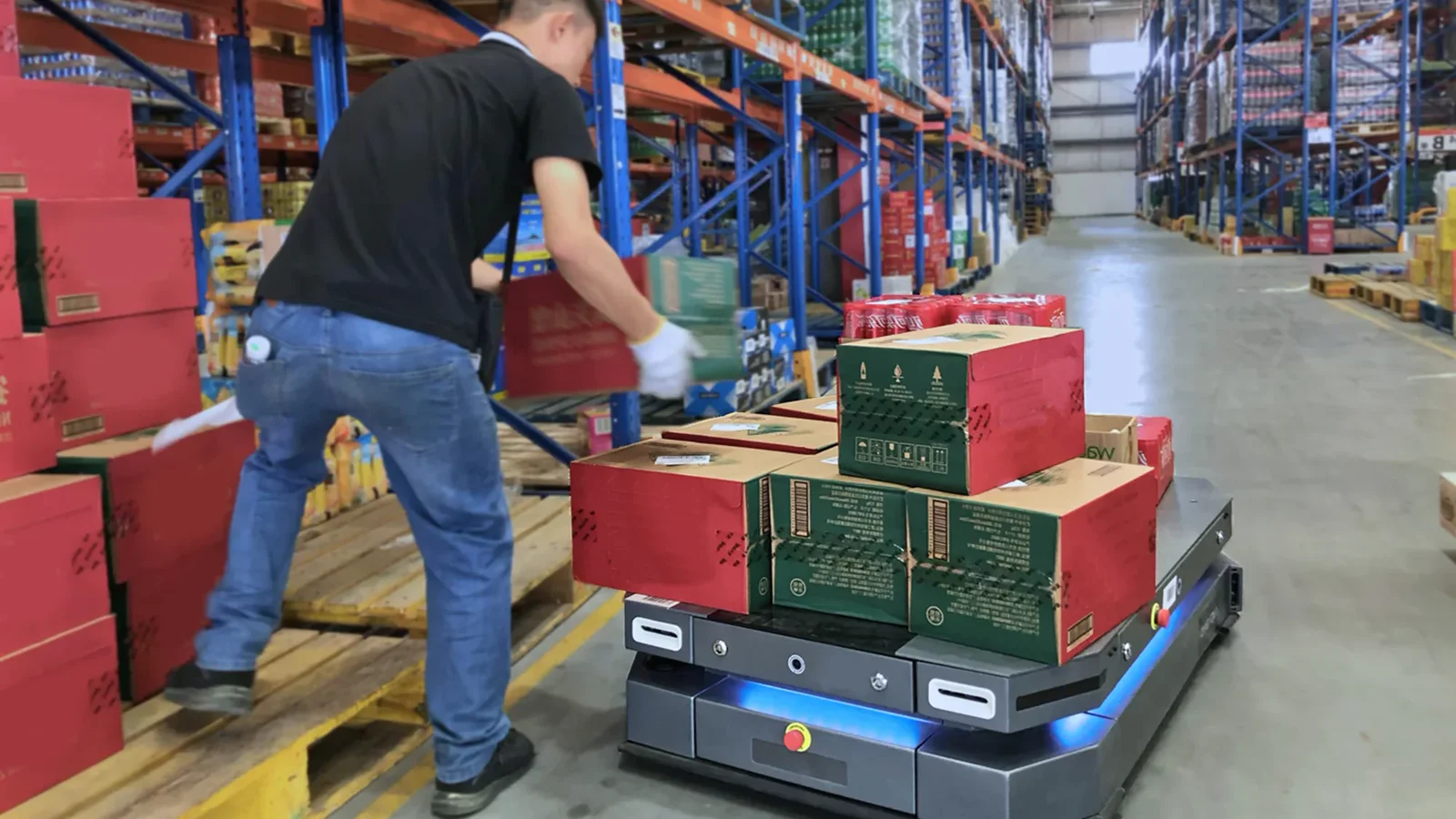
An order picking robot automates all or part of picking: travel to the item, the pick itself, or transport of the order to dispatch. Today, the most widespread method in warehouses hands the walking to autonomous mobile robots (AMRs) and leaves the picking movement to the operator. According to a Eurostat1 survey published on 21 January 2019 (2018 data), warehouse management was already the leading use of service robots in European Union companies: 44 % of the companies using them.
The market is accelerating: the IFR2 recorded 117 500 transport and logistics robots sold in 2025, up 21 % (press release of 30 September 2026). ForwardX, for which RoboNex is the official distributor in France, quotes on its home page3 customers reporting picking productivity increases of 113 % to 200 % (manufacturer figures). These are customers of ForwardX, not of RoboNex.
What is an order picking robot?
An order picking robot is a machine that takes over one step of picking in a warehouse: fetching, picking, consolidating or routing the items in an order. The term covers very different technologies, from the small mobile robot that accompanies the picker to the vision-guided arm that grasps items.
Most projects start with walking, which takes up a large share of the picker's time. Eliminating this travel increases the number of lines handled per hour without changing the core task. This page is part of our logistics robot guide.
What are the methods of robotic picking?
There are five main methods of robotic picking, which are often combined within the same warehouse. The table compares them.
| Method | Principle | What the robot does | Examples or status |
|---|---|---|---|
| Collaborative AMR picking | The robot goes from location to location, the operator places the items in it | Travel, guidance, transport to dispatch | ForwardX Flex4 range |
| Goods-to-person | The robot lifts a shelf or rack and brings it to a fixed station | Transport of stock to the picker | Lifting AMR, Max5 range for racks and pallets |
| Case or pallet picking | The robot transports full cartons or picking pallets | Transport of heavy loads | Max (case picking), autonomous forklifts |
| Picking arm (pick and place) | A vision-guided arm grasps the item in a tote | Picking the item | Technology available, profitability depends on the SKUs |
| Humanoid robot | A robot with arms grasps and orients parcels at a station designed for humans | Handling | Pilot use announced by AGIBOT6 |
How does AMR-assisted order picking work?
AMR-assisted picking works as a relay: the robot travels, the operator picks. The fleet software batches orders, assigns a robot, calculates the sequence of locations, then guides the picker by screen, indicator lights or sound signal. Once the order is complete, the robot heads off on its own to the packing area while another robot arrives.
The ForwardX f(x) Fleet Manager7 describes this logic: task orchestration, traffic control, real-time fleet monitoring and several picking strategies depending on whether the warehouse serves businesses or consumers. ForwardX also lists "Workflow Guidance" among the strengths of its Flex range.
See it in action
See AMR-assisted order preparation
ForwardX film: order preparation with mobile robots. This manufacturer reference illustrates a workflow, without promising the same throughput at another site.
The YouTube player only loads after your click. These are manufacturer references, not RoboNex installations.
What is a picking robot?
A picking robot, strictly speaking, is a robot that grasps the item itself. It combines an arm, a gripper or suction cup, and a camera that recognises the position and shape of the object. It is also called a "pick and place" robot. It is installed at a fixed station, often fed with totes by mobile robots or an automated storage system.
This type of picking robot is relevant for regular, rigid, well-presented items. Soft, highly varied or fragile products remain more difficult. Humanoid robots are also targeting this task: AGIBOT describes robots that pick up parcels, adjust their orientation and place them on sorting conveyors. These uses still need to be validated in a pilot.
B2B or B2C picking: is the robot the same?
No, the robot and the strategy often differ. In e-commerce (B2C), orders have few lines and few units: many orders are batched per tour, with compact AMRs carrying totes. ForwardX cites, for example, a project with 22 Flex 300-SCB robots in piece picking at SF DHL, a customer of the manufacturer.
In store or trade distribution (B2B), orders involve full cartons or pallets. ForwardX presents its Max5 range as bringing the logic of the Flex range to case and pallet picking flows, with payloads of 1 500 to 2 500 kg.
What gains can you expect from an order picking robot?
The most frequently cited gains are a higher number of units picked per hour and fewer errors. On its home page3, ForwardX reproduces testimonials from its customers: a 113 % productivity increase and 99 % picking accuracy at ITOCHU (South China), 200 % productivity and 90 % fewer errors at SF DHL (manufacturer figures).
These values give an order of magnitude, not a promise for your warehouse. INRS8 (the French occupational health and safety institute) highlights another gain: robots can reduce the risk of musculoskeletal disorders by relieving operators of carrying and moving loads. For budgeting, see our AMR price page.
What limits and risks should you watch?
The main risk is shifting the physical strain rather than eliminating it. INRS8 observes that the tasks left to operators can become more physically or mentally demanding, and that a robot that stops frequently requires repeated interventions. Tasks the machine cannot perform fall back "as compensation" on the teams.
On top of this come the risks linked to mobility: collision, crushing against racking, falling loads. Safety laser scanners do not cover every case. Involving pickers from the design stage, planning real breaks and tracking incidents over time are all part of a successful project.
Where should you start to automate order picking?
Start by measuring your current activity: lines and units per hour, distance travelled per order, SKU profile (size, weight, turnover), seasonal peaks, error rate. This data determines the method: collaborative picking, goods-to-person or case picking.
Then test on a limited area and flow, with a few robots and indicators set in advance. If throughput and ergonomics meet expectations, scale up gradually. For pallet and heavy-load flows, see our material handling robot page.
A picking pilot should also check robotic material handling, safety and ISO 3691-4 and compatibility with the ForwardX ranges. The return on investment calculation uses orders actually processed and the resources required.
How RoboNex supports you
RoboNex SAS is the official distributor in France of ForwardX (Flex and Max AMRs, f(x) Fleet Manager software), as well as AGIBOT and KEENON. For an order picking project:
- Proof of concept: analysis of your orders and SKUs, choice of method, trials on one area with your pickers.
- Integration: configuration of picking strategies, interface with your WMS, zoning, risk assessment, training.
- Deployment and support: extension area by area, adjustment of tours during peaks, maintenance.
The customers cited by ForwardX are the manufacturer's. To learn more: ForwardX France or contact.
Frequently asked questions
RoboNex team · answers in French, English and Chinese
What is a picking robot?

A picking robot is a robot that picks the items of an order itself, usually a camera-guided arm installed at a fixed station. In everyday language, mobile robots that accompany the picker and carry the order are also called picking robots. The two approaches can be combined: AMRs feed the stations, arms do the picking.
Can a robot completely replace order pickers?
In most warehouses, no. AMRs mainly eliminate walking and transport; the picking movement remains human. Picking arms suit regular items and humanoids are at the pilot stage. The robot therefore changes the picker's job, refocusing it on picking, checking and handling exceptions, rather than eliminating it.
How many robots does a warehouse need?
The number of robots depends on the volume of lines per hour, distances, peaks and charging time. It is calculated from the warehouse's actual data, often by simulation, then checked during a proof of concept. Fleet software then makes it possible to add robots during busy periods.
Does AMR picking work with my WMS?
Generally yes, through an interface. The WMS sends orders to the fleet software, which distributes them among the robots and sends back confirmations. ForwardX states that its f(x) Fleet Manager integrates with various management systems through open APIs. Exact compatibility with your WMS is checked during the study.
How much does an order picking robot cost?
RoboNex does not publish prices: the cost depends on the number of robots, the software and the integration. The specialist US press (Warehouse Revolution9, June 2026) puts a "goods-to-person" AMR at between 25 000 and 75 000 dollars per robot, excluding software and integration. Our page on the price of an AMR details these ranges and their limits.
Updated on 21 November 2026.
Sources and references (9)
- ec.europa.eu/eurostat/web/products-eurostat-news/-/ddn-20190121-1
- ifr.org/ifr-press-releases/news/global-sales-of-professional-service-robots-surge-24-perce
- forwardx.com/
- forwardx.com/flex-series/
- forwardx.com/max-series/
- store.agibot.com/pages/about-us
- forwardx.com/fx-fleet-manager/
- inrs.fr/media.html?refINRS=DO%2042
- warehouserevolution.net/automation/autonomous-mobile-robots/