


Key takeaways
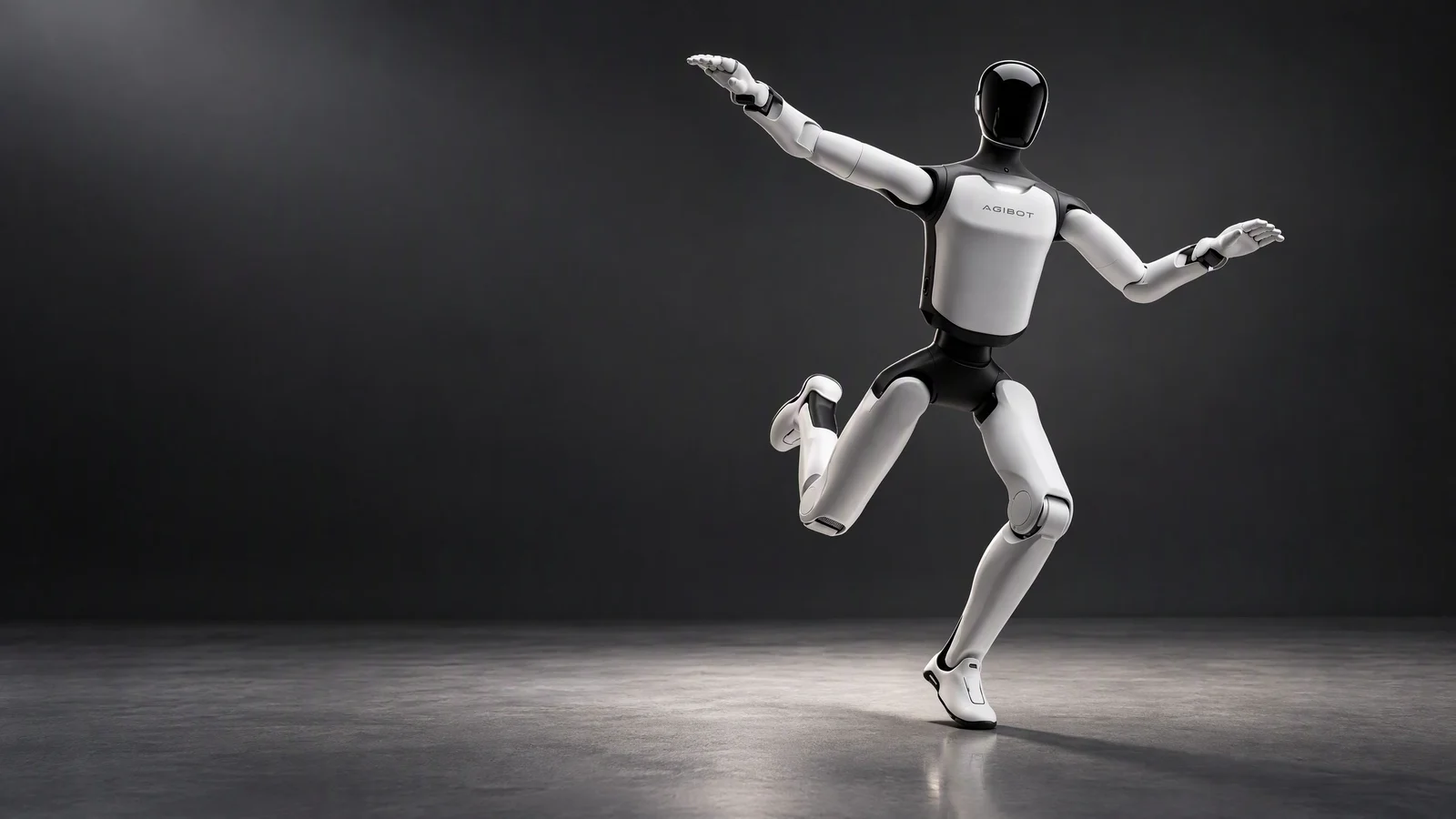
A business humanoid robot is a robot with a human form (head, torso, two arms, on legs or on a wheeled base) that performs tasks designed for human workstations: picking up a part, placing it in a test station, moving a tote, welcoming a visitor. The market moved from prototype to series production in 2026. According to IDC data published by AGIBOT on 30 September 20261, global humanoid shipments approached 25,000 units in the first half of 2026, including more than 8,600 from AGIBOT (around 35 % of the market). In September 20262, AGIBOT announced that its 20,000th production robot had rolled off the line.
For a French company, the question is no longer "does this exist?" but "on which workstation, for what gain, at what risk?". The industrial case best documented by a manufacturer is the AGIBOT G2 at Longcheer Technology, a customer of AGIBOT (not of RoboNex): loading and unloading tablets on a quality control line, up to 310 units per hour and over 99 % success in continuous operation, according to AGIBOT (April 2026)3. RoboNex, the official AGIBOT distributor in France, offers to verify this kind of gain on your own site through a proof of concept before any commitment.
What is a business humanoid robot, and how does it differ from a conventional industrial robot?
A business humanoid robot differs from a fixed robotic arm in its ability to work in an environment designed for people, without rebuilding the workstation. A conventional industrial arm is fast and precise, but it requires a cell, guarding and dedicated programming. A humanoid robot combines mobility, two arms, cameras and an AI model that lets it learn a task by demonstration. AGIBOT calls this "embodied AI": the software perceives, decides and acts in the physical world.
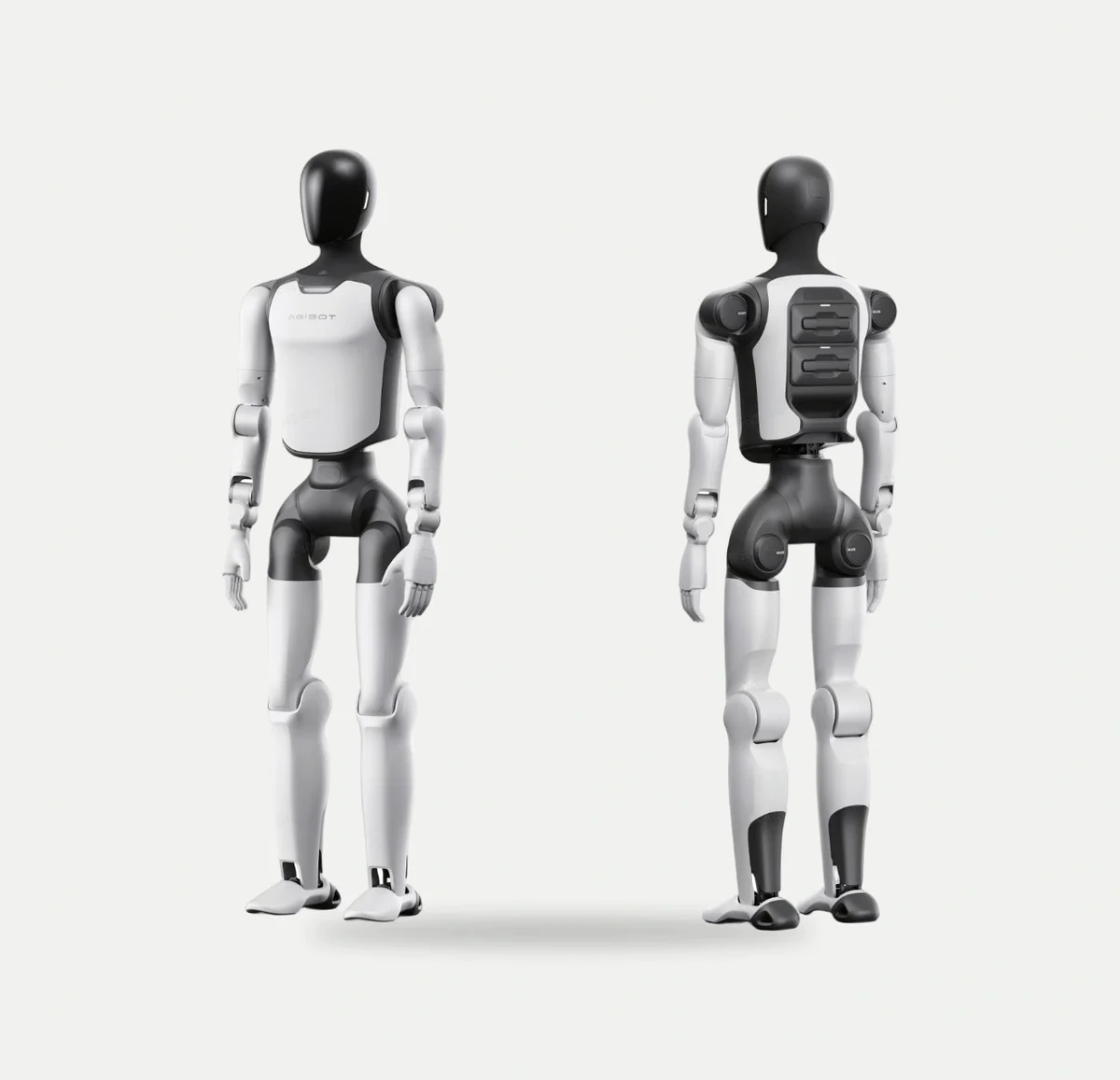
This versatility comes at a price: a humanoid robot is currently slower than a special-purpose machine on a single repetitive task. It makes sense when the workstation changes often, when the task requires two hands, or when there is no room for an enclosed cell.
| Criterion | Fixed industrial robot | Cobot | Humanoid robot |
|---|---|---|---|
| Mobility | None | Low (moved by hand) | Autonomous (wheels or legs) |
| Number of arms | One | One | Two |
| Changing task | Reprogramming | Simplified reprogramming | Learning by demonstration, as announced by manufacturers |
| Workstation integration | Dedicated cell | Adapted workstation | Existing human workstation, subject to a risk assessment |
| Industrial maturity | Very high | High | Being deployed (2026) |
For a detailed comparison of these three families, see our guide cobot, AMR or humanoid.
Which humanoid robot manufacturers already sell in volume?
Chinese manufacturers dominate humanoid robot shipments in 2026. AGIBOT ranks first worldwide in the first half of 2026 according to the IDC data it publishes (AGIBOT, 30/09/20261). Unitree sells entry-level models at public prices, such as the G14 and the R15, mainly aimed at research and education. In the United States, Tesla (Optimus), Figure and Agility Robotics are advancing their programmes, with commercial models still hard to obtain in France.
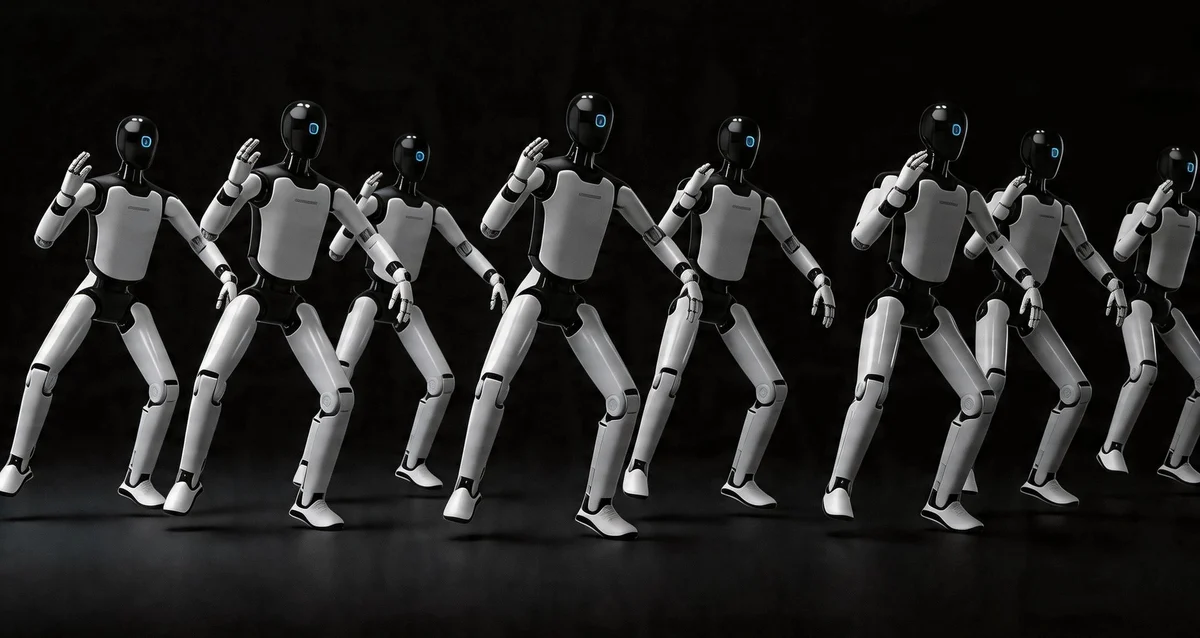
AGIBOT covers three families relevant to business: the G series (G2, G2 Max) for industrial tasks, the A series (A2, A3) for reception and presentation, and the more compact X series (X2). In April 20266, the manufacturer presented seven standardised solutions, notably for loading and unloading, industrial material handling, logistics sorting, retail and security patrols.
How much does a humanoid robot cost for a business?
The price of a humanoid robot for a business ranges from a few thousand dollars for a research model to several tens of thousands for an industrial model, before integration. The only reliable public prices concern the entry level: Unitree lists the G1 at 13,500 dollars and the R1 from 4,900 dollars, excluding taxes and shipping (unitree.com, accessed on 21/11/20264). Industrial models such as the AGIBOT G2 are sold on quotation (store.agibot.com7).
The purchase price is only part of the total cost: workstation integration, safety, software, training and maintenance come on top. Our page humanoid robot price details sourced market ranges and cost items.
What is the AGIBOT G2 worth for industry?
The AGIBOT G2 is a wheeled-base humanoid designed for industry: two arms with 7 degrees of freedom, 5 kg rated payload per arm and 10 kg with both arms, ±0.1 mm repeatability, two hot-swappable batteries for around 4 hours of runtime, according to the AGIBOT user manual (July 2026)8. AGIBOT announces automotive-grade components and IP42 protection on its product page9.
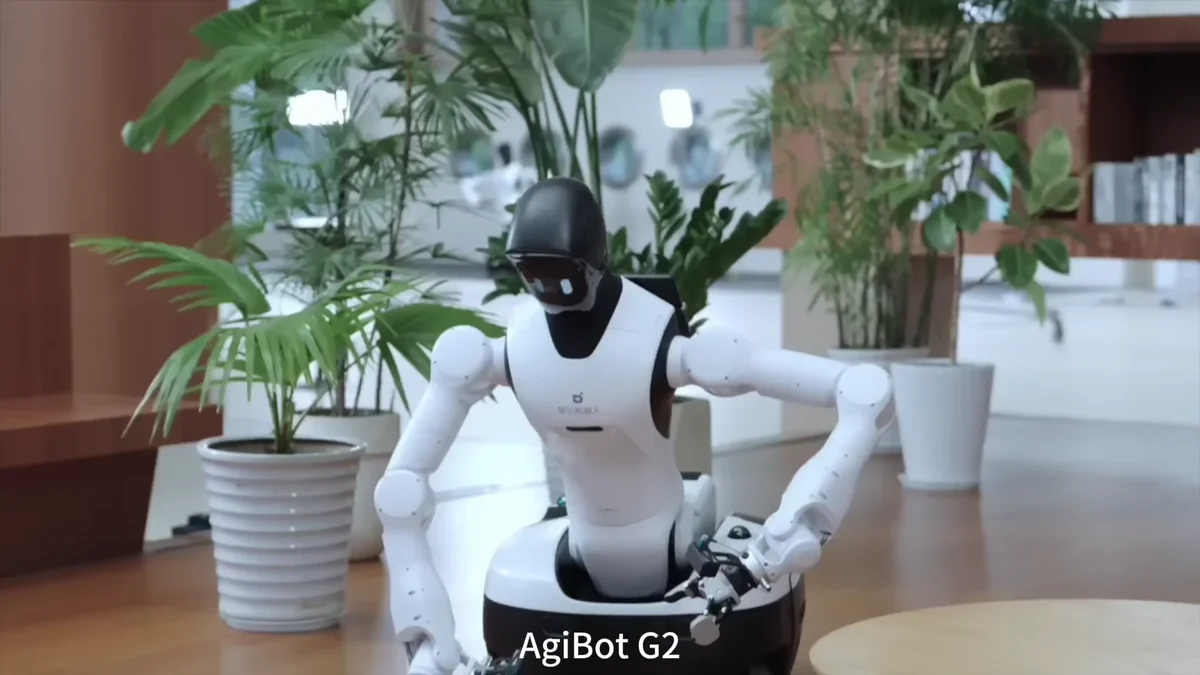
The G2 is the model of AGIBOT's 15,000th robot and the one deployed at Longcheer. All its official specifications, its uses and our approach are gathered on the AGIBOT G2 page.
What are the AGIBOT A2 and A3 used for?
The AGIBOT A2 and A3 are human-sized humanoids that walk on two legs, aimed at reception, presentation and performance rather than production. AGIBOT presents the A2 Ultra (169 cm, around 69 kg) as an exhibition hall guide able to welcome and direct visitors (A2 Ultra product page10). The A3 (173 cm) targets commercial performances, interactive entertainment, research and education (A3 product page11).
To compare the versions and find out which one suits a reception hall, a trade show or a showroom, see the AGIBOT A2 and A3 page.
Which industrial uses are realistic for a humanoid robot in 2026?
Realistic industrial uses in 2026 are repetitive two-handed tasks in a structured environment: loading and unloading machines or test stations, picking and placing parts, transferring totes between workstations, visual quality control. The AGIBOT G2 manual lists logistics handling, precision assembly, inspection and security patrols (G2 manual8).
Heavy or very fast tasks still call for other solutions. In July 202612, AGIBOT presented the G2 Max, the manufacturer's first model designed for heavy loads and palletising. Our page humanoid robot uses in industry details, workstation by workstation, what works, what remains to be proven and the alternatives.
Can you rent a humanoid robot for an event?
Renting a humanoid robot for a trade show, an opening or a product launch is a frequent request, and the AGIBOT A2 and A3 models are partly designed for these uses: AGIBOT highlights event promotion for the A2 Ultra (A2 Ultra product page10). RoboNex sells robots for purchase and does not offer direct rental. Any rental or leasing arrangement must be explored with a financing provider.
The page humanoid robot rental for events sets out the possible formats, the logistical constraints and the questions to ask before booking.
How do you deploy a humanoid robot without taking risks?
A humanoid robot is deployed in three phases: a proof of concept on a real workstation, integration into the production system, then scale-up with support. The proof of concept measures three indicators before any investment: the throughput achieved, the success rate and the human intervention time. A humanoid project schedule is set mission by mission, after analysing the requirements and workstation. The request is followed by a proof of concept, robot training for the mission and deployment. RoboNex defines the stages with you without stating a standard demonstration, pilot or commissioning duration.
Each humanoid project is tailored to the mission: your request, proof of concept at the workstation, 500 to 1,000 hours of robot training, then deployment. This indicative training effort prepares the robot for its future workstation and is separate from staff training. The requirements and mission determine the schedule: RoboNex sets it case by case, without applying cleaning or service robot lead times.
Our guide deploying a humanoid robot: the proof of concept describes each step, the deliverables, the success criteria and the role of each party.
Is a humanoid robot safe next to operators?
A humanoid robot can work near operators provided that a risk assessment of the workstation is carried out before commissioning, as for any machine. The AGIBOT G2 carries two lidars, eight ultrasonic sensors, depth cameras and torque sensors in its joints (G2 manual8), which enables it to detect obstacles and limit forces.
The European framework is about to change: Regulation (EU) 2023/1230 on machinery13 applies from 20 January 2027 (date corrected by the corrigendum published in the OJEU on 4 July 2023) and repeals the Machinery Directive 2006/42/EC on that date. CE marking of the robot and a risk assessment at the workstation remain the basis of any commissioning. CE conformity and French-language documentation for each model delivered in France are to be confirmed model by model. RoboNex includes this assessment in the proof of concept.
Which sectors in France are interested in humanoid robots?
The most advanced sectors are those combining repetitive tasks and labour shortages: electronics and assembly, automotive and suppliers, logistics and order preparation, quality control. The service sector follows, with reception, showrooms, museums and higher education. AGIBOT states that it has deployed its solutions in manufacturing, logistics, retail and public infrastructure (AGIBOT, April 20266).
For mobile logistics robots (AMRs), which are more mature for transporting loads, see our logistics robot pillar. Professional cleaning topics are covered on robot-laveuse-pro.fr, a RoboNex site.
To distinguish a demonstration from an operational workstation, start with industrial uses of humanoids, then define a workstation proof of concept. humanoid pricing and the return on investment calculation depend on that mission; the guides and contextualised videos place demonstrations in context.
A2 and A3 illustrate the difference between event presence and a mission requiring validation.
About RoboNex describes the team’s role and project support in France.
How RoboNex supports you
RoboNex SAS is the official AGIBOT distributor in France. Our approach follows three steps. First, a proof of concept on your site: choice of workstation, quantified objectives, risk assessment and a supervised trial. The availability of a demonstration unit in France is to be confirmed case by case. Next, integration: connection to your workstations and systems, team training, safety procedures. Finally, deployment and support: commissioning, maintenance, software updates and a direct link with the manufacturer.
We do not publish prices: each proposal is a quotation drawn up after studying the workstation. AGIBOT delivery lead times to France are given with the quotation . To start a study, use our contact page or see the AGIBOT in France page.
Frequently asked questions
RoboNex team · answers in French, English and Chinese
Which company makes humanoid robots?

The main humanoid robot manufacturers in 2026 are AGIBOT and Unitree in China, along with Tesla, Figure, Agility Robotics and Boston Dynamics in the United States. According to IDC data published by AGIBOT on 30 September 2026, AGIBOT is the world's leading manufacturer by volume in the first half of 2026, with more than 8,600 humanoids shipped.
Can you buy a humanoid robot in France?
Yes, a company can buy a humanoid robot in France, either directly from certain manufacturers for entry-level models, or through an official distributor for industrial models. RoboNex distributes AGIBOT in France and supports the purchase with a proof of concept, integration and support. Industrial models, such as the AGIBOT G2, are sold on quotation.
What does a humanoid robot cost?
The price of a humanoid robot depends on the model and the use. Public prices range from 4,900 dollars for the Unitree R1 Air to 13,500 dollars for the Unitree G1, excluding taxes and shipping, according to unitree.com on 21 November 2026. Industrial models, such as the AGIBOT G2, are on quotation. Integration, training and maintenance must be added. Details on our price page.
Can a humanoid robot replace an operator?
A humanoid robot takes over a task, not an entire job. In 2026, it performs well-defined repetitive movements (picking, placing, loading a workstation) at a measurable throughput, under supervision. Operators remain necessary for monitoring, unexpected situations and varied tasks. The proof of concept is precisely there to measure the share of the task that can really be automated.
How long does it take to deploy a humanoid robot?
A humanoid project schedule is set mission by mission, after analysing the requirements and workstation. The request is followed by a proof of concept, robot training for the mission and deployment. RoboNex defines the stages with you without stating a standard demonstration, pilot or commissioning duration.
Updated on 21 November 2026.
Sources and references (13)
- agibot.com/article/231/detail/125.html
- agibot.com/article/231/detail/123.html
- agibot.com/article/231/detail/60.html
- unitree.com/g1/
- unitree.com/R1/
- agibot.com/article/231/detail/62.html
- store.agibot.com/
- agibot.com/filepage/296.html
- agibot.com/products/G2
- agibot.com/products/A2_Ultra
- agibot.com/products/A3
- agibot.com/article/231/detail/85.html
- eur-lex.europa.eu/eli/reg/2023/1230/oj?locale=fr