


Key points
An indoor delivery robot is an autonomous mobile robot that transports items inside a building: room service and luggage in a hotel, medicines, samples and linen in a hospital, parcels, mail and supplies in an office building. It finds its way on its own, avoids obstacles, takes the lift and passes through equipped doors. Transport and logistics are the leading application of professional service robots worldwide, with 117,500 units sold in 2025, or 47% of the market, according to the IFR (30 September 2026)1.
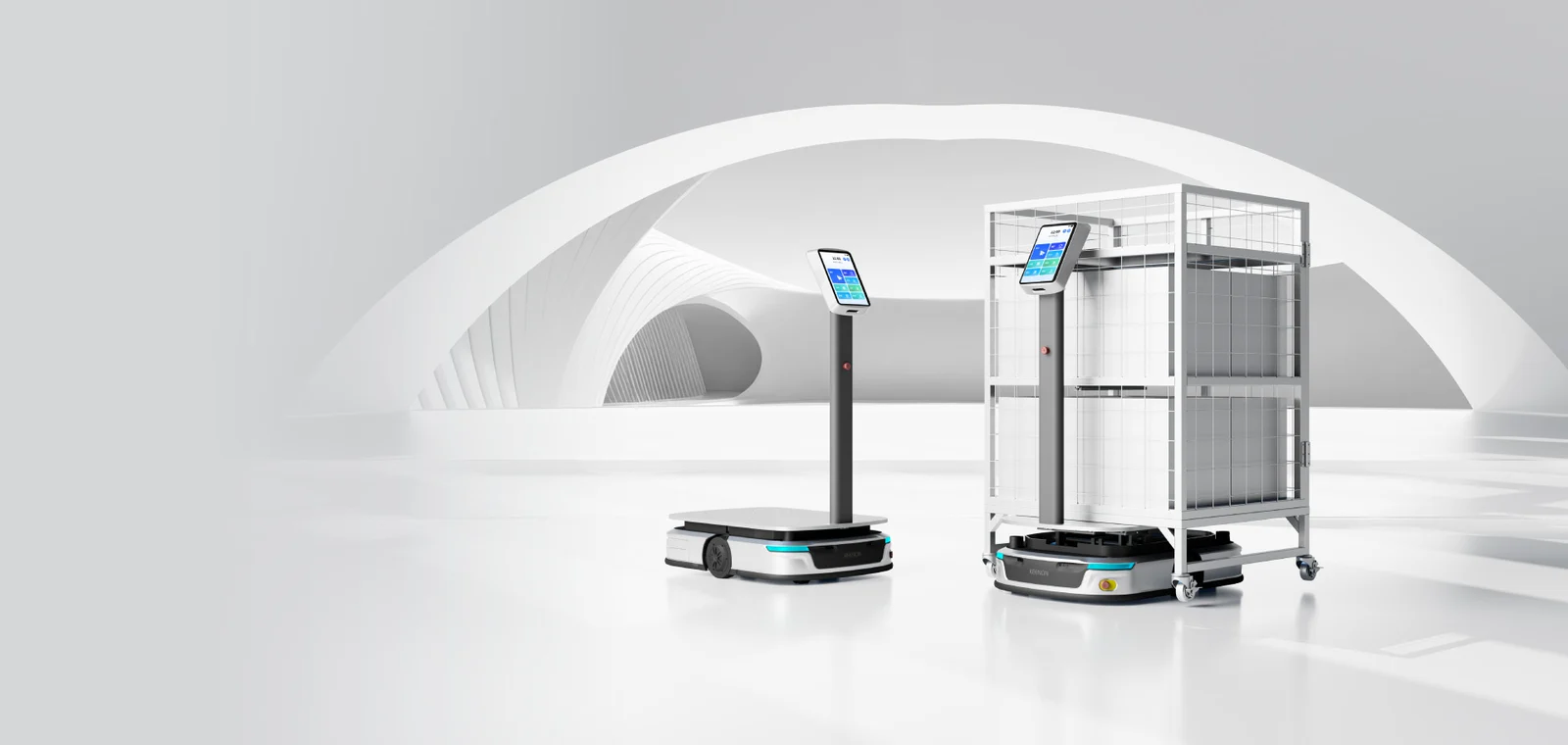
KEENON, for which RoboNex is the official distributor in France, covers this need with three models: the BUTLERBOT W3 (up to four closed compartments, 20 kg), the S100 (more than 100 kg) and the S300 (300 kg), according to their official data sheets consulted on 21 November 2026. This page deals with delivery inside buildings; pavement delivery robots and drones are different uses. For the overview, see our service robot pillar.
How does an indoor delivery robot work?
An indoor delivery robot works from a map of the building created during installation. A member of staff loads the item, selects the destination on the screen or from an app, and the robot sets off on its own. It calculates its route, avoids people and obstacles, calls the lift through a connected module and opens equipped doors. On arrival, the recipient collects the item from the compartment assigned to them. KEENON states that its robots integrate with building lifts and access systems (KEENON, property management2). The robot then returns to its base or moves on to another mission.
Which KEENON robots for indoor delivery?
KEENON offers three indoor delivery robots, which differ in payload and format. The table sets out the official data.
| Feature | BUTLERBOT W3 | S100 | S300 |
|---|---|---|---|
| Payload | 20 kg in total | more than 100 kg | 300 kg |
| Format | up to 4 closed compartments | 865 × 600 mm platform | lifts shelving up to 1,200 × 1,200 mm |
| Battery life | up to 12 h | 8 h | 6 h at full load |
| Charging time | 6.5 h | 2.5 h | 3.5 h |
| Maximum speed | 0.8 m/s | 1 m/s | not stated |
| Minimum passage | 70 cm | 90 cm | not stated |
| Lift | connected module | not stated | not stated |
| Robot weight | 48 kg | 87.5 kg | 115 kg |
Sources: W33, S1004, S3005. The W3 is used for items that need protecting and are delivered to a room or office; the S100 and S300 for bulky loads.
Which delivery robot for a hotel?
For a hotel, the most suitable delivery robot is one with closed compartments that takes the lift, such as the BUTLERBOT W3. It delivers room service, guest amenities and forgotten items to the upper floors, around the clock (24/7). KEENON also describes luggage delivery from the lobby to the room by a high-payload robot, with 10 minutes per delivery versus 30 minutes on foot in a typical 518-room hotel (KEENON, hospitality6), a manufacturer figure. The restaurant dining room calls for a different type of robot, presented on robot-serveur.com, a RoboNex site. Hotel uses are detailed on our robots for hotels page.
Which delivery robot for a hospital?
In a hospital, the delivery robot carries medicines, samples, equipment, linen and waste between the pharmacy, laboratories, stores and wards. KEENON cites the central pharmacy, sample transport, operating theatres, central sterilisation and supply logistics (KEENON, healthcare7). The manufacturer distinguishes delivery, which relieves nurses at peak times, from heavy restocking, handled by a high-payload robot for linen and medical waste. Sensitive items require closed compartments and controlled access. Our robots for nursing homes (EHPAD) and hospitals page details these uses.
Which delivery robot for an office building?
In an office building, the indoor delivery robot carries parcels, mail, documents and supplies from reception to the doors of offices or apartments. KEENON presents this scenario in its property management solution, with a typical example of 200 deliveries handled for a single staff member, and stresses that it removes congestion at reception (KEENON, property management2). The manufacturer highlights the multiple compartments, which allow several deliveries per trip, and integration with lifts. In a high-rise building, turnstiles and badge-access doors are the first point to check.
Can a delivery robot work without Wi-Fi?
Most indoor delivery robots need a network to receive missions, call the lift and report their status to the supervision system. The KEENON S300 is an exception according to its manufacturer: it works offline, without Wi-Fi, without 5G and without a central control system, and is deployed in about one day without magnetic tape or QR codes on the floor, versus three to six months for a traditional installation (S300 data sheet5). These are the manufacturer's data. For a robot that takes the lift, network coverage in the car and on the landings still needs to be checked.
What prerequisites for installing an indoor delivery robot?
An indoor delivery robot requires a building that has been checked before the model is chosen.
| Point to check | Why |
|---|---|
| Corridor width | at least 70 cm for the W3, 90 cm for the S100 |
| Slopes and thresholds | 7 degrees maximum for the W3 according to its data sheet |
| Lift | connection module and agreement of the maintenance company |
| Doors and turnstiles | access control module to be planned |
| Network | Wi-Fi coverage of corridors, landings and lift cars |
| Charging | location away from circulation routes, dedicated socket |
| Volumes | number of deliveries per day to size the fleet |
Delivery depends on the building: robots in hospitality raise questions about floors, while robots in healthcare and nursing homes involve routes and vulnerable people. reception robots serve a different mission; compare the KEENON ranges and safety and ISO 3691-4 before selecting a mobile solution.
How RoboNex supports you
RoboNex SAS is the official distributor of KEENON in France. For an indoor delivery project in a hotel, a healthcare facility or an office building, RoboNex follows three steps. First, a proof of concept: technical visit, survey of routes and volumes, testing of the lift, doors and network, then a trial on a real route with defined indicators (deliveries per day, walking time avoided, incidents). Next, integration: mapping, connection to lifts and access points, destination configuration, team training. Finally, deployment and support. Every proposal is quoted individually, with no catalogue price. To request an assessment: contact page or KEENON in France.
Frequently asked questions
RoboNex team · answers in French, English and Chinese
What is an indoor delivery robot?

An indoor delivery robot is an autonomous mobile robot that transports items inside a building, such as a hotel, a hospital or an office building. It moves on its own using a map of the site, avoids obstacles, takes the lift and delivers in closed compartments. It differs from pavement delivery robots, which are designed for public roads.
How much does a delivery robot cost?
The cost of an indoor delivery robot depends on the model, the payload, the number of robots, the lift and access modules, integration with the building and maintenance. KEENON does not publish prices on its W3, S100 and S300 data sheets. RoboNex does not publish catalogue prices: every proposal is a quotation after a visit, for purchase, long-term rental or a service-inclusive formula.
Can a delivery robot take the lift?
Yes. KEENON's BUTLERBOT W3 takes the lift on its own thanks to a connected module, and KEENON states that its delivery robots integrate with building lifts and access systems. The lift must be compatible and its maintenance company must accept the interface. This is the first point checked during the technical visit, because it determines delivery to upper floors.
What payload can a delivery robot carry?
The payload of an indoor delivery robot ranges from a few kilos to several hundred depending on the model. At KEENON, the BUTLERBOT W3 carries 20 kg spread across up to four compartments, the S100 more than 100 kg and the S300 300 kg, by lifting shelving up to 1,200 × 1,200 mm. The choice depends on what you deliver and on the width of the corridors.
Is a delivery robot safe among the public?
An indoor delivery robot moves at reduced speed (0.8 m/s maximum for the W3, 1 m/s for the S100 according to KEENON) and detects obstacles in order to stop or go around them. It remains a machine: a risk assessment of the route, particularly in areas used by elderly people or children, is carried out before commissioning, during the proof of concept.
Updated on 21 November 2026.