


Key takeaways
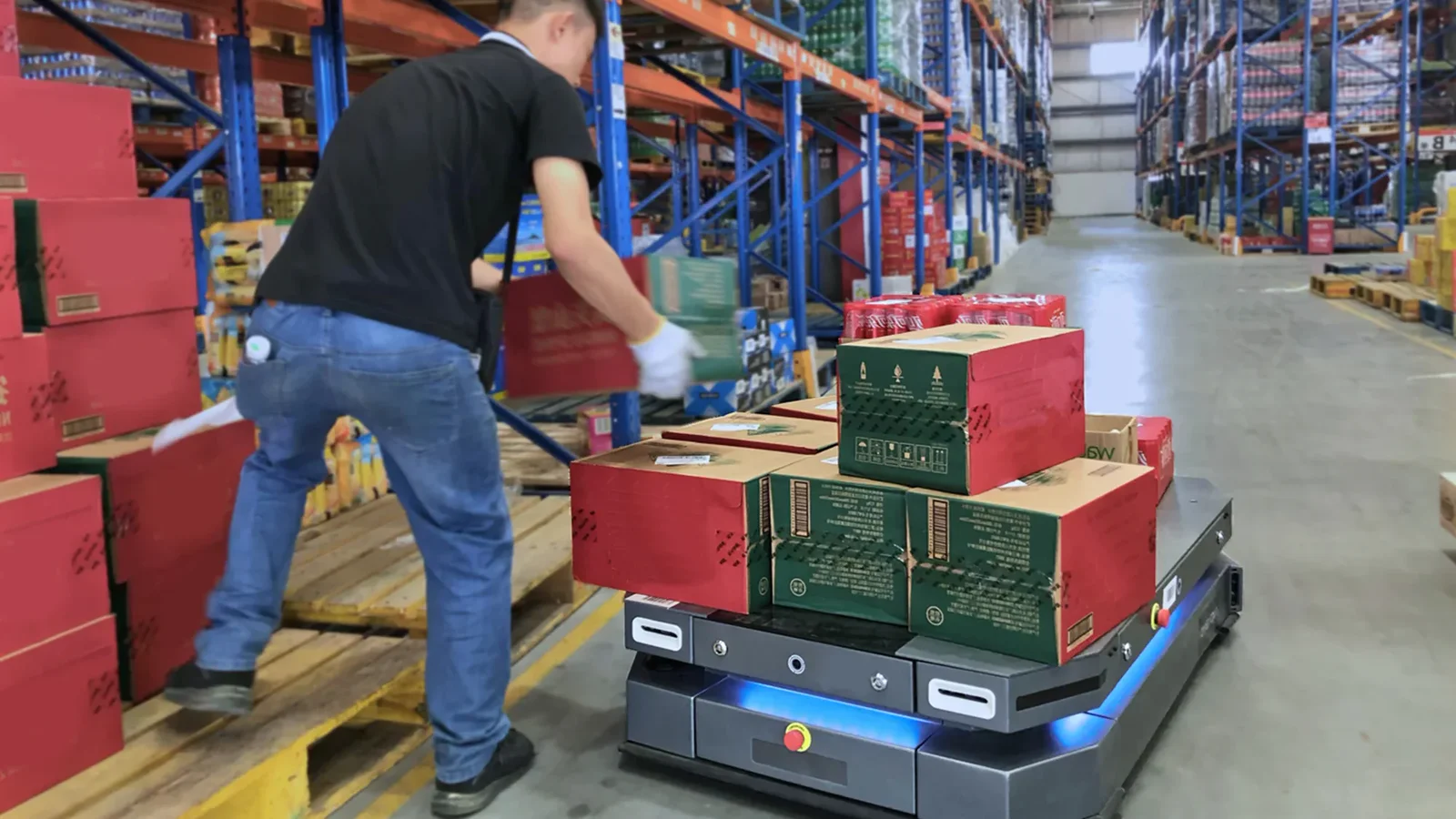
An autonomous mobile robot (AMR) is a driverless transport robot that locates itself on a map built by its own sensors, then plans its route around obstacles. According to INRS1 (the French occupational health and safety institute, journal Hygiène et sécurité du travail no. 273, December 2023), AMRs move "freely, without a driver or remote operator" to handle pallets, totes, shelves, cartons or assembly parts, and deploying them "requires no or few changes to the existing infrastructure".
The AMR is driving the growth of professional service robotics. The IFR2 counted 117 500 transport and logistics robots sold worldwide in 2025, up 21 %, or 47 % of professional service robots (press release of 30 September 2026). The manufacturer ForwardX, for which RoboNex is the official distributor in France, states on its home page3 more than 4 500 AMRs and more than 250 deployments (accessed on 21 November 2026).
What is an autonomous mobile robot (AMR)?
An autonomous mobile robot is a machine that carries a load from one point to another, choosing its own route within a defined area. The AMR perceives its environment in 2D or 3D, uses this to map the work area and locate itself in it, then adapts its path in real time to obstacles, INRS explains.
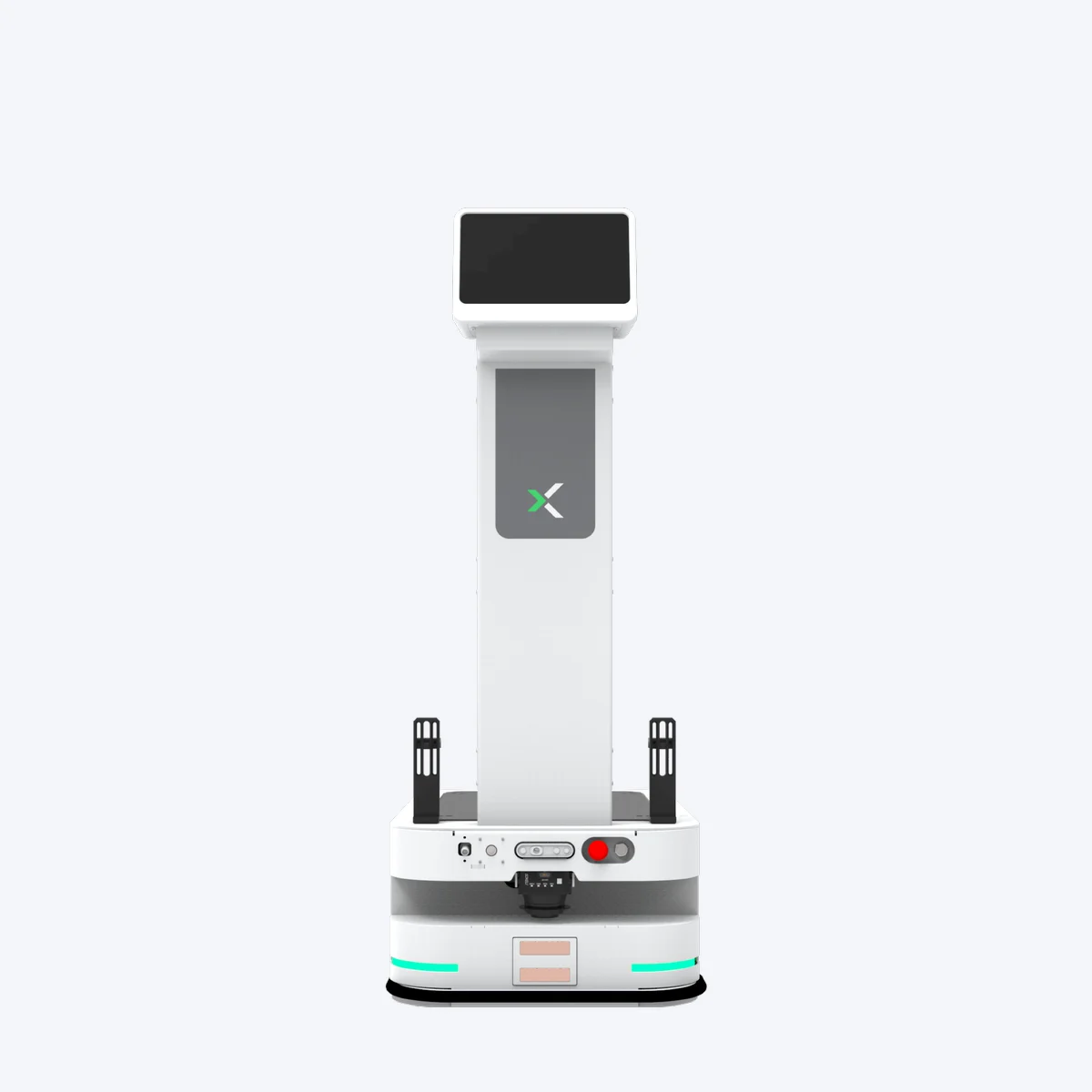
INRS places AMRs in the family of "autonomous mobile machines". It points out that lithium batteries, more compact than lead-acid, have made small robots possible, able to carry a single carton or tote. AMRs thus complement conventional driverless trucks, which are mostly used for loads of several hundred kilos. This page is part of our logistics robot guide.
How does an AMR robot find its way?
An AMR finds its way by comparing what its sensors see with a map of the area, a technique called SLAM (simultaneous localisation and mapping). The AMR does not need a wire or floor tape, but it can rely on markers when the site requires it.
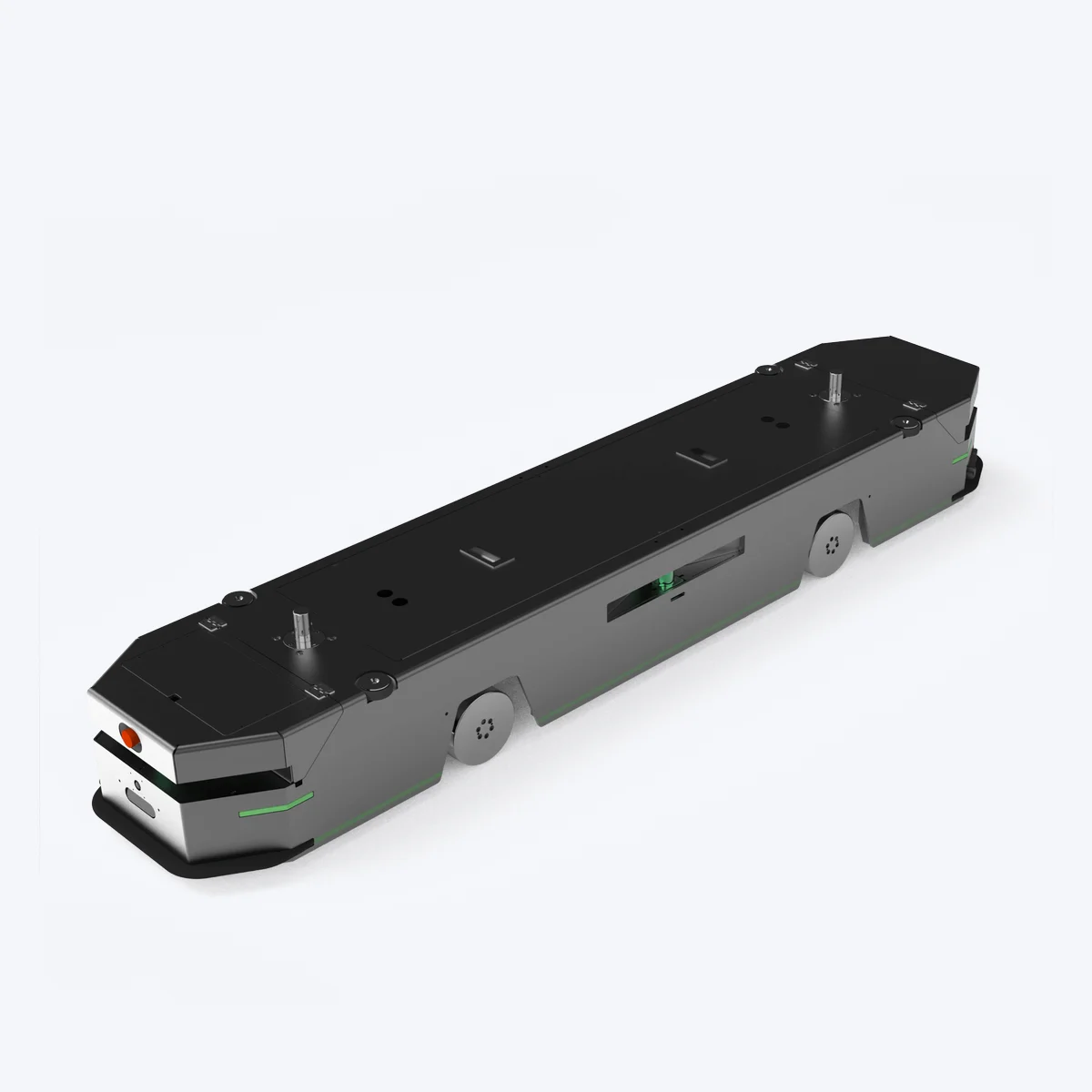
The product sheets of the ForwardX Flex range4 illustrate these options. They list four positioning modes (laser SLAM, vision, floor QR codes, wall QR codes) and three navigation modes: optimal route calculated in real time, predefined route network, or hybrid mode. The Max range5 adds an operator-following mode. Choosing a mode therefore means striking a balance between freedom of movement and predictability for teams.
What is an autonomous AMR robot made of?
An autonomous AMR combines a motorised base, perception sensors, safety devices, a battery and a wireless link to the fleet software. The table sets out the components published by ForwardX for a compact model.
| Component | Role | Published example (ForwardX Flex) |
|---|---|---|
| LiDAR | Measuring distances, mapping, detecting obstacles | 4 LiDARs |
| Cameras | Recognising obstacles, reading visual markers | 1 front wide-angle camera, 1 front 3D camera |
| Odometry and inertial measurement unit | Estimating movement between two measurements | 1 odometer, 1 IMU |
| On-board safety | Stopping the robot, alerting people | Safety bumpers, emergency stop, audible and visual alarm |
| Load module | Lifting or carrying the load | 60 mm lift, 300 kg (Flex 600) |
| Battery | Working autonomy | About 8 hours per charge |
| Communication | Receiving missions from the fleet | Wi-Fi 802.11 a/b/g/n/ac, 4G or 5G as an option |
ForwardX also states on its technology6 page that its AMRs use vision to distinguish people, manual trucks, pallet jacks, other AMRs, pallets and cartons.
What can an autonomous AMR robot carry?
An autonomous AMR carries anything that fits on its deck or under its forks, within the limit of its rated payload. The public ForwardX ranges give an order of magnitude:
- Flex4 robots carry totes, cartons or light shelves, up to 300 kg;
- Max5 robots move racks and pallets, up to 1 500 kg (Max 1500-L) and 2 500 kg (Max 2500-L);
- Apex7 autonomous forklifts handle Euro pallets, with for example 1 400 kg and a 1 600 mm lift for the Apex 1400-L.
How do you manage a fleet of AMR robots?
A fleet of AMRs is managed by software that receives orders from the information system, assigns missions, and manages traffic and charging. Without this software, several robots in the same aisles would get in each other's way.
The ForwardX f(x) Fleet Manager8 describes these functions: AMR mapping and deployment, task orchestration, traffic control ("traffic controller"), real-time communication with wireless charging stations, fleet monitoring and sensor diagnostics. It interfaces with other systems through open APIs and offers several order picking strategies depending on whether the warehouse serves business or consumer customers.
Autonomous AMR or AGV: which should you choose?
An AGV follows a route referenced in the building; an autonomous AMR chooses its route on a map. The AGV suits stable flows separated from pedestrians; the AMR suits changing flows and shared aisles. INRS specifies that, in standards terms, AMRs are considered AGVs: both fall under the same safety standard.
The line is blurred, since many AMRs can also run on a network of fixed routes. Our AGV vs AMR comparison details the selection criteria, from guidance to the cost of changes.
What are the limits of an autonomous AMR robot?
The first limit of an autonomous AMR is detection: its safety laser scanners "do not cover 100 % of impact or crushing risks", writes INRS1. Their detection field is a plane parallel to the floor: raised forks or the basket of an aerial work platform can escape the robot.
INRS adds that AMRs are often presented as "safe" and "ready to use", which is a mistake: a site-specific risk assessment remains essential. A forbidden zone on the map is only a software safeguard. In a June 2026 note9, INRS points out that "a technological barrier remains" and that organisational measures (signage, keeping areas clear, training) still cover the residual risks.
Which standard governs the safety of an AMR robot?
The safety of an AMR falls under ISO 3691-4:2023, which deals with driverless industrial trucks and their systems. INRS cites two requirements visible on site: speed must be reduced within 500 mm of an object, and hazardous zones must be marked on the floor.
In regulatory terms, an AMR is machinery subject to Directive 2006/42/EC, then to Regulation (EU) 2023/1230 from 20 January 2027, the date set by the 2023 corrigendum10. Our ISO 3691-4 standard page details the content of the standard and how responsibilities are shared.
To choose an architecture, the AGV versus AMR comparison complements these navigation principles. Then relate AMR pricing to the actual robotic material handling or order picking flow and check safety and ISO 3691-4 on site.
Contextualised demonstrations and guides help compare observed scenes with the intended flow, without treating them as a throughput guarantee.
How RoboNex supports you
RoboNex SAS is the official distributor in France of ForwardX, whose Flex, Max, Apex and Lynx ranges and f(x) Fleet Manager software cover the needs described on this page. RoboNex also distributes AGIBOT and KEENON. Our approach:
- Proof of concept on your site: mapping of a test area, choice of navigation mode, trials with your loads and your teams, before and after measurements.
- Integration: fleet configuration, connection to the WMS or MES, zoning and floor marking, risk assessment with you, training.
- Deployment and support: gradual ramp-up, maintenance and adjustment of missions.
The customer references cited by ForwardX belong to the manufacturer, not to RoboNex. For the brand, see ForwardX France; for a site study, contact us.
Frequently asked questions
RoboNex team · answers in French, English and Chinese
What does AMR mean in robotics?

AMR stands for Autonomous Mobile Robot. The term refers to a transport robot that locates itself on a map built with its LiDARs and cameras, and plans its route while avoiding obstacles. INRS points out that other trade names are in use (AIV, IGV, mobile platform) but that these machines all fall under the same standard.
What is the battery life of an AMR robot?
Battery life depends on the model, the load and the number of missions. ForwardX states, for example, about 8 hours per charge for its Flex and Max 1500-L ranges, and about 7 hours for the Max 2500-L. For continuous operation, the fleet software sends robots to charge in turn, which is sized during the site study.
Can an autonomous AMR robot move among operators?
Yes, that is in fact its purpose, but under certain conditions. The robot slows down and stops in front of a detected person, although according to INRS this does not cover every case. You therefore need to define shared areas, mark hazardous zones on the floor, limit speeds, keep aisles clear and train everyone involved, including cleaning staff and visitors.
How long does it take to deploy AMR robots?
ForwardX claims on its website a deployment in 4 weeks, a manufacturer figure that varies from site to site. The actual lead time depends on mapping, the interface with the information system, safety arrangements and training. A proof of concept on a limited area makes it possible to establish a realistic schedule before scaling up.
Updated on 21 November 2026.
Sources and references (10)
- inrs.fr/media.html?refINRS=DO%2042
- ifr.org/ifr-press-releases/news/global-sales-of-professional-service-robots-surge-24-perce
- forwardx.com/
- forwardx.com/flex-series/
- forwardx.com/max-series/
- forwardx.com/innovative-technology/
- forwardx.com/apex-series/
- forwardx.com/fx-fleet-manager/
- inrs.fr/media.html?refINRS=NO%2049
- eur-lex.europa.eu/legal-content/FR/TXT/?uri=CELEX:32023R1230R%2801%29