


Key takeaways
There is no single price for an AMR robot: the price depends on the type of robot, its payload, the number of units and, above all, the software and integration. The guide published by the specialist outlet Warehouse Revolution1 (6 June 2026, US market) gives these orders of magnitude for purchase: 25 000 to 75 000 dollars for a "goods-to-person" AMR, 30 000 to 80 000 dollars for a transport or towing AMR, and 80 000 to 150 000 dollars for an autonomous forklift, per robot.
The robot is only part of the bill. The same source estimates a system of 20 "goods-to-person" robots in a mid-sized distribution centre at between 800 000 and 2 million dollars, including software, integration and deployment. The alternative is subscription rental (RaaS): the IFR2 notes that this model continues to grow in popularity and is already dominant in the United States (press release of 30 September 2026). RoboNex does not publish any prices: each project is quoted after a site study.
How much does an AMR robot cost in 2026?
An AMR robot costs from a few tens of thousands to more than one hundred thousand dollars depending on its category, according to published estimates. These figures are ranges from the US specialist press, with no value as a quotation for a French site. This page complements our logistics robot guide.
| Item | Published range | Source |
|---|---|---|
| "Goods-to-person" AMR, per robot | $25 000 to 75 000 | Warehouse Revolution, June 2026 |
| Transport or towing AMR, per robot | $30 000 to 80 000 | Warehouse Revolution |
| Autonomous forklift, per robot | $80 000 to 150 000 | Warehouse Revolution |
| Fleet management software, set-up | $50 000 to 200 000, plus annual licence | Warehouse Revolution |
| WMS integration | $20 000 to 100 000 depending on complexity | Warehouse Revolution |
| Mapping and deployment services | $10 000 to 50 000 | Warehouse Revolution |
| Complete system of 20 robots | $800 000 to 2 000 000 | Warehouse Revolution |
| RaaS subscription, per robot per month | $1 500 to 4 000 | Warehouse Revolution |
None of the manufacturers distributed by RoboNex publishes list prices on the pages consulted: neither the ForwardX product sheets nor the RaaS page.
Why is the robot price not enough to budget an AMR project?
The robot price is not enough because an AMR is never "plug-and-play", as INRS3 (the French occupational health and safety institute, journal Hygiène et sécurité du travail no. 273, December 2023) points out. Its integration "always requires configuration, testing and adaptations to the environment".
In practice, a complete AMR budget includes: mapping and mission programming, the fleet software and its interface with the WMS or MES, charging stations, Wi-Fi coverage, safety arrangements (floor marking, barriers in front of docks or stairs, signage), the risk assessment, team training, then maintenance and annual licences. Comparing two offers on the robot unit price alone almost always leads to unpleasant surprises.
Which factors affect the price of an AMR robot?
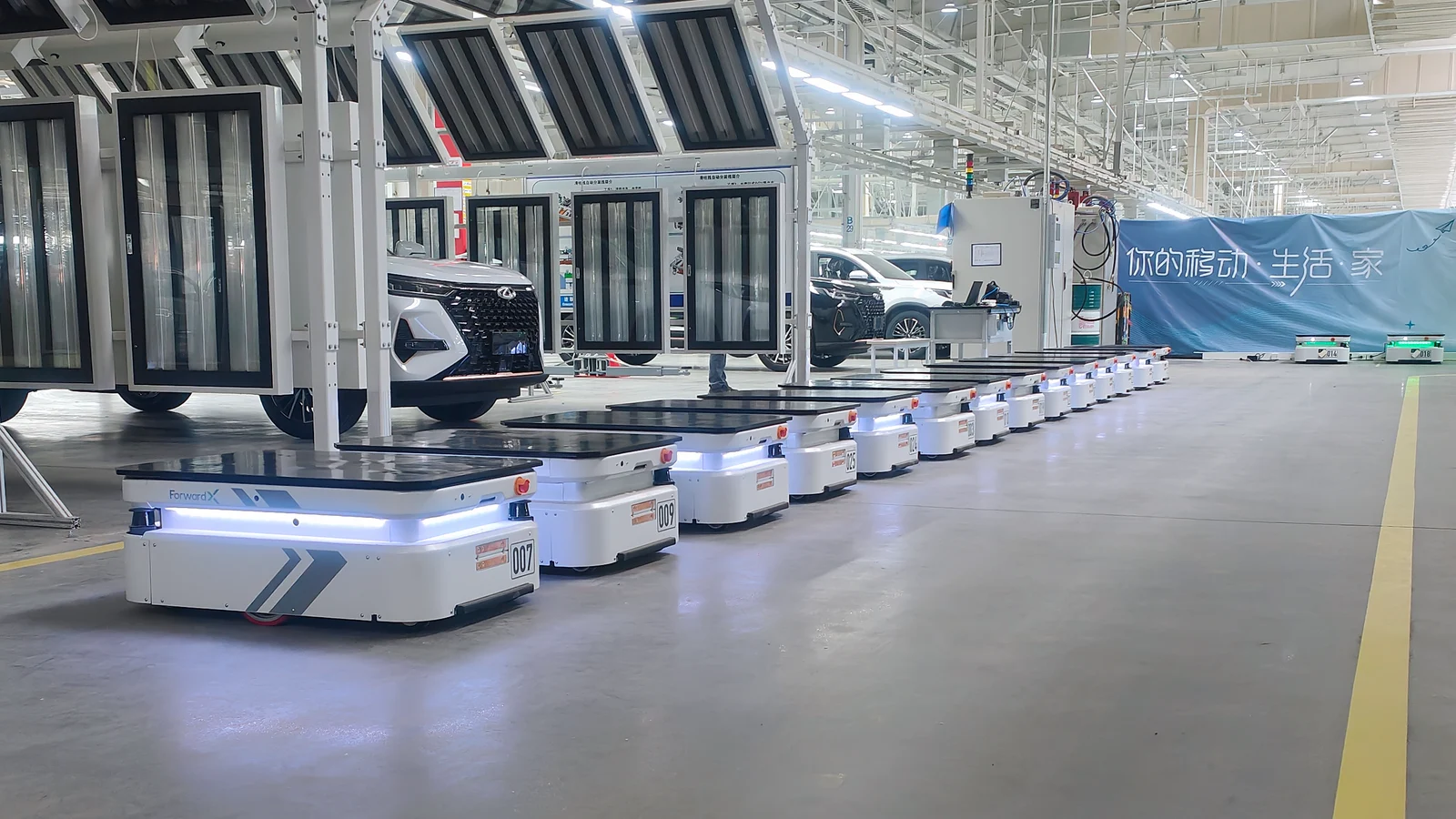
The price of an AMR robot varies first with the payload and the handling function, then with fleet size and integration complexity. The table illustrates these factors using the public ForwardX ranges.
| Factor | Effect on cost | Example (ForwardX ranges) |
|---|---|---|
| Payload | The heavier the load, the more expensive the chassis and motors | Flex4 up to 300 kg; Max5 up to 2 500 kg |
| Function | Lifting, forks and stacking add mechanics and sensors | 60 mm lift (Flex) or 145 mm (Max 2500-L); forks at 1 600 mm (Apex 1400-L6) |
| Number of robots | Software and integration are spread over more units | Fleet controlled by f(x) Fleet Manager7 |
| Navigation | Floor or wall markers (QR codes) to install if the site requires them | Laser SLAM, vision or QR codes depending on the range |
| Interfaces | WMS, MES, automatic doors, conveyors, lifts | Third-party APIs of the fleet software |
| Site safety | Adaptations, marking, risk assessment, braking tests | INRS recommendations |
| Operation | Maintenance, licences, batteries, support | Depending on the contract |
What is the ForwardX RaaS offer?
The ForwardX RaaS (Robots as a Service) offer is a subscription giving access to its autonomous mobile robots without an upfront purchase. On its RaaS page8, ForwardX presents this model as a way of treating automation as "operating expenditure" rather than a "large upfront investment", with "minimal" initial costs.
ForwardX highlights flexibility: when activity increases, additional robots are supplied and activated quickly. The page covers the Apex, Flex, Lynx and Max ranges. However, it publishes no rates, no commitment period and no details of the services included. The terms of this offer in France, through RoboNex, are confirmed at the quotation stage.
Buying or renting an AMR robot: how do you compare?
To compare buying and renting an AMR robot, both options must be reduced to a total cost over the same period, services included. Buying gives ownership and suits long, stable use. RaaS or rental suits testing, absorbing seasonality or growing a fleet without tying up cash.
| Criterion | Purchase | RaaS or rental |
|---|---|---|
| Initial outlay | High | Low |
| Accounting | Depreciated investment | Operating expense |
| Maintenance and updates | Separate contract | Often included, to be checked |
| Adding robots | New purchase | Added during the contract |
| Long-term cost | Generally lower | Generally higher |
Our robot financing pillar page details finance leasing, financial rental and grants.
What return on investment can you expect from an AMR robot?
The return on investment of an AMR robot depends on labour costs, utilisation rate and the quality of the integration; published figures diverge. ForwardX claims on its home page9 a payback in 5 to 9 months and 50 % operating savings (manufacturer figures).
Warehouse Revolution, for its part, models a payback of 18 to 36 months for a system of 20 robots, and reports paybacks of two to three years observed on "goods-to-person" systems, citing the 2024 annual report of the US association MHI. For your site, only a measurement of your flows and a proof of concept allow a reliable calculation.
How do you get a reliable quotation for an AMR robot?
A reliable quotation is based on a precise specification. INRS3 recommends that it describe:
- the environment: floor condition and slipperiness, slopes, doors, possible obstacles, lighting, temperature;
- the people present in the area and their routes;
- the robot's tasks: load pick-up and drop-off, charging, routes;
- the loads: type, dimensions, weight, stability;
- the interfaces: conveyors, machines, sectional doors, information system.
Add your volumes (lines or pallets per hour, seasonal peaks) and your operating hours. The more precise this data, the smaller the gap between quotation and final cost.
To price the full flow, specify robotic material handling or order picking, then select an architecture using the AGV versus AMR comparison. The return on investment calculation tests benefits, while robotics grants and subsidies require case-by-case eligibility checks.
How RoboNex supports you
RoboNex SAS, official distributor of ForwardX in France (as well as AGIBOT and KEENON), prices every project on quotation, after a study of your site:
- Proof of concept: measurement of your flows, trials on a test area, estimate of the number of robots needed.
- Integration: choice of models, fleet software, interfaces, safety arrangements and training, costed item by item.
- Deployment and support: maintenance and addition of robots, on a purchase basis (RoboNex does not yet offer a rental formula).
See also ForwardX France and our AGV vs AMR comparison, or request a study.
Frequently asked questions
RoboNex team · answers in French, English and Chinese
What is the price of an AMR robot?

According to Warehouse Revolution estimates (June 2026, US market), a transport AMR costs from 30 000 to 80 000 dollars, a "goods-to-person" AMR from 25 000 to 75 000 dollars and an autonomous forklift from 80 000 to 150 000 dollars. Software, integration and deployment come on top. A quotation after a site study remains essential.
Why doesn't RoboNex publish its prices?
Because a list price would be misleading. The cost of a project depends on the number of robots, the range, the interfaces with your information system, the safety arrangements and the maintenance contract. RoboNex therefore prices each project after a site study, item by item, so that the quotation matches the real cost.
How much does it cost to rent an AMR robot?
Warehouse Revolution mentions RaaS subscriptions of 1 500 to 4 000 dollars per robot per month in the United States. ForwardX offers a RaaS subscription but does not publish a rate. RoboNex sells its robots outright and does not yet offer a rental plan: in France, a rental goes through a financing company, and the rent depends on the term, the services included and the number of robots.
Is an AMR robot profitable for an SME?
It can be, provided you start from a measured flow: distances travelled, number of lines, staff involved. INRS observes that AMRs are spreading to SMEs that previously had little involvement with automated handling. Starting with a few robots on a specific flow, possibly rented, limits the risk before scaling up.
What recurring costs should you plan for after purchase?
You need to plan for the annual fleet software licence, maintenance, replacement of wear parts and batteries, support, and updating the risk assessment whenever zones or missions change. These costs should be compared over the project's lifetime, and some are included in RaaS packages.
Updated on 21 November 2026.
Sources and references (9)
- warehouserevolution.net/automation/autonomous-mobile-robots/
- ifr.org/ifr-press-releases/news/global-sales-of-professional-service-robots-surge-24-perce
- inrs.fr/media.html?refINRS=DO%2042
- forwardx.com/flex-series/
- forwardx.com/max-series/
- forwardx.com/apex-series/
- forwardx.com/fx-fleet-manager/
- forwardx.com/raas/
- forwardx.com/