


Key takeaways
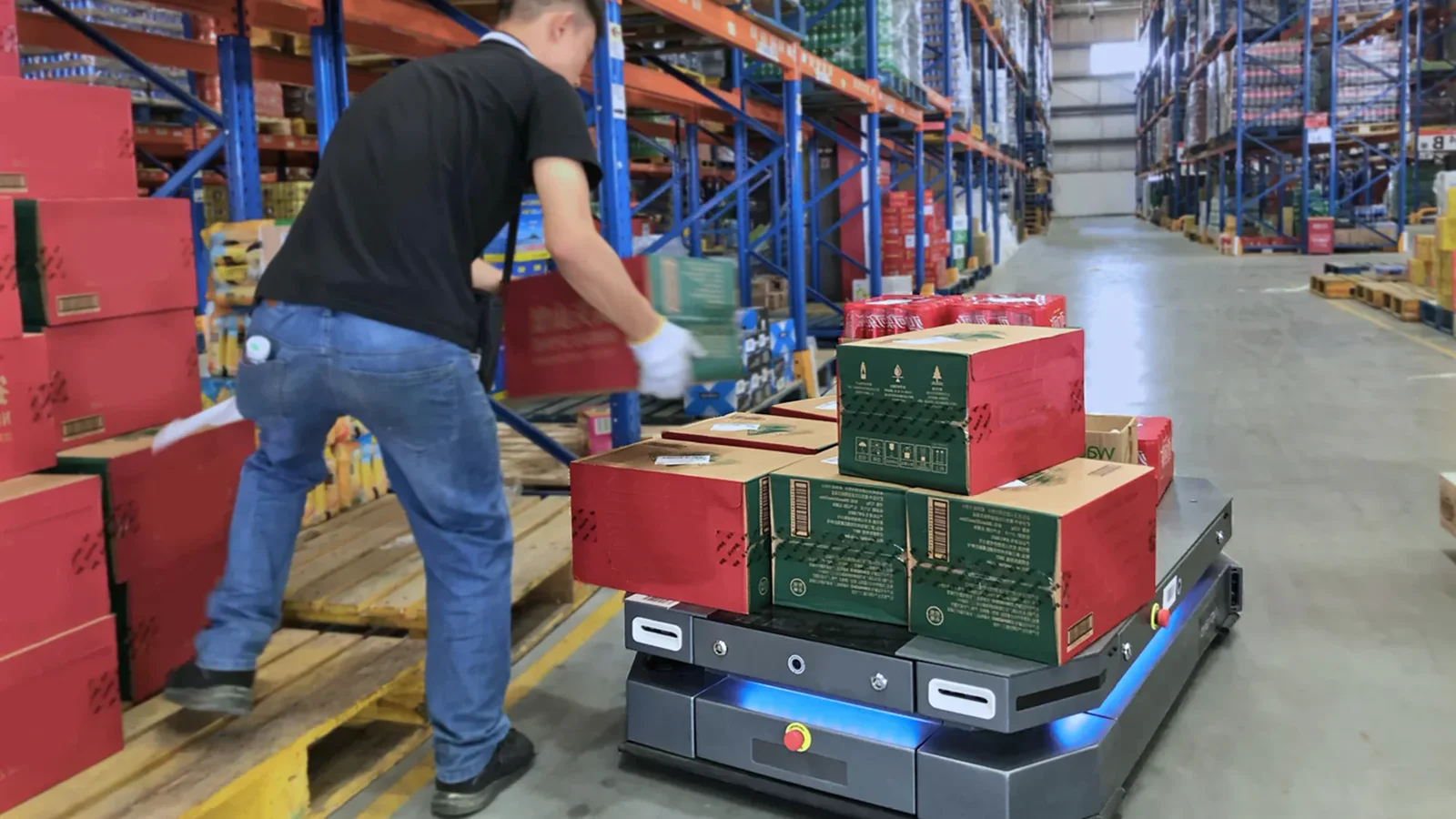
A logistics robot is a machine that moves, picks or stores goods without a driver, in a warehouse or a factory. In practice, this mostly means mobile robots: automated guided vehicles (AGVs), autonomous mobile robots (AMRs) and autonomous forklifts. It is the largest market in professional service robotics: according to the IFR1 (press release of 30 September 2026), 117 500 transport and logistics robots were sold worldwide in 2025, up 21 %, or 47 % of all professional service robots.
Automating a logistics warehouse with these robots no longer necessarily means rebuilding the facility. INRS2 (the French occupational health and safety institute) observes that AMRs are deployed with few or no changes to the infrastructure, including in SMEs. ForwardX, for which RoboNex is the official distributor in France, states on its website3 that more than 4 500 AMRs and more than 250 deployments are in operation (accessed on 21 November 2026). The safety of all these robots falls under a single standard, ISO 3691-4:20234.
What is a logistics robot?
A logistics robot is automated equipment that moves or handles loads within the internal supply chain: goods receipt, storage, order picking, line replenishment and dispatch. The term covers very different machines, from fixed automated storage systems to robots that travel along the aisles.
This page covers mobile robots, which account for most sales. The IFR specifies that transport and logistics robots are mainly used for transport and the automation of material flows. In regulatory terms, they are machinery subject to the Machinery Directive 2006/42/EC, then to Regulation (EU) 2023/1230 from 20 January 2027. In terms of standards, they are driverless industrial trucks.
Which warehouse tasks can a logistics robot automate?
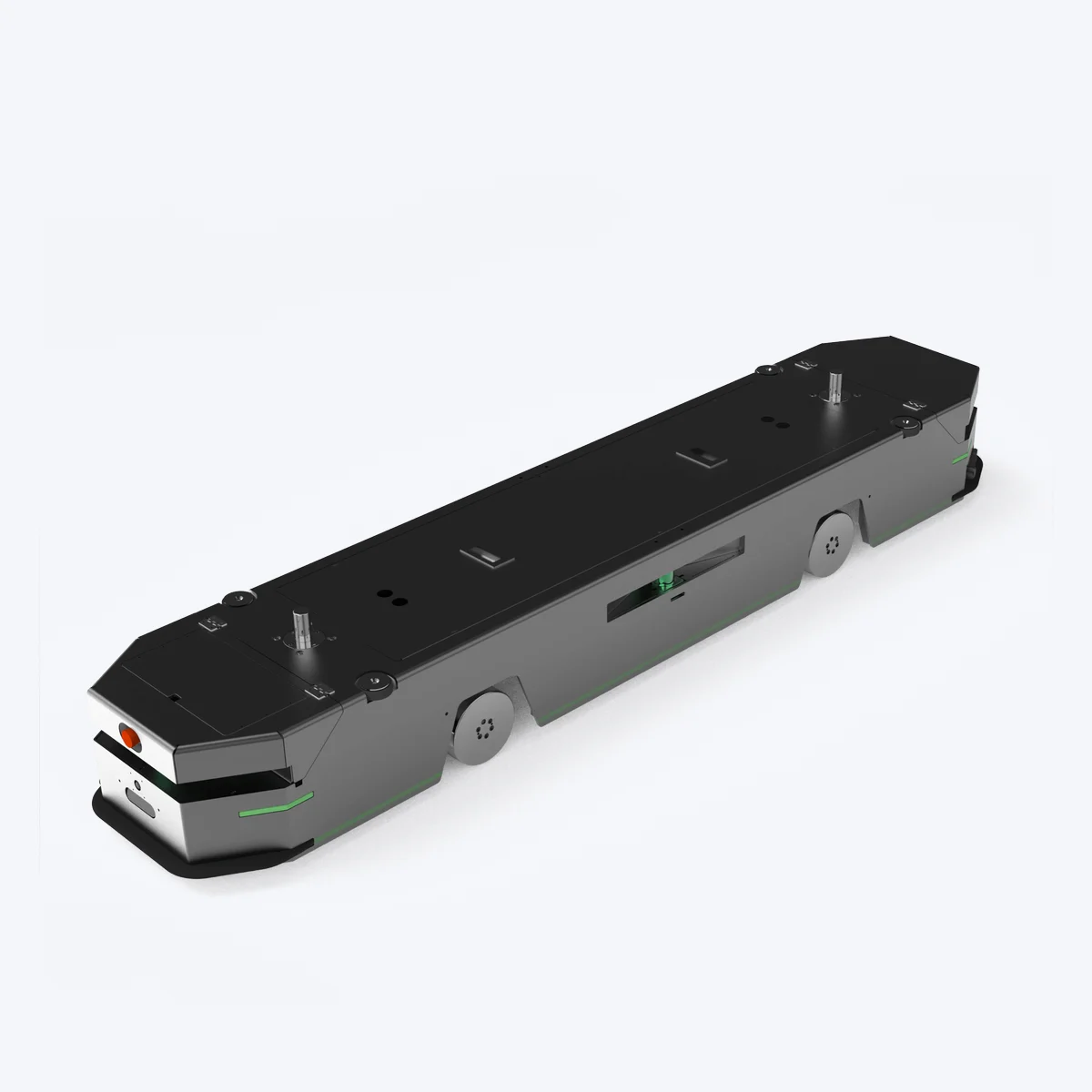
A logistics robot first automates travel, which takes up a large share of pickers' and forklift drivers' time. The table below matches common tasks with robot types, using examples from the ForwardX ranges.
| Task | Robot type | Example range (ForwardX) | Payload stated by the manufacturer |
|---|---|---|---|
| Piece picking, tote transport | Compact AMR | Flex 3005 | 300 kg (Flex 300-L) |
| Transport of shelves, carts or parcels | Lifting or towing AMR | Flex 600 | |
| Case or pallet picking, rack moving | Heavy-duty AMR | Max6 | 1 500 kg (Max 1500-L), 2 500 kg (Max 2500-L) |
| Pallet transport and stacking | Autonomous forklift | Apex7 | 1 400 kg (Apex 1400-L, 1 600 mm lift) |
| Line feeding in automotive plants | Industrial AMR | Lynx8 | Depending on model |
| Fleet control, WMS and MES interface | Fleet management software | f(x) Fleet Manager9 | Not applicable |
Fine handling tasks, such as grabbing an item from a tote, are still often done by the operator, whom the robot comes to and guides. Humanoid robots are starting to be tested on these movements: see humanoid robots in industry.
What is an autonomous mobile robot (AMR)?
An autonomous mobile robot, or AMR, is a transport robot that locates itself on a map built by its own sensors (LiDAR, cameras) and plans its route around obstacles. It does not follow a wire or a floor tape, which means it can be deployed in an existing building and its missions can be changed in software.
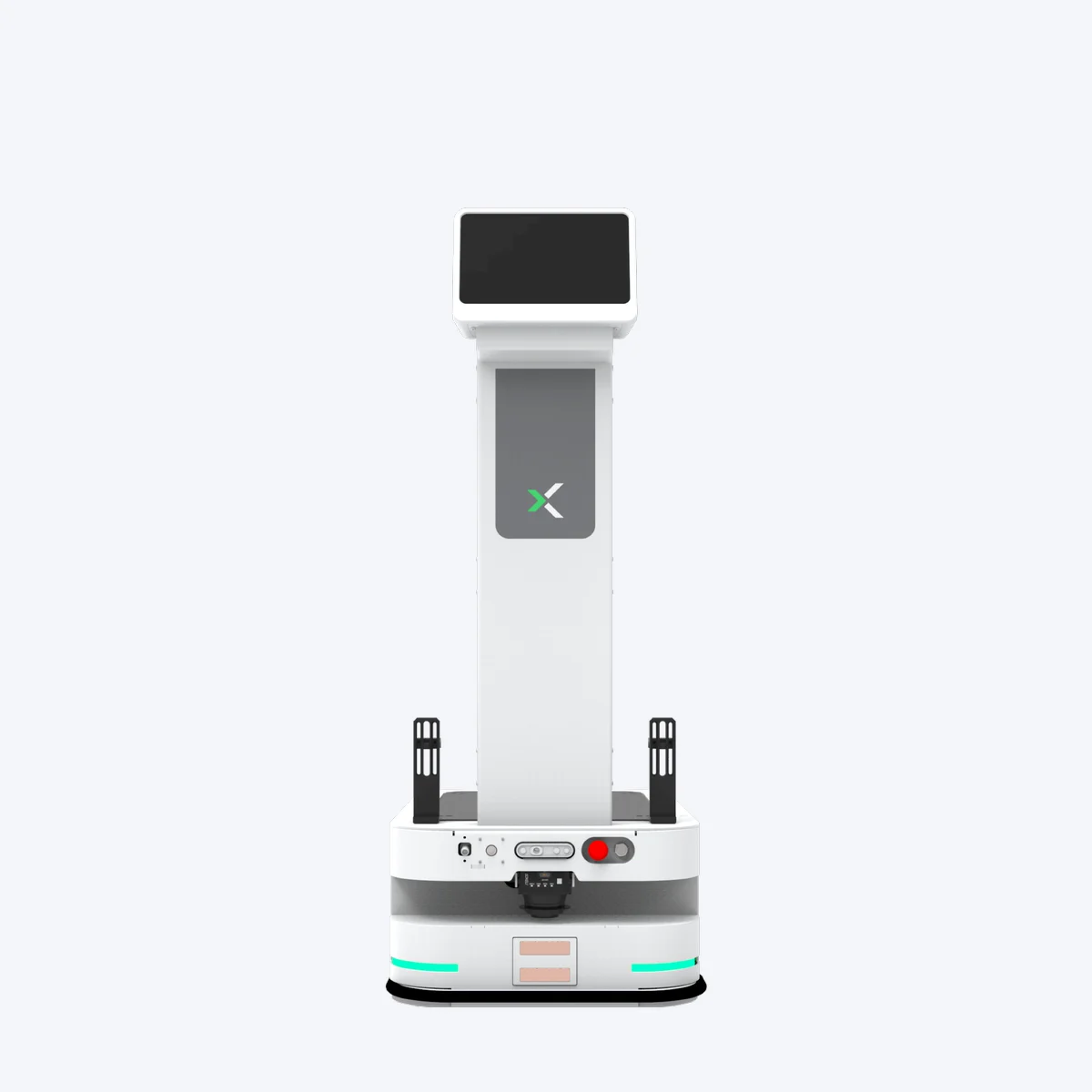
The AMR is now the basic building block of warehouse automation. Our autonomous mobile robot (AMR) page explains how it works, its sensors, fleet management and its limits.
What is the difference between an AGV and an AMR?
An AGV follows a route that is physically marked or referenced in the building, whereas an AMR navigates using a map and adapts its path. The AGV is more rigid but highly predictable; the AMR is more flexible but requires closer management of areas shared with pedestrians. Both fall under the same safety standard.
The line between them is not always clear, as many AMRs can also run on a network of fixed routes. Our AGV vs AMR comparison sets out a criterion-by-criterion table: guidance, navigation, flexibility, infrastructure, cost of changes, safety and use cases.
How much does an AMR robot cost?
The price of an AMR depends on its payload, its functions (lifting deck, forks, towing), the number of robots, the fleet management software and the integration work. The price of the robot alone is not enough to assess a project: mapping, interfaces with the information system, training and maintenance all weigh on the total cost.
RoboNex does not publish prices: each project is quoted after a site study. Our AMR price page brings together public, sourced market ranges, cost drivers and financing options.
How does a robot automate order picking?
An order picking robot mainly eliminates the picker's walking. In the most common AMR model, the robot goes to the location, the operator places the item shown on the screen into it, then the robot heads to the dispatch area while another one arrives. The software batches orders and optimises routes.
This is how ForwardX describes the assisted picking function of its fleet software9: order batching, robot assignment, route optimisation and interaction with operators, with different strategies for B2B and B2C. Our order picking robot page details the methods and selection criteria.
Which robot for handling heavy loads and pallets?
For heavy loads, two families share the work: high-capacity AMRs, which slide under a rack or pallet and lift it, and autonomous forklifts, which reproduce the forklift driver's movements. The latter can pick up a pallet from the floor, stack it or place it on a conveyor.
The choice depends on lift height, pallet type, aisle width and coexistence with manual trucks. Our material handling robot page compares these solutions, from pallet transport to production line feeding.
Which standard governs the safety of logistics robots?
The reference standard is ISO 3691-4:2023, which covers driverless industrial trucks and their systems, both AGVs and AMRs. Its European version has been harmonised under the Machinery Directive since Implementing Decision (EU) 2024/132910, published on 15 May 2024: a robot designed to this standard is presumed to comply with the requirements it covers.
Regulation (EU) 2023/1230 replaces the directive on 20 January 2027, according to the corrigendum11 of July 2023. Our ISO 3691-4 standard page details its content, exclusions, dates and on-site requirements.
Where should you start when automating a logistics warehouse?
Start with the need, not the robot. INRS2 recommends drawing up a specification before any purchase, identifying:
- the working environment: floor condition and slipperiness, slopes, doors, possible obstacles, lighting, temperature;
- the people present in the area: operators, maintenance, cleaning staff, visitors, and their routes;
- the robot's tasks: load pick-up and drop-off, charging, routes to be used;
- the loads: type, dimensions, weight, stability;
- the interfaces: conveyors, machines, sectional doors, warehouse management system.
Next, measure your current flows (lines per hour, distances travelled, seasonal peaks) to set a quantified target. Finally, test on a limited scope before scaling up: one area, one flow, a few robots.
What gains can you expect from a logistics robot?
Gains depend on the site, and the published figures mostly come from manufacturers. ForwardX claims on its home page3 a return on investment in 5 to 9 months, productivity multiplied by 2 to 3, 50 % operating savings and deployment in 4 weeks (manufacturer figures). These values give an order of magnitude, not a promise for your warehouse.
The most consistent gains are qualitative: less walking and load carrying for teams, which INRS cites as a contribution to preventing musculoskeletal disorders, better traceability of movements and capacity that can be adjusted by adding robots. To estimate your own return, start from your measured flows and a proof of concept.
What are the risks and limits of a logistics robot?
The main risk is collision with a person, followed by crushing between the robot and a fixed object, and the robot or its load falling. INRS stresses that AMRs are sometimes presented as "safe" and "ready to use", which is a mistake: a site-specific risk assessment remains essential.
In a June 2026 note12, INRS adds that safety laser scanners do not cover every configuration and that safety still relies heavily on organisation: signage, keeping areas clear, information and training. A serious project plans these measures from the outset.
Select the flow before the robot: distinguish robotic material handling from order picking, then compare AMR pricing. safety and ISO 3691-4 and the return on investment calculation belong in the specification.
About RoboNex describes the team’s role and project support in France.
How RoboNex supports you
RoboNex SAS is the official distributor in France of ForwardX (AMRs and autonomous forklifts for intralogistics), as well as AGIBOT and KEENON. For a logistics robot project, our approach follows three steps:
- Proof of concept on your site: flow survey, mapping of a test area, trials with your loads and your teams, before and after measurement.
- Integration: choice of models (Flex, Max, Apex or Lynx), fleet configuration, interface with your WMS or MES, zoning and marking, risk assessment with you, training.
- Deployment and support: gradual ramp-up, maintenance, adjustment of missions as your flows change.
The customer references published by ForwardX belong to the manufacturer, not to RoboNex. To learn more about the brand, see our ForwardX France page, or contact us for a study of your site.
Frequently asked questions
RoboNex team · answers in French, English and Chinese
What is an autonomous logistics robot?

It is a robot that carries loads without a driver and without a route marked on the floor. It locates itself on a map built by its LiDARs and cameras, then chooses its route while avoiding obstacles. It is called an autonomous mobile robot, or AMR. It falls under ISO 3691-4:2023 and must bear the CE marking.
Can an SME automate its warehouse?
Yes. INRS observes that AMRs are also being installed in SMEs, which previously had little involvement with automated handling, because they require little building work. The safest approach is to start with a specific flow, a few robots and a measured proof of concept. The budget is then built on a quotation, depending on the number of robots and the integration required.
Can a logistics robot work alongside forklift drivers?
Yes, provided coexistence is organised. INRS points out that safety laser scanners detect in a plane close to the floor and may not see raised forks. You therefore need to define shared areas, mark hazardous zones on the floor, reduce speeds and train teams. Some AMRs also recognise trucks using vision.
Do you need to modify the building to install AMRs?
Generally very little. An AMR finds its way on a map of the area and needs neither wire nor floor tape. You still need to check floor condition, slopes, doors, Wi-Fi coverage and charging points, and sometimes install physical barriers in front of docks or stairs, which the map alone cannot forbid.
Are logistics robots used in hospitals?
Yes. ForwardX lists hospitals among its sectors, for internal transport of equipment. The environment is, however, different from a warehouse: presence of the public, lifts, hygiene. ISO 3691-4 actually excludes public areas. Our guide to robots in nursing homes and hospitals covers these uses.
Updated on 21 November 2026.
Sources and references (12)
- ifr.org/ifr-press-releases/news/global-sales-of-professional-service-robots-surge-24-perce
- inrs.fr/media.html?refINRS=DO%2042
- forwardx.com/
- iso.org/fr/standard/83545.html
- forwardx.com/flex-series/
- forwardx.com/max-series/
- forwardx.com/apex-series/
- forwardx.com/lynx-series/
- forwardx.com/fx-fleet-manager/
- eur-lex.europa.eu/legal-content/FR/TXT/?uri=CELEX:32024D1329
- eur-lex.europa.eu/legal-content/FR/TXT/?uri=CELEX:32023R1230R%2801%29
- inrs.fr/media.html?refINRS=NO%2049