


Key points
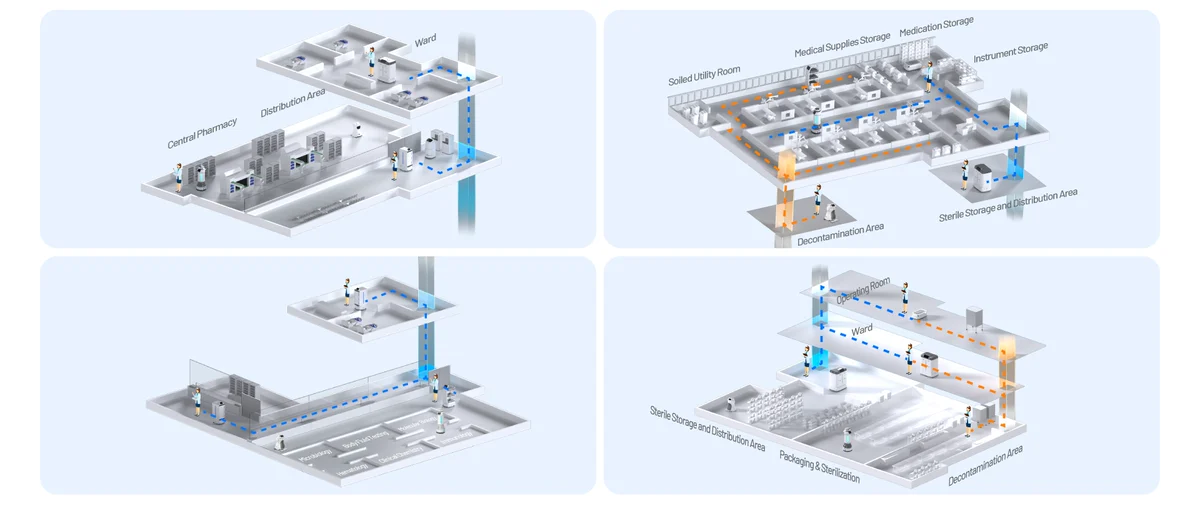
A robot in a nursing home (EHPAD) or hospital is first and foremost used for indoor logistics: transporting supplies, linen, medicines and samples from one department to another and from one floor to another, taking the lift on its own. It provides no care and does not replace human contact: KEENON presents its robots for care homes as "force multipliers" for care staff (KEENON, nursing homes1, consulted on 21 November 2026). In hospitals, the manufacturer cites the central pharmacy, sample transport, operating theatres, central sterilisation and supply logistics (KEENON, healthcare2).
Transport and logistics are the leading application of professional service robots worldwide: 117,500 units sold in 2025, or 47% of the market, according to the IFR (30 September 2026)3. RoboNex, the official distributor of KEENON in France, helps facilities test these robots on their own routes. For the overview, see our service robot pillar.
What is a robot used for in a nursing home?
A robot in a nursing home delivers to rooms and departments what staff currently carry on foot: medical supplies, linen, residents' personal parcels. KEENON describes robots that move on their own between floors and take the lift to deliver to rooms (KEENON1). The manufacturer illustrates this scenario with a typical facility where 2 staff handle deliveries and 100 requests per day. The aim is to give care staff back the time lost walking, so they can spend it with residents. The robot exchanges a few words with residents, but it is neither a companion robot nor an activity robot.
What is a robot used for in a hospital?
A robot in a hospital handles repetitive logistics flows between departments. KEENON highlights two logistics uses (KEENON, healthcare2): delivery (medicines, equipment, samples) to reduce congestion at peak times and the workload of nurses; and restocking, where a high-payload robot transports medical waste and brings linen, towels and supplies from the stores to the wards. The manufacturer highlights a dispatch and supervision platform that handles the control, tracking and analysis of each mission. The stated gains are qualitative: KEENON does not publish any figure for time saved in hospitals.
Which KEENON robots for a nursing home or hospital?
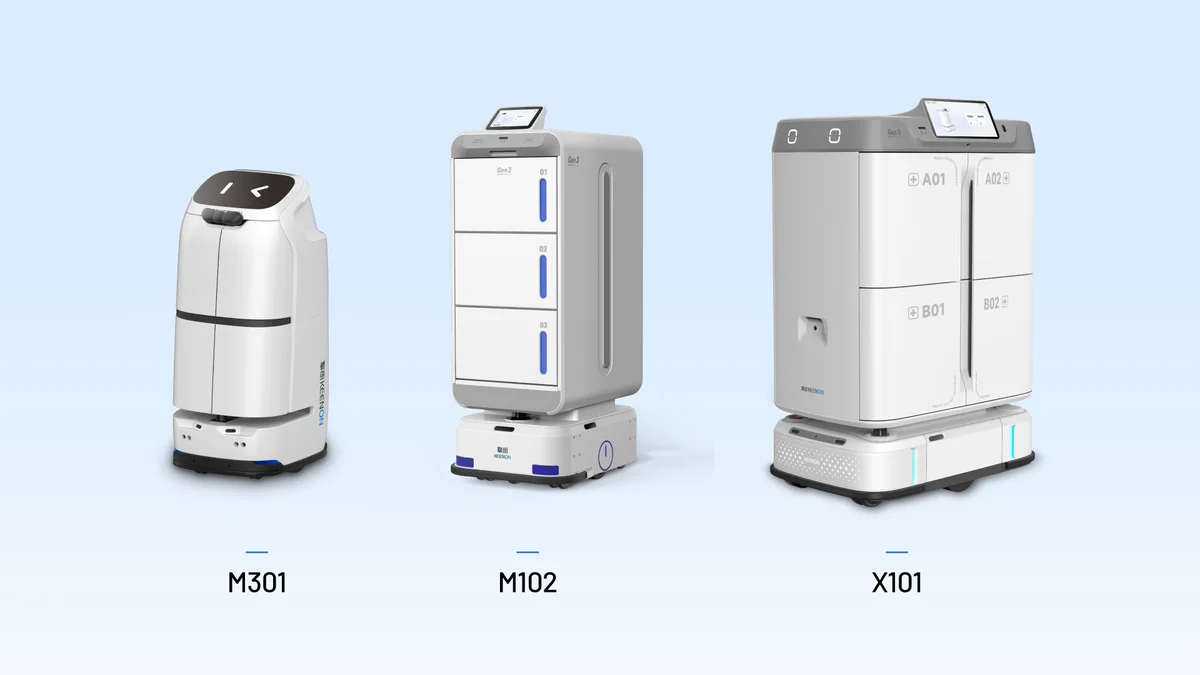
KEENON offers several families suited to healthcare, depending on the payload and the sensitivity of the items transported. The table sets out the published data.
| KEENON model | Healthcare use | Official data |
|---|---|---|
| BUTLERBOT W3 | delivery to rooms or wards, items to be protected | up to 4 independent compartments, 20 kg, up to 12 h, 70 cm passage, connected lift |
| S100 | transport of carts and bulky supplies | more than 100 kg, 8 h, 1 m/s, 90 cm passage |
| S300 | linen, waste, heavy restocking | 300 kg, shelving up to 1,200 × 1,200 mm, 6 h at full load |
| X101 and M102 | manufacturer's healthcare range | no technical data published on the pages consulted |
Sources: W34, S1005, S3006, X1017, M1028. KEENON's nursing home page also lists the W3 and S300 among the associated products.
What prerequisites for installing a robot in a healthcare facility?
A logistics robot in a healthcare facility requires a compatible building, checked before any choice of model. Corridors must leave at least 70 cm of passage for the W3 and 90 cm for the S100, according to KEENON's data sheets. If the robot changes floors, the lift must accept a connection module, with the agreement of the lift maintenance company. Fire doors and badge-access doors require an access control module, which KEENON lists among its accessories without detailing it. Wi-Fi must cover the whole route, and a charging area must be provided away from circulation routes. To compare indoor transport robots, see our indoor delivery robot page.
Can a robot transport medicines safely?
A robot can transport medicines if its compartments are closed and access is restricted to authorised people. The BUTLERBOT W3 has compartments with automatic doors, each accessible separately (W3 data sheet4). Locking by code or badge and traceability of each opening, which are essential for a pharmacy, must be checked model by model. The medication circuit remains the responsibility of the facility: the robot fits into the pharmacy's procedures, it does not replace them. This point is validated with the pharmacist and nursing management before the trial.
What are the limits of a robot in a nursing home or hospital?
A robot in a nursing home or hospital has clear limits. It provides no care and replaces neither care assistants nor nurses. It depends on the infrastructure: an incompatible lift or a cluttered corridor blocks the mission. It must share space with disoriented residents, walking frames and wheelchairs, which requires low speeds and carefully studied routes. Finally, the gains announced by manufacturers are typical scenarios: they are measured in your facility, on your real routes. Floor cleaning in healthcare facilities is covered on robot-laveuse-pro.fr, a RoboNex site.
For a healthcare facility, distinguish indoor robotic delivery from reception robots, then compare the organisation with robots in hospitality. safety and ISO 3691-4 informs mobile-machine risks without replacing care-specific requirements or local assessment.
How RoboNex supports you
RoboNex SAS is the official distributor of KEENON in France. For a nursing home, clinic or hospital, RoboNex follows three steps. First, a proof of concept: technical visit, survey of routes and volumes, checks on lifts, doors and network, then a trial on a real route with defined indicators (missions per day, walking time avoided, incidents). Next, integration: mapping, connection to lifts and access points, compartment configuration, team training. Finally, deployment and support. Distribution by RoboNex of the X101 and M102 healthcare models is to be confirmed. Every proposal is priced individually. To request an assessment: contact page.
Frequently asked questions
RoboNex team · answers in French, English and Chinese
Which robot for a nursing home?

The most useful robot in a nursing home is an indoor delivery robot, which carries supplies, linen and parcels between floors and takes the lift on its own. KEENON matches this need with the BUTLERBOT W3, with up to four compartments, and the S300 for heavy loads. Companion or activity robots meet a different need, stimulating residents, and come from other manufacturers.
Can a robot replace a care assistant?
No. A service robot in a nursing home provides no care and does not replace human relationships. It handles repetitive trips, such as delivering supplies or linen, to free up time for care staff. KEENON itself presents its robots for care homes as "force multipliers" for teams, not as replacements for staff.
Can a robot take the lift in a hospital?
Yes, some delivery robots take the lift on their own. KEENON states that its BUTLERBOT W3 uses the lift thanks to a connected module, and that its robots for care homes move between floors. This function requires a compatible lift and the agreement of its maintenance company for the interface. This is checked during the technical visit, before any commitment.
How much does a robot for a hospital or nursing home cost?
The cost of a robot for a healthcare facility depends on the model, the number of robots, the lift and access modules, integration with the building and maintenance. There is no meaningful price without a study of the routes. RoboNex does not publish catalogue prices: every proposal is a quotation after a visit, with purchase, long-term rental or a service-inclusive formula to compare.
What are the benefits of a logistics robot in a hospital?
A logistics robot in a hospital reduces repetitive trips for nurses and staff, smooths deliveries at peak times and improves the traceability of flows. KEENON also highlights a lower risk of infection and injury when transporting linen and waste. These benefits are stated by the manufacturer and are measured during an on-site trial.
Updated on 21 November 2026.