


Key points
A reception robot greets visitors, answers frequently asked questions, directs them to the right department and sometimes escorts them to a room, in a company lobby, a hotel, a showroom or a public-facing building. It absorbs repetitive requests and draws attention, but it does not replace a receptionist in complex situations. The IFR indicates that mobile guidance, information kiosks and telepresence make up most of the second-largest application of professional service robots worldwide, hospitality (IFR, 30 September 20261).
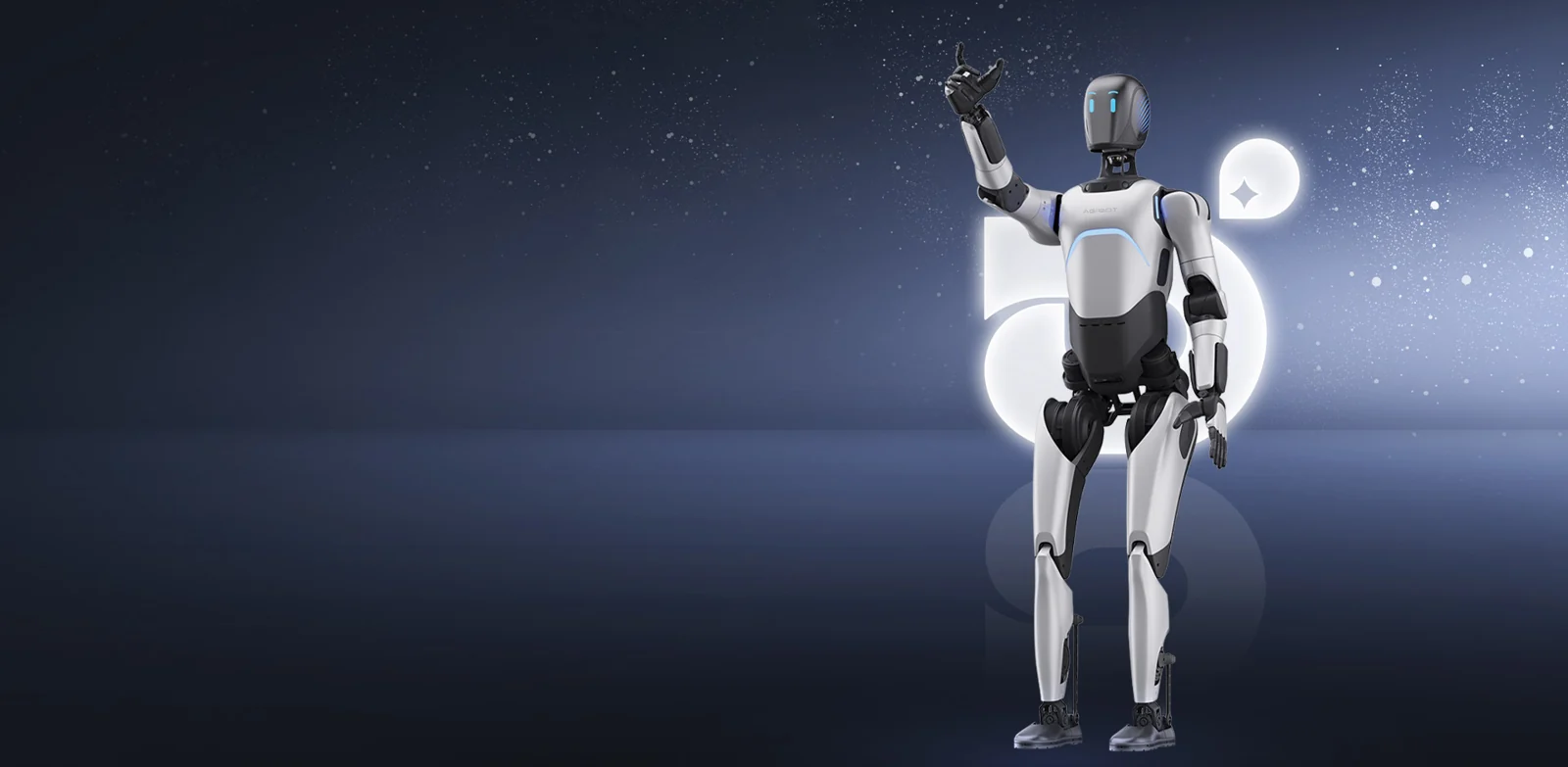
There are two approaches: the mobile service robot, which guides and informs, and the humanoid robot, which adds gestures and brand impact. AGIBOT presents the A2 Ultra as an exhibition hall guide and claims more than 1,000 units deployed (A2 Ultra data sheet2, consulted on 21 November 2026). RoboNex, the official distributor of AGIBOT and KEENON in France, helps you choose and test. For the overview, see our service robot pillar.
What does a reception robot do in a company?
A reception robot in a company greets visitors, answers repetitive questions (opening hours, rooms, departments, directions), directs them to the right contact and can escort them to a meeting room. It can also present the company or its products in a showroom. For the A2 Ultra, AGIBOT lists welcoming, route guidance and facial recognition greeting, as well as the role of brand ambassador with customised outfits (A2 Ultra data sheet2). The reception robot hands over to a human as soon as a request falls outside its scope: this is what the AGIBOT X2 does in ASD stores, where it passes the conversation on to the sales assistant (AGIBOT, 28 September 20263).
Mobile or humanoid reception robot: which to choose?
The choice between a mobile reception robot and a humanoid robot depends on the goal: informing efficiently or making a lasting impression. The table sums up the differences.
| Criterion | Mobile service robot (guidance) | Humanoid robot (AGIBOT A2) |
|---|---|---|
| Main role | guide, inform, escort | welcome, present, embody the brand |
| Effect on visitors | useful, discreet | highly visible, strong brand impact |
| Battery life | varies by model | 3 h standing, more than 1.5 h walking for the A2 Ultra |
| Gestures | none or limited | articulated arms and hands, facial expressions |
| Footprint | wheeled base | 169 cm, around 69 kg for the A2 Ultra |
| Supervision | low | operator and emergency stop nearby |
Sources: A2 Ultra data sheet2, IFR1. A high-traffic venue open all day often favours the mobile robot; a showroom or event often favours the humanoid.
Temporary entertainment requires a separate scope: see humanoids for events, without assuming a direct RoboNex rental offer.
Which reception robot models does RoboNex distribute?
RoboNex distributes reception robots from two manufacturers in France. At AGIBOT, the A2 Ultra is the reception model: 169 cm, 40 degrees of freedom, expressive face screen, microphone array, 3D lidar and cameras, autonomous navigation (A2 Ultra data sheet2). The A3 is aimed more at interactive entertainment, with up to 10 hours of battery life (A3 data sheet4). Details of both are on our AGIBOT A2 and A3 page. AGIBOT has also made in-store guidance and assistance one of its seven standardised solutions (AGIBOT, 17 April 20265). At KEENON, reception is part of the hotel solution, with autonomous navigation in the lobby (KEENON6); the XMAN7 humanoid range is listed without published specifications.
How does a reception robot answer questions?
A reception robot answers questions using a knowledge base prepared by the company and a voice dialogue engine. On the AGIBOT A2 Ultra, the LinkSoul platform is used to configure the knowledge base, wake word, personality, voice and welcome message (A2 Ultra data sheet2). AGIBOT also cites multilingual interaction. The quality of the exchange depends on three factors: content preparation, the acoustics of the lobby and the language. Comprehension in French, with varied accents and background noise, has to be tested on site.
What gains can you expect from a reception robot?
The gains from a reception robot are measured in requests absorbed and time given back to the reception team. KEENON states an 80% time saving on guidance in a typical hotel scenario of 300 requests per day with 2 staff (KEENON, hospitality6), a manufacturer figure. AGIBOT has deployed 100 X2 humanoids in 100 stores of the ASD chain, its customer and not RoboNex's, to welcome, advise and guide shoppers, without publishing any quantified result (AGIBOT3). The image benefit is real but hard to quantify: set simple indicators before the trial (requests handled, handovers to a human, satisfaction).
Can a reception robot use facial recognition?
A reception robot such as the AGIBOT A2 Ultra has a facial recognition greeting function, but its use in France is regulated. The CNIL, the French data protection authority, points out that biometric data are personal data, since they make it possible to identify a person, and that facial recognition raises unprecedented societal questions (CNIL8). For everyday reception, the safest option is to disable identification and limit the robot to presence detection. Any other configuration should be validated with your data protection officer before the robot goes live.
What criteria for choosing a reception robot?
A reception robot is chosen according to the venue, the audience and the content, not just the model.
| Criterion | Question to ask |
|---|---|
| Venue | floor area, flooring, slopes, doors, peak-hour footfall |
| Hours of use | a few hours a day or all day? |
| Content | who writes and updates the answers? |
| Languages | French only, or foreign visitors too? |
| Network | stable Wi-Fi across the whole lobby? |
| Data | facial recognition disabled? GDPR-compliant cameras? |
| Supervision | who monitors and recharges the robot? |
Reception does not necessarily replace indoor robotic delivery: compare the functions separately. robots in hospitality and robots in healthcare and nursing homes add circulation and interaction constraints; the KEENON ranges help identify the range to assess.
How RoboNex supports you
RoboNex SAS is the official distributor of AGIBOT and KEENON in France. For a reception robot project, RoboNex follows three steps. First, a proof of concept in your lobby: routes, acoustics, network, welcome scenario, safety and data protection rules, then a trial with defined indicators. Next, integration: writing the answers in French, customising the outfit, training your teams. Finally, deployment and support together with the manufacturer. The availability of each model in France is confirmed on request. Every proposal is priced individually. For a one-off event rather than a permanent reception role, see our humanoid robot rental page. Contact: contact page.
Frequently asked questions
RoboNex team · answers in French, English and Chinese
What is a reception robot?

A reception robot is a service robot that welcomes visitors to a venue, answers their frequently asked questions and directs them. It can be mobile, on a wheeled base, or humanoid, such as the AGIBOT A2 Ultra. It is found in company lobbies, hotels, showrooms, museums and public-facing buildings. It complements the reception team without replacing it for complex requests.
How much does a reception robot cost?
The price of a reception robot depends on the type of robot (mobile or humanoid), the model, the customisation of content and outfit, training and the support contract. The manufacturers AGIBOT and KEENON do not publish prices for their reception models. RoboNex does not publish catalogue prices: every proposal is a quotation after assessing your venue and use.
Does a reception robot speak French?
Recent reception robots offer multilingual voice interaction, and AGIBOT cites this function for the A2. However, the quality of comprehension in French depends on the speech engine, ambient noise and content preparation. It is checked during an on-site trial, with your own questions and in your own lobby, before any commitment.
Can a reception robot replace a receptionist?
No. A reception robot handles repetitive questions and wayfinding, which frees up the team's time for complex requests, visitors who need help and the security of the venue. In ASD stores, the AGIBOT X2 humanoid passes the conversation on to the sales assistant when needed. A human presence remains essential in any public-facing venue.
How long does a reception robot run per day?
The operating time of a reception robot depends on the model. The AGIBOT A2 Ultra lasts 3 hours standing and just over 1.5 hours walking according to its manufacturer, with 2 hours of charging and a swappable battery. The AGIBOT A3 states up to 10 hours. For comparison, the KEENON W39 wheeled delivery robot states up to 12 hours.
Updated on 21 November 2026.
Sources and references (9)
- ifr.org/ifr-press-releases/news/global-sales-of-professional-service-robots-surge-24-perce
- agibot.com/products/A2_Ultra
- agibot.com/news/newsroom/post-124
- agibot.com/products/A3
- agibot.com/article/231/detail/62.html
- keenon.com/en/solution/smart-hotel
- keenon.com/en/product/XMAN-R1
- cnil.fr/fr/biometrie
- keenon.com/en/product/W3