


Key points
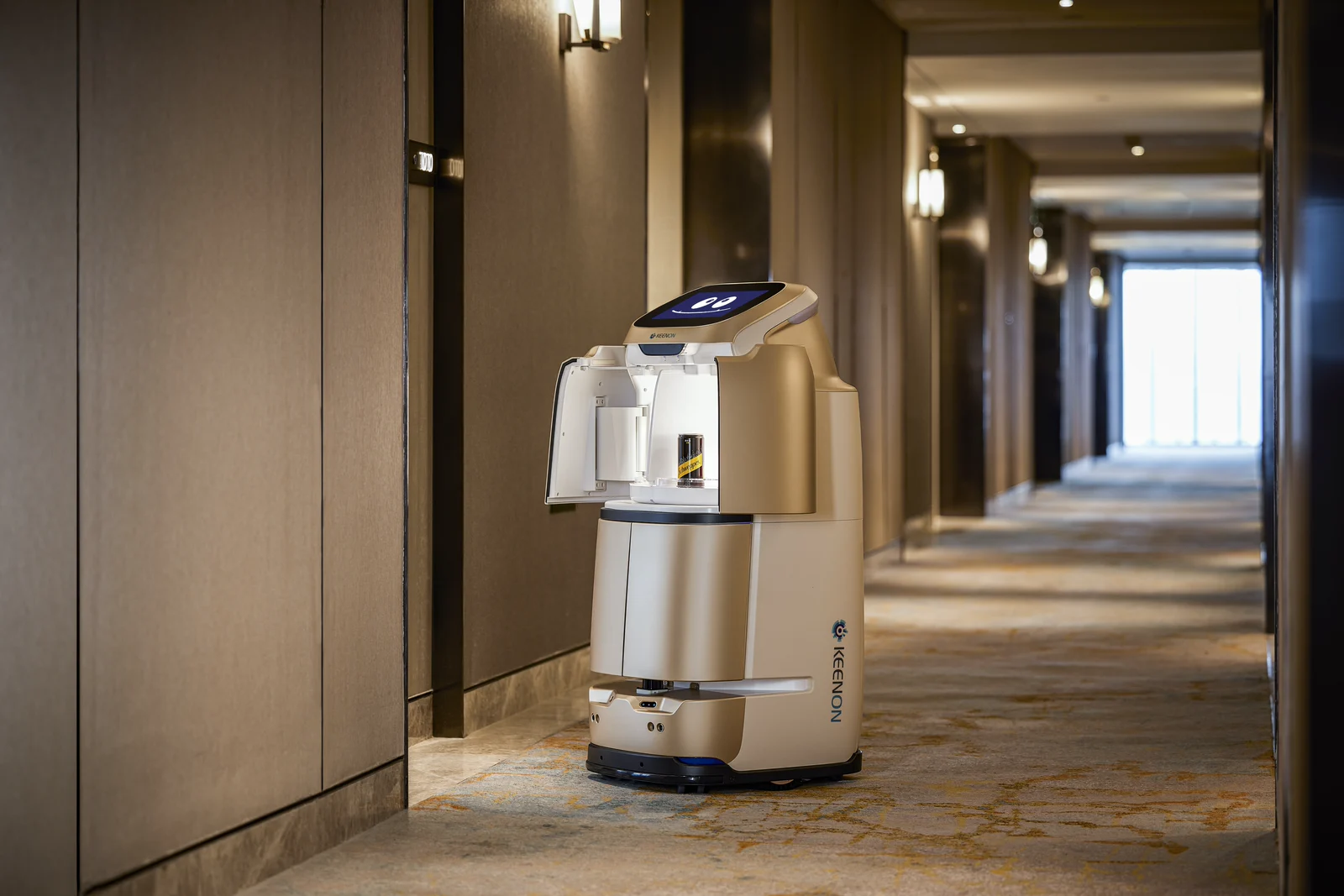
A hotel robot is a mobile service robot that delivers room service and guest amenities to rooms, carries luggage from the lobby to the upper floors and welcomes guests at reception, taking the lift on its own. Hospitality is the second-largest application of professional service robots worldwide, behind transport and logistics, according to the IFR (30 September 2026)1. KEENON, for which RoboNex is the official distributor in France, states that return on investment is generally achieved in under 12 months with two robots (KEENON, hospitality2, consulted on 21 November 2026), a manufacturer figure to be confirmed for each property.
The hotels cited by KEENON, such as the Sheraton Grande Tokyo Bay Hotel, are customers of the manufacturer, not of RoboNex. This page covers the uses, models, building prerequisites and testing method. For the overview, see our service robot pillar.
What does a robot do in a hotel?
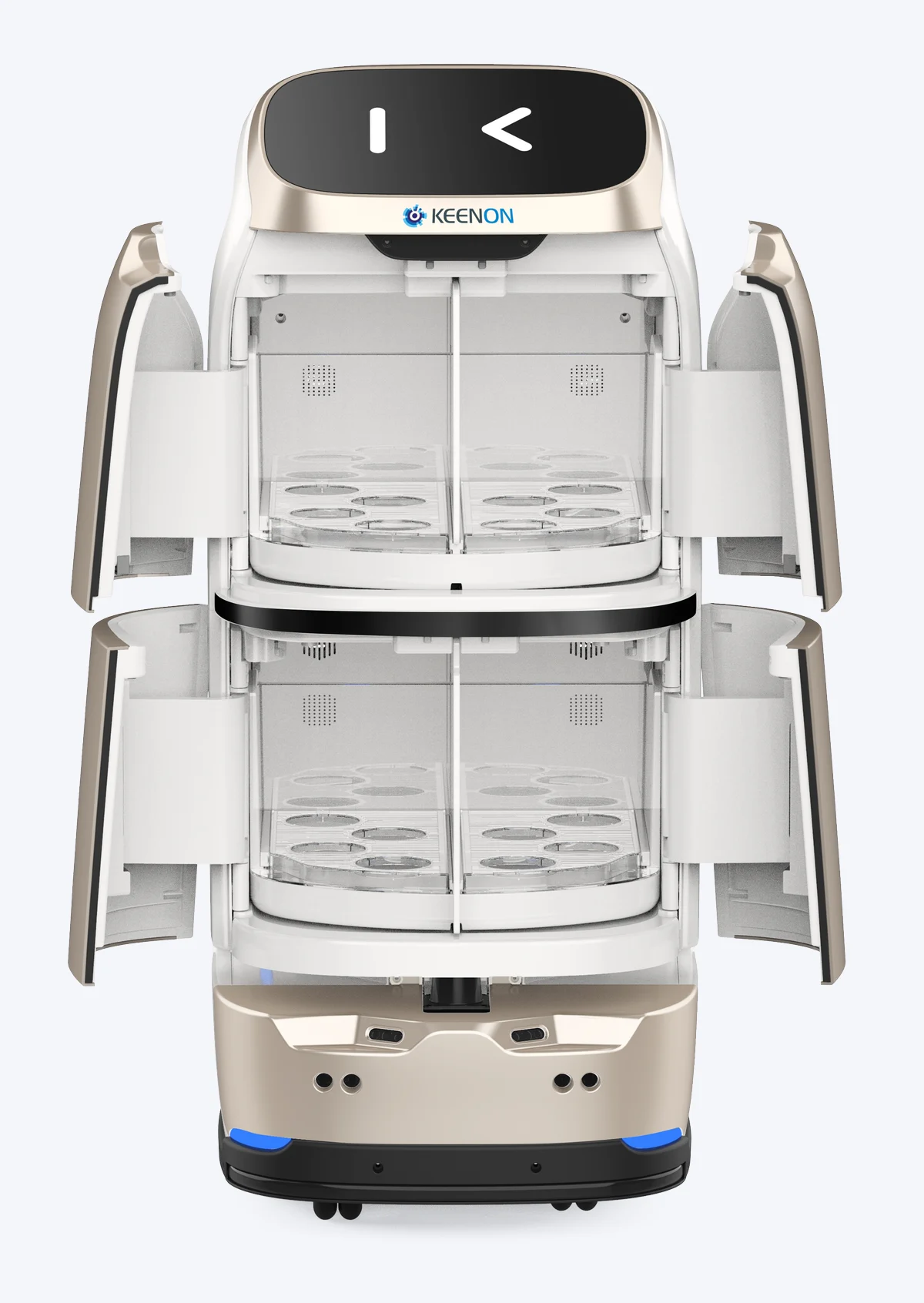
A robot in a hotel handles the repetitive trips between reception and the rooms. KEENON describes three main scenarios (KEENON2): welcoming guests on arrival, with autonomous navigation in the lobby; delivering luggage from the lobby to the room with a high-payload robot; and round-the-clock room service (24/7), with closed compartments for privacy. The guest collects their order from the compartment assigned to them. Staff remain at reception for requests that need a human conversation. For the hotel restaurant, see robot-serveur.com, and for cleaning, robot-laveuse-pro.fr, two RoboNex sites.
What gains can a hotel expect from a robot?
The hotel robot gains announced by KEENON are based on typical scenarios, to be checked in your own property. The table sets out the data published by the manufacturer.
| KEENON scenario | Manufacturer's assumptions | Stated gain |
|---|---|---|
| Welcome on arrival | open 24 h, 2 staff, 300 requests | 80% time saved on guidance |
| Luggage delivery | 518 rooms, 2 staff, 50 requests | 10 minutes by robot versus 30 minutes on foot, or 66.7% |
| Room service | 518 rooms, 24 h, 300 requests | better ratings on booking platforms |
| Overall satisfaction | not specified | up to 30% fewer complaints, more than 95% satisfaction |
Source: KEENON, hospitality2. These figures are manufacturer data: the proof of concept is there to measure them on your own flows.
Which KEENON robot for a hotel?
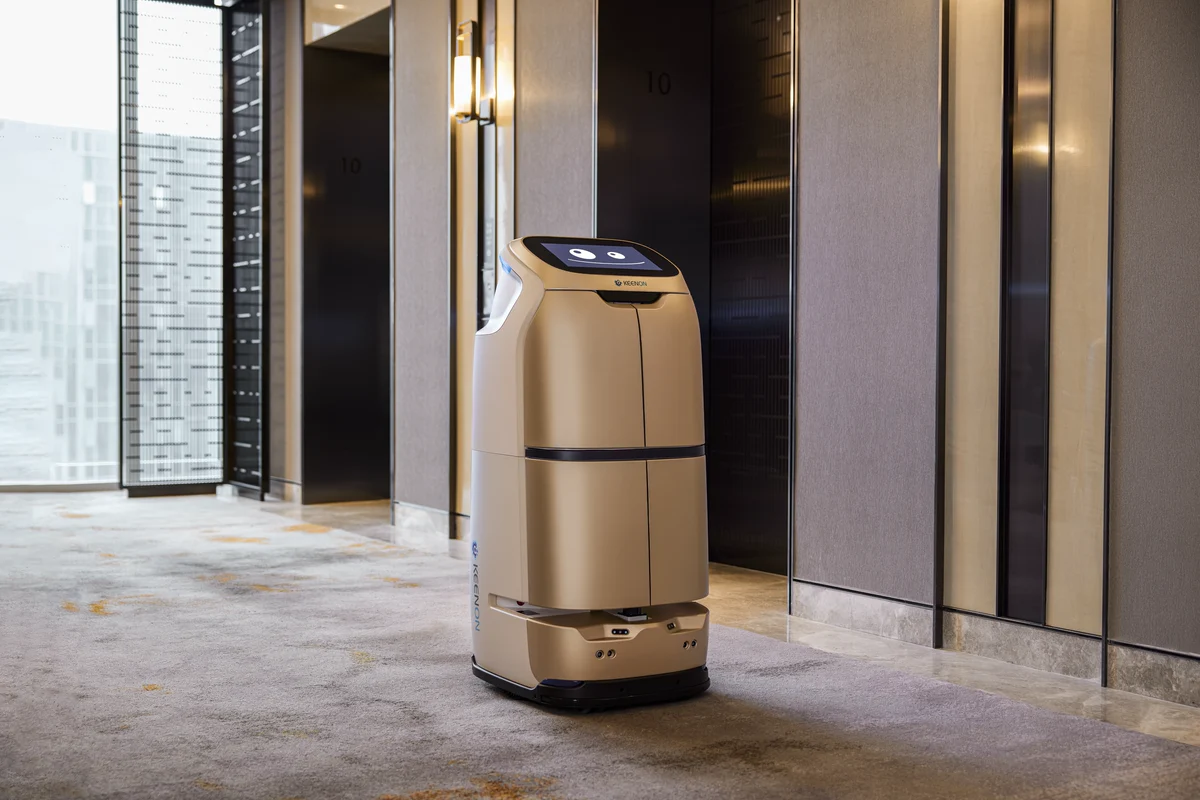
The KEENON robot most widely used in hospitality is the BUTLERBOT W3, designed for floor-to-floor delivery. According to its official data sheet3, it has up to four separately accessible compartments, with automatic doors and ventilation, carries 20 kg in total, runs for up to 12 hours and moves through a 70 cm passage. It takes the lift thanks to a connected module. KEENON cites the W3 in testimonials from the Sheraton Grande Tokyo Bay Hotel and the Hotel Boston Plaza Kusatsu Biwako, customers of the manufacturer. For heavier loads (luggage, linen, carts), the S100 (more than 100 kg) and S300 (300 kg) robots complete the range; KEENON does not specify which one it associates with luggage.
| Model | Hotel use | Payload | Battery life | Minimum passage |
|---|---|---|---|---|
| BUTLERBOT W3 | room service, guest amenities, forgotten items | 20 kg | up to 12 h | 70 cm |
| S100 | luggage, carts, supplies | more than 100 kg | 8 h | 90 cm |
| S300 | linen, heavy restocking | 300 kg | 6 h at full load | not stated |
See it in action
See robots supporting hotel services
KEENON presentation film showing hotel tasks and several robot models. Available functions depend on the model and site integration.
The YouTube player only loads after your click. These are manufacturer references, not RoboNex installations.
What technical prerequisites for a hotel robot?
A hotel robot requires a compatible building, checked before choosing the model. The lift must accept a connection module, with the agreement of the lift maintenance company: this is the most common blocking point. Corridors must leave 70 cm for the W3 and 90 cm for the S100, and slopes must stay below 7 degrees for the W3. Wi-Fi must cover all floors and the lift. Fire doors or badge-access doors require an access control module. Finally, integration with the hotel management software is not mentioned by KEENON, which only states that its solution integrates with the hotel's infrastructure.
Can a hotel robot welcome guests at reception?
A hotel robot can welcome guests in the lobby, greet them and guide them to the lift, the bar or a meeting room. KEENON describes this arrival welcome scenario with autonomous navigation and states an 80% time saving on guidance (KEENON2). The robot does not handle the full check-in or special requests, which remain with staff. For a more striking welcome with a humanoid robot, or to compare the approaches, see our reception robot page.
What are the limits of a robot in hospitality?
A robot in hospitality has limits worth knowing before investing. It depends on the lift and the network: a breakdown or incompatibility blocks deliveries to upper floors. It does not replace the personalised service of an upscale hotel, where human contact is part of the experience. It requires initial configuration (mapping, rooms, drop-off points) and a trained point of contact within the team. Finally, the gains published by KEENON are based on a typical 518-room hotel: a 40-room property will not have the same volumes. Hence the value of an on-site test, with measured indicators.
In a hotel, separate reception robots and indoor robotic delivery missions before assessing the KEENON ranges. Facilities hosting vulnerable people should compare robots in healthcare and nursing homes; the return on investment calculation should account for quieter periods.
Lobby or trade-show entertainment needs a separate scope: humanoids at events do not replace a hotel delivery robot.
How RoboNex supports you
RoboNex SAS is the official distributor of KEENON in France. For a hotel, RoboNex follows three steps. First, a proof of concept: technical visit, checks on the lift, Wi-Fi and access points, survey of room service and luggage volumes, then a real-world trial with defined indicators (deliveries per day, walking time avoided, incidents). Next, integration: mapping, connection to the lift, room configuration and staff training. Finally, deployment and support. Every proposal is priced after a site assessment, with no catalogue price. To request an assessment: contact page or KEENON in France.
Frequently asked questions
RoboNex team · answers in French, English and Chinese
How much does a robot for a hotel cost?

The cost of a robot for a hotel depends on the model, the number of robots, the lift module, the access points to equip, integration and maintenance. RoboNex does not publish catalogue prices: every proposal is a quotation after a visit to the property. Purchase, long-term rental and service-inclusive formulas should be weighed against the time freed up for teams. Our financing pillar details these options.
Can a hotel robot take the lift?
Yes. KEENON's BUTLERBOT W3 takes the lift on its own thanks to a connected module, to deliver to upper floors. This function requires a compatible lift and the agreement of its maintenance company for the interface. It is the first point checked during the technical visit, because without lift access the robot can only serve the ground floor.
Are there hotels with robots in France?
Some hotels already use delivery robots, notably in Asia. In its testimonials, KEENON cites two hotels in Japan equipped with the BUTLERBOT W3, which are its customers. The number of equipped hotels in France is not published by any official source. RoboNex, the official distributor of KEENON in France, organises on-site trials for properties that want to test before investing.
Can a robot carry guests' luggage?
Yes, a high-payload robot can carry luggage from the lobby to the room. KEENON describes this scenario and states 10 minutes per delivery with a robot versus 30 minutes on foot, in a typical 518-room hotel. The S100 and S300 robots carry more than 100 kg and 300 kg respectively. The exact model and luggage carrier are chosen according to the corridors and the lift.
Is a hotel robot profitable?
KEENON states that return on investment is generally achieved in under 12 months with two robots. This is a manufacturer figure, which depends on the number of rooms, the volume of room service and the hourly cost of staff. Real profitability is calculated from the volumes measured during the proof of concept. Our page on robot return on investment details the method.
Updated on 21 November 2026.