


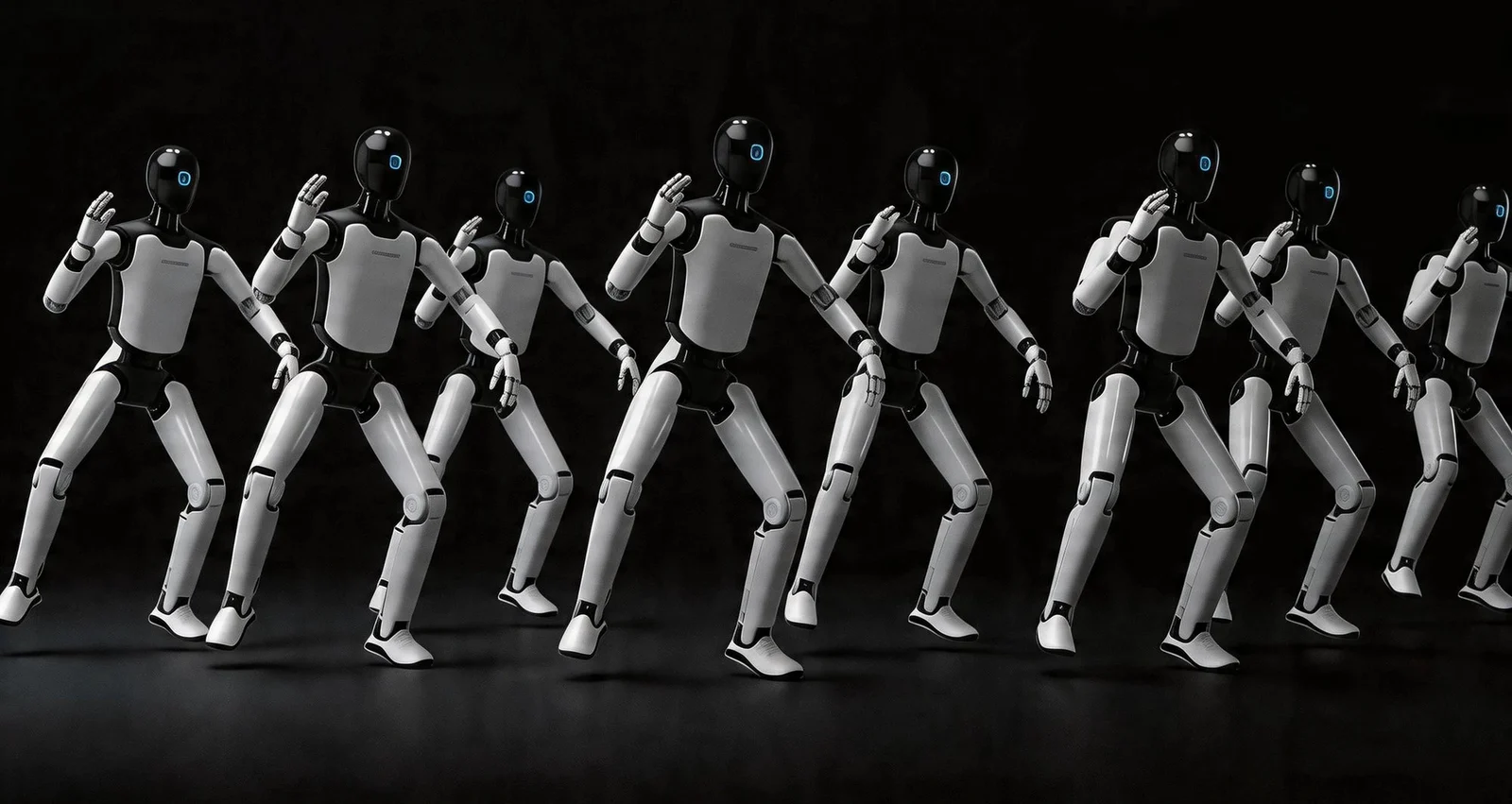
Key points
The cobot, the AMR and the humanoid robot do not meet the same need. The cobot (collaborative robot) is an arm that works at a fixed workstation, close to operators. The AMR (autonomous mobile robot) moves loads between workstations. The humanoid robot targets varied handling movements at workstations designed for humans, without redesigning them. The right choice starts from the task: a movement repeated in the same place, a flow of materials, or a sequence of changing tasks.
Their maturity differs markedly. According to the IFR1 (press release of 30 September 2026), 117,500 transport and logistics robots were sold worldwide in 2025, or 47 % of professional service robots, compared with around 7,000 full-size humanoids, most of whose applications "remain specialised and often require human teleoperation". The cobot, for its part, falls under the standards for industrial robots and is already widespread at many production workstations.
What is the difference between a cobot, an AMR and a humanoid robot?
The difference lies in what the robot does and where it does it. The cobot handles, but stays at the workstation. The AMR moves, but transports without fine handling. The humanoid combines movement and handling, with a human-like form.
The cobot is designed to interact with operators, according to INRS2, the French national research and safety institute. The AMR locates itself on a map and adapts its path to obstacles, INRS explains in a December 2023 report3. The humanoid fits into an existing workstation; AGIBOT, for example, presents its G24 as an "industrial-grade" operation robot. This page complements our industrial robotics section.
Cobot, AMR or humanoid: the comparison table
| Criterion | Cobot | AMR | Humanoid robot |
|---|---|---|---|
| Typical task | Screwdriving, light assembly, machine loading, inspection | Transport of totes, work in progress, racks and pallets | Varied handling, pick and place, workstation feeding |
| Mobility | Fixed (or mounted on a mobile base) | Mobile, map-based navigation | Mobile, on wheels or legs depending on the model |
| Load | Limited by the collaborative design | From a few hundred kilos to 2,500 kg (ForwardX Max5) | Not published for the G2, depends on the model |
| Safety | NF EN ISO 10218-1 and 10218-2, according to INRS | ISO 3691-4:2023 | No specific harmonised standard identified |
| Maturity | Proven | Proven, strong growth | Pilot stage according to the IFR |
| Integration | Tool, programming, workstation risk assessment | Mapping, fleet software, interfaces, zoning | Task learning, long trials in real conditions |
| Published cost benchmark | 25,000 to 80,000 € excl. VAT per application (Universal Robots, 2022) | 30,000 to 80,000 $ per transport robot, excluding integration (Warehouse Revolution6, 2026) | See the public benchmarks on our humanoids pillar page |
| Brand distributed by RoboNex | None | ForwardX | AGIBOT |
When to choose a cobot?
Choose a cobot when the task is repeated in the same place, with parts of modest size and weight, and an operator works nearby. Loading a machine tool, screwdriving, visual inspection or simple packing are typical cases.
A cobot is not safe by nature. INRS2 points out that its use "is not, however, without risk" and describes four technical principles that can be combined: safety-rated monitored stop, hand guiding, speed and separation monitoring, power and force limiting. It also flags risks of musculoskeletal disorders and psychosocial risks. On budget, Universal Robots7 estimated in 2022 that an application costs between 25,000 and 80,000 € excl. VAT.
When to choose an AMR?
Choose an AMR when the problem is a flow: operators who walk, push trolleys or wait for parts. The AMR links the stores to the lines, removes finished goods and feeds picking stations. According to INRS3, it is deployed with little or no modification of the infrastructure.
The AMR is the most mature of the three families in internal logistics. ForwardX, of which RoboNex is the official distributor in France, states on its website8 more than 4,500 AMRs and more than 250 deployments (accessed on 21 November 2026). Its limitation: it transports, it does not handle finely. Our page autonomous mobile robot (AMR) explains how it works.
When to consider a humanoid robot?
Consider a humanoid robot when the task is varied, the workstation was designed for a human and it would be costly to redesign it for an arm. The industrial uses described by AGIBOT9 include moving stacked containers, feeding production areas and loading components at production and test stations. AGIBOT states that it delivered its 20,000th robot on 24 September 2026.
The humanoid still needs to be validated in a pilot: the IFR notes that most current applications remain specialised and often require teleoperation. Throughput, reliability over several shifts and cost must be measured on your site. Our pillar page humanoid robots presents the models and the proof-of-concept method.
Can cobots, AMRs and humanoids be combined?
Yes, and it is common. A cobot mounted on an AMR forms a mobile manipulator, which can serve several machines. AMRs can feed a workstation where a cobot or a humanoid works. A humanoid can load an AMR, which then carries the load away.
Each combination creates a new installation, whose overall risks must be assessed: those of the arm, those of movement and those of their interactions. INRS points out that a modification after commissioning (new function, new zone) requires the risk assessment to be updated.
What safety rules apply to each family?
Each family has its own framework, but all fall under machinery regulations. For industrial and collaborative robots, INRS refers to the standards NF EN ISO 10218-1 and 10218-2. For mobile robots, the reference is ISO 3691-4:2023, presented in our logistics section.
For humanoids and autonomous machines more broadly, INRS notes in a June 2026 note10 that Regulation (EU) 2023/1230, applicable from 20 January 2027, introduces new requirements governing the autonomy of mobile machines and systems with self-evolving behaviour. INRS also flags the placing on the market of machines "whose technological maturity is not fully stabilised".
How to choose between a cobot, an AMR and a humanoid?
Start from the task and answer three questions. Does the robot need to move? If not, look at the cobot or the industrial arm. If so, does it only need to transport? Then the AMR is the most proven answer. Does it need to transport and handle varied objects at human workstations? The humanoid becomes an option, to be tested in a pilot.
Then add throughput, load, the presence of people and budget. For costs, see our guide industrial robot price. In every case, an on-site proof of concept settles the question better than a catalogue.
The comparison becomes practical when applied to automating an SME and a robotic material handling flow. Assess industrial project budgets, then use choosing a robotics integrator to verify interfaces, safety and pilot scope.
The abbreviations and concepts used here are defined in our robotics glossary.
How RoboNex supports you
RoboNex SAS is the official distributor in France of ForwardX (AMRs and autonomous forklifts) and AGIBOT (humanoid robots), as well as KEENON (service robots). RoboNex does not distribute cobots: if your need calls for a collaborative arm, we will tell you so. Our approach:
- Proof of concept on your site, with the suitable ForwardX or AGIBOT robot and indicators set in advance.
- Integration with flows, workstations and the information system, risk assessment with you, training.
- Deployment and support, on quotation after a study.
See AGIBOT France, ForwardX France or contact us.
Frequently asked questions
RoboNex team · answers in French, English and Chinese
What is the difference between a cobot and an industrial robot?

A cobot is an industrial robot designed to work close to operators, with functions such as power and force limiting in the event of contact. A conventional industrial robot works in a closed cell, faster and with heavier loads. Both fall under the standards NF EN ISO 10218-1 and 10218-2, according to INRS.
Is an AMR a cobot?
No. An AMR is a mobile robot that carries loads by navigating on a map; it falls under the ISO 3691-4 standard on driverless industrial trucks. A cobot is an arm that handles parts at a workstation. A cobot can, however, be mounted on an AMR, creating a mobile manipulator whose combined risks must be assessed.
Can a humanoid robot replace a cobot?
Not today for the tasks where the cobot excels: a repeated, precise movement at the same workstation. The humanoid targets varied tasks at workstations designed for humans. The IFR states that most humanoid applications remain specialised and often require teleoperation. A proof of concept makes it possible to compare on your real task.
Which robot should I choose to carry parts between two workshops?
An autonomous mobile robot (AMR) is the most proven answer for this flow. It travels between workshops, shares aisles with pedestrians after a risk assessment and is controlled by fleet software. A cobot does not move on its own, and a humanoid would be oversized for simple transport.
Which of the three robots is the cheapest?
There is no general answer, because they do not do the same job. Published benchmarks put a cobot application between 25,000 and 80,000 € excl. VAT (Universal Robots, 2022) and a transport AMR between 30,000 and 80,000 dollars excluding integration (Warehouse Revolution, 2026). The total cost depends mainly on integration.
Updated on 21 November 2026.
Sources and references (10)
- ifr.org/ifr-press-releases/news/global-sales-of-professional-service-robots-surge-24-perce
- inrs.fr/risques/robots-collaboratifs/ce-qu-il-faut-retenir.html
- inrs.fr/media.html?refINRS=DO%2042
- agibot.com/products/G2
- forwardx.com/max-series/
- warehouserevolution.net/automation/autonomous-mobile-robots/
- universal-robots.com/fr/blog/quel-est-le-cout-du-cobot/
- forwardx.com/
- store.agibot.com/pages/about-us
- inrs.fr/media.html?refINRS=NO%2049