


Key takeaways
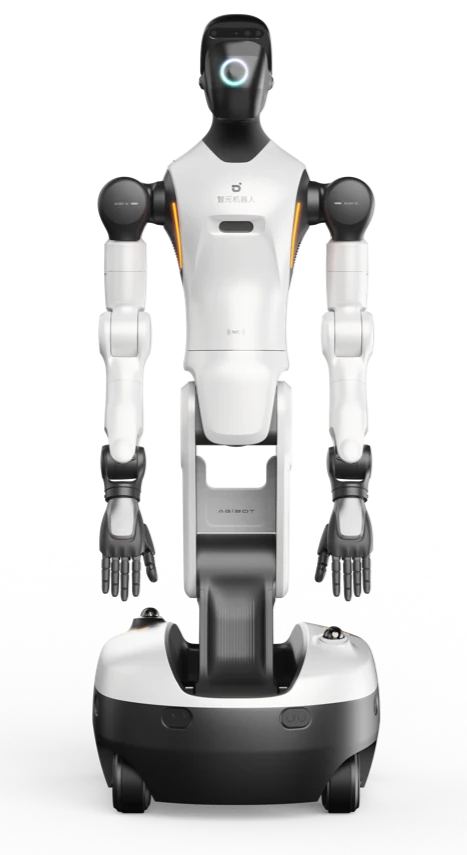
The AGIBOT G2 is a wheeled-base humanoid robot designed for industrial tasks: two arms with 7 degrees of freedom, 5 kg rated payload per arm and 10 kg with both arms (15 kg peak), ±0.1 mm repeatability, travel speed up to 1.5 m/s and two hot-swappable batteries for around 4 hours of runtime. These figures come from the official AGIBOT G2 user manual1, published on 30 July 2026. AGIBOT presents it as an "industrial-grade" robot, with automotive-grade components and IP42 protection (G2 product page2).
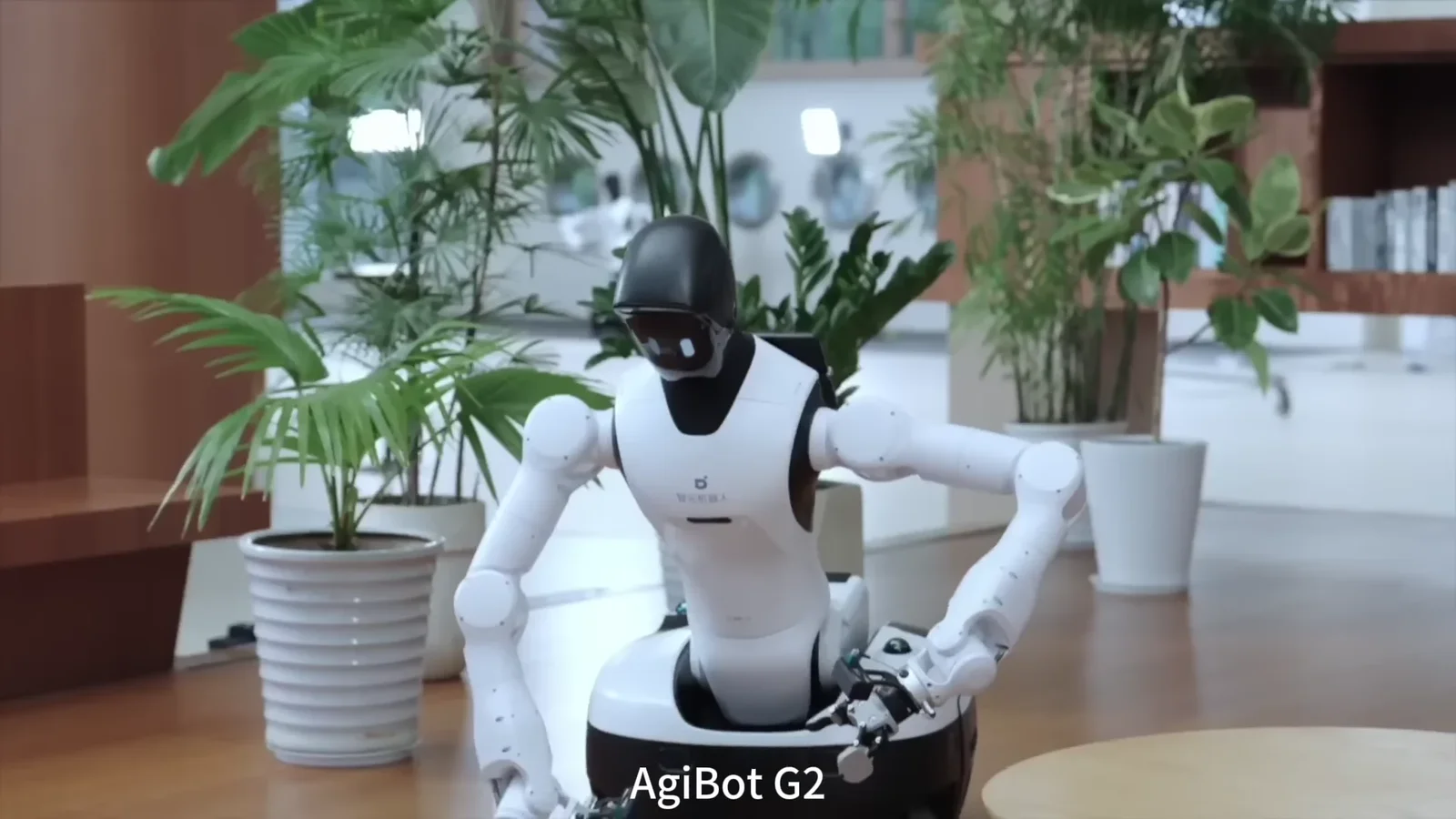
The G2 is already in production at manufacturers that are AGIBOT customers. At Longcheer Technology, it loads and unloads tablets on a quality control line, at up to 310 units per hour and over 99 % success in continuous operation, according to AGIBOT (14 April 2026)3. The 15,000th robot to come off AGIBOT's lines, in June 2026, was a G2 (AGIBOT4). RoboNex, the official AGIBOT distributor in France, offers to test the G2 on your workstation before any purchase. To position the G2 among other humanoids, see our business humanoid robot pillar.
What are the official specifications of the AGIBOT G2?
The official specifications of the AGIBOT G2 are given in its user manual. The table shows the main values, without rounding or additions.
| Characteristic | Official AGIBOT value |
|---|---|
| Height | 1,225 to 1,795 mm (variable) |
| Width × length | 640 × 760 mm |
| Weight | 185 kg |
| Degrees of freedom (excluding end effectors) | 25 |
| Arms | 7 degrees of freedom each |
| Rated payload | 5 kg per arm, 10 kg with both arms, 15 kg peak |
| Repeatability / absolute positioning | ±0.1 mm / ±1 mm |
| Force control resolution | ≤ 0.02 N·m, torque sensors in the joints |
| Vertical working range (with O10 end effector) | 0 to 2.3 m |
| Base | 4 steerable wheels, up to 1.5 m/s, on-the-spot rotation and crab-walk movement |
| Minimum passage width | 850 mm |
| Batteries | 2 hot-swappable batteries, 1,652 Wh in total, 48 V |
| Runtime | Around 4 h |
| Computing (standard version) | 500 TOPS (INT8), 64 GB memory, 2 TB SSD |
| Computing (high-performance version) | 2,070 TFLOPS (FP4), 128 GB memory, 2 TB SSD |
| Operating temperature | 0 to 45 °C |
Source: AGIBOT G2 user manual1. Some third-party resellers state 26 degrees of freedom: the AGIBOT manual gives 25 excluding end effectors.
Which sensors equip the AGIBOT G2?
The AGIBOT G2 combines vision, depth sensing and obstacle detection to work near operators. According to the AGIBOT manual1, the head carries a binocular camera, three fisheye cameras, an RGB-D camera, an array of four microphones and a loudspeaker. Each wrist has an RGB-D camera, which helps with precise grasping. The base carries two 360° lidars, eight ultrasonic sensors (detection from 30 to 3,000 mm) and an inertial measurement unit.
The announced navigation accuracy is ±5 cm and ±3° in the standard version, and ±3 cm and ±2° in the high-precision version. This sensor set allows the G2 to locate itself in the workshop, approach a workstation and grasp parts there without added markers, subject to validation on site.
Which industrial uses is the AGIBOT G2 intended for?
The AGIBOT G2 targets two-handed, repetitive and precise tasks in a structured environment. The AGIBOT manual1 cites logistics handling, high-precision assembly, inspection and security patrols, but also reception, exhibition hall guiding, education and research. The product page2 highlights sub-millimetre precision assembly and force control.
The best-documented case is Longcheer, an AGIBOT customer: the G2 picks up tablets, places them in test stations, then sorts conforming and defective units. AGIBOT announces a cycle of around 19 to 20 seconds, around 3,000 units per shift and less than 4 % loss due to stoppages (AGIBOT, April 20263). For a workstation-by-workstation review, see humanoid robot uses in industry.
See it in action
Filmed shifts on a production line
AGIBOT broadcasts show G2 robots working in a tablet inspection flow. The results below are those published by the manufacturer.
- More than 64 h
- of reported operation
- 64,828
- reported tasks
- 17,625 units
- cumulative line output
AGIBOT report dated 29 June 2026. The robots contribute to the line workflow; these volumes are not an independent count by RoboNex. Read the manufacturer source.
The YouTube player only loads after your click. These are manufacturer references, not RoboNex installations.
How long can the AGIBOT G2 work without interruption?
The AGIBOT G2 works for around 4 hours on its two batteries, according to the AGIBOT manual1. The batteries are hot-swappable, which allows operation to be extended without stopping the robot. The manual specifies that the G2 does not run on a single battery: replacement is therefore done one battery at a time.
An optional charging station lets the G2 return to recharge on its own. For a workstation running two or three shifts, the number of spare batteries, the location of the station and the organisation of swaps must be planned from the study stage. At Longcheer, AGIBOT reports more than 140 cumulative hours of continuous operation (AGIBOT3).
What is the difference between the AGIBOT G2 and the G2 Max?
The AGIBOT G2 Max is the heavy-load version of the G range, presented by AGIBOT at the WAIC show on 18 July 20265. AGIBOT describes it as its first force-controlled robot designed for heavy loads, intended for material handling and palletising, with an adjustable working height and an omnidirectional base. It supports battery swapping and autonomous recharging.
| Criterion | AGIBOT G2 | AGIBOT G2 Max |
|---|---|---|
| Positioning | Precise two-handed tasks | Heavy handling, palletising |
| Payload with both arms | 10 kg rated, 15 kg peak | Not published on the pages consulted |
| Power | 2 hot-swappable batteries | Battery swapping and autonomous recharging |
| Public price | On sales contact | On sales contact |
Both models are offered on sales request on the AGIBOT store6.
What is the price of the AGIBOT G2?
The AGIBOT G2 has no public price: the official AGIBOT store offers it only via sales contact (store.agibot.com6, accessed on 21 November 2026). The cost of a G2 project depends on the computing version, end effectors, workstation integration, software, training and the maintenance contract. Sourced market ranges and cost items are detailed on our humanoid robot price page.
For a production workstation, assess G2 against industrial uses of humanoids and choosing a cobot, AMR or humanoid, then prepare a workstation proof of concept. industrial project budgets help distinguish hardware from interfaces and integration.
Compare A2 and A3 with G2 by workstation and interaction type, without assuming interchangeability.
How RoboNex supports you
RoboNex SAS is the official AGIBOT distributor in France. For the AGIBOT G2, our approach follows three steps. The proof of concept: together with you, we choose a workstation, set quantified objectives (throughput, success rate, intervention time), carry out the risk assessment and organise the trial on your site. The availability of a demonstration G2 in France is to be confirmed case by case. Integration: adapting the workstation, connecting to your machines and systems, teaching the task, training teams. Deployment: commissioning, maintenance, updates and a direct link with AGIBOT.
Every RoboNex humanoid project is tailored to the task: request, proof of concept at the workstation, 500 to 1,000 hours of robot training according to the requirements and mission, then deployment. The schedule is set mission by mission, with no standard demonstration, pilot or commissioning duration.
CE conformity and French-language documentation of the G2 delivered in France are checked before any commissioning. The guide deploying a humanoid robot details the method. To start a study, contact us.
Frequently asked questions
RoboNex team · answers in French, English and Chinese
What is the AGIBOT G2?

The AGIBOT G2 is an industrial humanoid robot on a wheeled base manufactured by AGIBOT. It has two arms with 7 degrees of freedom, carries 10 kg with both arms, achieves ±0.1 mm repeatability and runs for around 4 hours on two hot-swappable batteries, according to the official manual published in July 2026. It targets material handling, workstation loading and precision assembly.
How much does the AGIBOT G2 weigh and how big is it?
The AGIBOT G2 weighs 185 kg according to its official manual. Its height varies from 1,225 to 1,795 mm, as the torso adjusts to reach low or high workstations. Its base is 640 mm wide and 760 mm long, and the robot needs a passage of at least 850 mm to move around. With the O10 end effector, its vertical working range goes from 0 to 2.3 m.
Does the AGIBOT G2 walk on legs?
No, the AGIBOT G2 moves on a base with four steerable wheels, not on two legs. This choice favours stability, payload and runtime, which are useful on flat factory floors. The G2 travels at up to 1.5 m/s, turns on the spot and moves sideways in crab mode. It can cross an obstacle of 1.5 cm at most. AGIBOT humanoids in the A series, such as the A2 Ultra, walk on two legs.
Where is the AGIBOT G2 already in use?
The AGIBOT G2 is used notably at Longcheer Technology, an AGIBOT customer, on a tablet quality control line. According to AGIBOT, the robot achieves up to 310 units per hour there, with over 99 % success in continuous operation. These figures are provided by the manufacturer and are not a commitment for another site.
Can the AGIBOT G2 be tested in France?
Yes, RoboNex, the official AGIBOT distributor in France, organises proofs of concept on the customer's site to measure throughput, success rate and intervention time before any purchase. The schedule and the availability of demonstration equipment are confirmed at the study stage. The process starts with a visit to the target workstation and the definition of quantified objectives.
Updated on 21 November 2026.